

 EU
Some parts cannot be machined from one side. A shaft with a keyway, a valve body with ports on several faces, or a cam with a helical groove all need the cutting tool to reach around the workpiece. A 4-axis CNC machine handles this machining in a single setup, so nobody has to do manual repositioning between machining operations.
This guide explains how 4-axis machining works, the two motion types, and how it compares with 5-axis machining. It also covers limits, uses, and design rules for complex parts. It is written for engineers, designers, and buyers who need to decide whether a part belongs on a 4-axis CNC machine.
What Is 4-Axis Machining?
4-axis machining is a CNC machining process that adds a rotary axis to the three linear axes of a standard mill. A cutting tool moves along the linear axes to remove material from a workpiece held in a chuck or fixture. A servo motor drives each axis, and the controller coordinates all four.
X-axis: Moves the cutting tool left and right (horizontal). On a typical vertical machining center, the table slides along X.
Y-axis: Moves the cutting tool forward and backward (depth). Together with X, it places features across the top face.
Z-axis: Moves the cutting tool up and down (vertical). It sets the depth of cut, and the spindle feeds along the Z axis to cut the material.
A-axis (4th axis): Turns the workpiece around the X axis. On some machines the rotary axis is the B axis, which rotates around the Y axis.
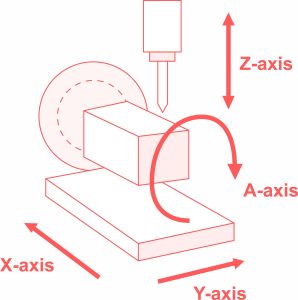
The X, Y, and Z axes sit at right angles to each other and place the tool anywhere inside the work envelope. The rotary axis adds to them and does not replace them. The workpiece can rotate to a new angle while it stays in the same fixture, so nobody has to unclamp the part, flip it, and clamp it again during machining. This makes a 4-axis CNC machine a good fit for parts with features on several sides.
How 4-Axis Machining Works
Rotary Axis Movement Around X or Y (A-Axis and B-Axis)
The rotary axis turns the workpiece. A rotary table or a built-in trunnion holds the part, and a motor turns the 4th axis to a programmed angle. The A axis rotates the workpiece around the X axis. The B axis rotates it around the Y axis. Vertical mills with a rotary table usually have an A axis. A horizontal machining center often has a B axis table. The controller treats this rotational axis like any other axis and moves the 4th axis to the angular position in the program.
Why One Setup Can Reach Several Faces
A workpiece clamped in a chuck or fixture can rotate to face the tool from several sides. On a 3-axis mill, each face needs a new setup and manual repositioning, and each one adds a small positioning error. With a single setup on a 4-axis CNC machine, the workpiece keeps one datum for every face.
Common Types of 4-Axis Motion
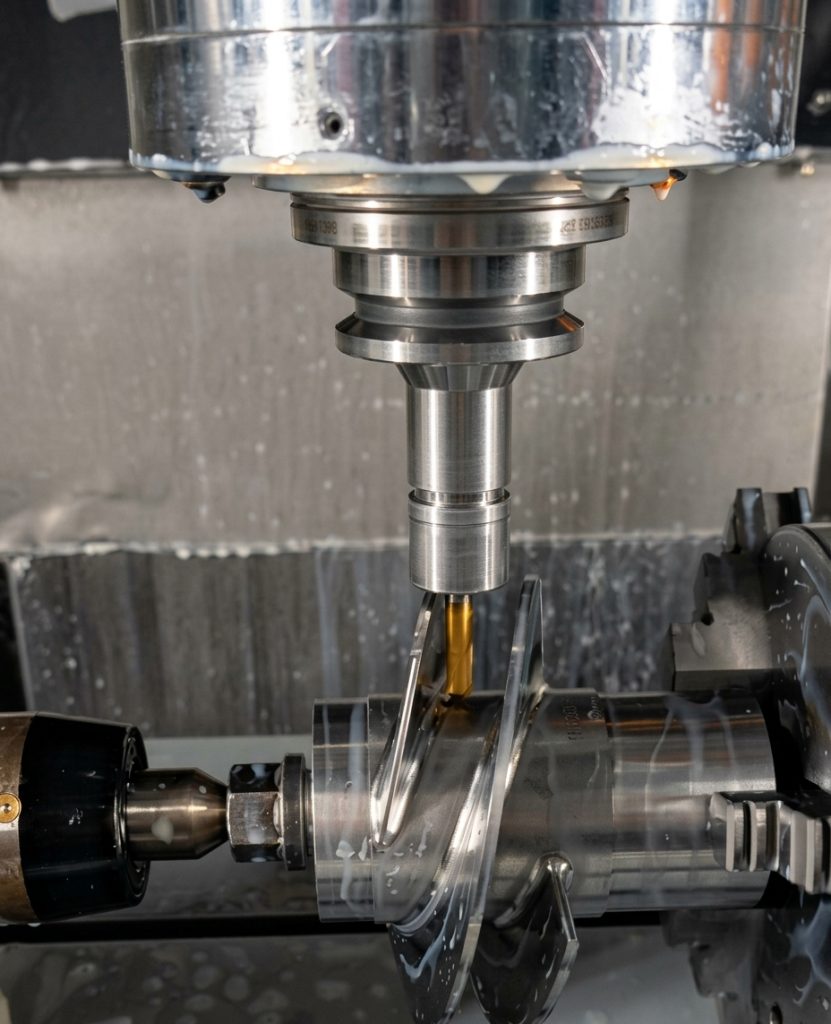
The 4th axis lets the part rotate in two ways. The choice affects programming, the machining process, and cycle time.
Indexed (3+1) Motion
In indexed motion, the workpiece rotates to a set angle and locks in place. The 4-axis CNC machine then cuts with the X, Y, and Z axes, as in 3-axis machining. During each cut, the workpiece remains stationary. This is also called 3+1 machining. Programming is close to 3-axis machining, so indexed machining is usually the cheaper and more common option on a 4-axis CNC machine.
Continuous 4-Axis Motion
In continuous motion, the 4th axis can rotate at the same time as X, Y, and Z moves. This simultaneous movement lets the cutting tool follow a path that changes both position and part angle. The A axis turns while the linear axes move. The 4-axis CNC machine needs a controller and CAM software that support simultaneous toolpaths.
Features Each Motion Type Can Produce
Indexed motion produces angular features on flat faces, such as cross holes, keyways, wrench flats, and side pockets. Continuous motion produces features that follow the surface as it turns, such as helical slots, cam lobes, and engraved text around a cylinder. One program can mix both.
Benefits of 4-Axis Machining
4-axis CNC machining has many advantages over 3-axis machining. The main benefits come from keeping the workpiece in one fixture.
Fewer Setups Than 3 Axis Machining: One machining setup can replace up to four, so there is less manual repositioning and less fixture work.
Tighter Tolerances Between Features on Different Faces: All faces share one datum, which gives greater accuracy and high precision between holes and faces and lowers alignment risk.
Shorter Cycle Time and Lower Part Cost: Less handling cuts non-machining time and lowers the total cost per part on repeat orders, which improves production efficiency.
Limitations of 4-Axis Machining
Compound Angles and Undercuts: One rotary axis cannot tilt in a second direction, so these features need 5-axis machining or a design change.
Programming Effort in Continuous Mode: Continuous machining needs CAM software that builds simultaneous toolpaths and a post-processor that matches the machine’s ability to move all axes together.
Part Balance and Size on the Rotary Axis: The rotational axis has a limited swing diameter and load rating, so long or unevenly weighted parts can bend or lose accuracy.
4-Axis vs 5-Axis Machining
5-axis machining adds a second rotary axis. The additional axis lets the tool or the workpiece tilt in two directions.
| Factor | 4-Axis Machining | 5-Axis Machining |
| Rotary axes | One (A-axis or B-axis) | Two (such as A and C, or B and C) |
| Faces reached in one setup | Faces around one rotary axis | Most faces except the one that is clamped |
| Compound angles | Not possible | Possible |
| Typical parts | Shafts, housings, cams, valve bodies | Impellers, turbine blades, complex molds |
| Programming | Simple for indexing, harder for continuous motion | Harder in most cases |
| Machine and hourly cost | Lower | Higher |
Setups and Feature Access
A 4-axis CNC machine reaches the faces that sit around its 4th axis. The end held by the chuck or fixture stays blocked. A 5-axis machine tilts in a second direction, so it can reach angled faces and multiple surfaces in a single machining setup.
Programming Effort and Machine Cost
5-axis machining costs more to set up and to run. Its toolpaths are harder to program and verify, and operators need more training. These costs show up in the machining price of the part.
When a 4-Axis Axis Machine Is Enough
A 4-axis CNC machine is enough when every feature can be reached by turning the workpiece around one axis. Typical signs are features on multiple sides, cylindrical parts, and no angled holes in two planes. If the drawing has compound angles or more complex shapes, 5-axis machining is the safer choice.
Common Applications of 4-Axis Machining
4-axis machining suits parts with features on multiple sides or around a cylinder. It also suits more complex parts and complex shapes that need several faces cut to high accuracy.
Shafts and Cylindrical Parts
Round parts are the natural fit for 4-axis machining. Shafts, spindles, and pins often carry keyways, flats, cross holes, and splines around the diameter. The rotary axis presents each position to the cutting tool without re-clamping.
Multi-Face Housings and Valve Bodies
Housings often have ports, bores, and mounting faces on several sides. A 4-axis CNC machine can finish all of them in a single setup and keep port alignment accurate. Valve bodies, pump housings, and manifolds are common examples.
Complex Parts With Helical or Cam Features
Continuous machining makes helical grooves, spiral flutes, and cam lobes possible. Cams, worm shafts, and screw-shaped profiles are common examples. A 4-axis CNC machine can create complex parts like these with only one extra axis.
Industries That Rely on 4-Axis Parts
Aerospace uses a 4-axis CNC machine for brackets, fittings, and shaft components. Automotive machining covers housings, camshafts, and transmission parts. The medical industry uses 4-axis machining for bone screws, implant components, and surgical instruments.
Design Considerations for 4-Axis CNC Machining
Good design choices make parts on a 4-axis CNC machine faster and cheaper to machine.
Tool Reach at Every Rotation Angle
At each angle of the 4th axis, the tool and holder need a clear path to the feature. Deep pockets and tall walls near a feature can block the holder. Short tools are stiffer, so keep features shallow where the function allows. A stiffer tool also gives better control of the surface finish.
Holding the Part Through a Full Rotation
The workpiece must rotate through a full turn without hitting the tool, fixture, or machine. Round stock holds well in a chuck, and a tailstock can support long parts. Leave extra stock for a clamping area, because the clamped region cannot be machined in that setup.
Keeping Features Close to the Rotary Centerline
Features far from the rotational axis centerline sit on a larger radius, where small angular errors turn into larger position errors. Even an extra degree of error moves the feature. Center key features on the rotary axis wherever possible.
Defining Angular Relationships on the Drawing
Give every angled feature a clear angular position on the drawing. Pick one datum, such as a keyway or a flat, and dimension angles from it. State the angular tolerance for features that must line up across faces.
Spotting 5-Axis Features Before Quoting
Check the model for angles that need a tilt in two directions. A hole angled to both the axis of rotation and a face is one example. These features push a part from 4-axis to 5-axis, and the cost rises. A small change to a hole angle can keep the part on a 4-axis CNC machine.
Making the Right Choice for Your Part
The right choice depends on the part, the tolerances, and the machining volume.
Part Geometry and Number of Faces
Count the faces that need machining and note how they relate. Features around one axis fit 4-axis machining. A single flat face fits 3-axis machining. Compound angles or sculpted surfaces call for 5-axis machining.
Tolerance, Volume, and Cost
Tight tolerances between faces favor a 4-axis CNC machine, since a single setup keeps one datum. Higher volumes also favor it, because one fixture and one program can be reused across repeat orders. For one-off prototypes, 3-axis machining with two setups may cost less.
Add-On Rotary Table or Dedicated 4-Axis Axis CNC Machine
An add-on rotary table turns a 3-axis mill into a rotary setup with a 4th axis at a lower cost. It uses machine table space and works well for indexed machining. A dedicated 4-axis CNC machine has the rotary axis built into its structure. This CNC machine is stiffer and better suited to continuous motion and repeat production.
Conclusion
4-axis machining adds one rotary axis to a standard mill and lets a single setup reach several faces. That cuts handling, keeps tolerances tight between faces, and lowers cost on suitable parts. Its limit is the single rotary axis. Parts with compound angles need 5-axis machining. A design review with your CNC machining supplier before quoting is the easiest way to confirm the fit.
