

 EU
EUABS and polypropylene are the two thermoplastics that come up most often across industrial and injection moulding work. Both are fully recyclable. Both process well by CNC machining, injection moulding and 3D printing, which is part of why they dominate so many bills of materials.
The two materials behave very differently once a part is in service, though. Their mechanical strength and chemical resistance diverge in ways that matter after the mould is cut, not before. Choosing the wrong one rarely shows up on the initial quote. The error appears later, as a warped enclosure, a cracked hinge or a housing that fails after contact with a solvent. Material selection needs to start with the final application environment, not the spec sheet.
What Is ABS(Acrylonitrile Butadiene Styrene) Plastic?
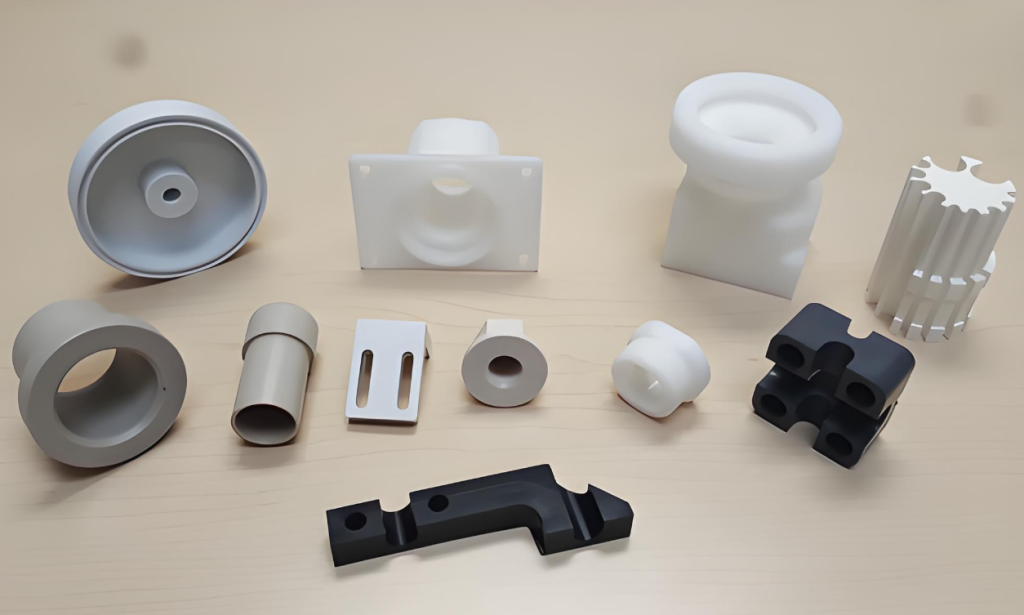
ABS is an amorphous terpolymer, built from three distinct monomers rather than one repeating unit. Acrylonitrile provides strength and chemical resistance. Butadiene contributes toughness and impact resistance. Styrene delivers surface gloss and rigidity. Suppliers adjust these monomer ratios to produce different grades, which is why ABS varies noticeably in stiffness and impact performance even within the same product line.
Because ABS is amorphous, it has no fixed melting point. It softens gradually as temperature rises, reaching a pliable state near its glass transition temperature of around 105°C .
What Is PP(Polypropylene) Plastic?
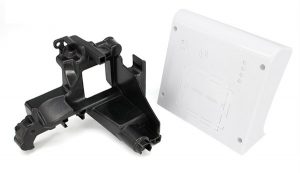
Polypropylene is a semi-crystalline polymer, formed from a single repeating propylene monomer. Its density sits below 1 g/ml, low enough that a solid block of PP will float on water. This alone is often the quickest way to tell the two materials apart if the labels have come off.
Commercial PP comes in two main types. Homopolymer PP (PP-H) offers greater stiffness and suits structural parts. Copolymer PP (PP-C) has ethylene added during polymerisation, which improves low temperature impact resistance. PP has a definitive melting point between 160°C and 170°C [待核实], significantly higher than the thermal limits of ABS. Despite that, its heat deflection temperature, the point at which it starts to bend under load, remains lower than ABS’s. A high melting point does not translate into high stiffness under stress, and this gap is one of the most commonly misread specs when comparing the two materials.
What Is The Difference Between ABS and PP?
Physical and mechanical strength
ABS offers higher tensile strength and a greater flexural modulus, making it the harder, stiffer material of the two. Engineers specify ABS for rigid housings and structural parts that need to hold their shape under load.
Polypropylene moves the other way. It is highly ductile and flexes readily under mechanical stress without cracking. Where ABS is specified for rigidity, PP is specified for controlled flexibility.
Moisture absorption
ABS is hygroscopic and readily absorbs moisture from the surrounding air, which is why it needs drying before injection moulding. Polypropylene resists moisture absorption almost completely, making it the reliable choice for damp or submerged environments over the long term.
Fatigue resistance
Polypropylene is in a different class here. It tolerates continuous, repeated bending without cracking or crazing, the fine surface cracking that develops in most plastics under cyclic stress. This property is what makes PP mandatory for living hinges, the thin flexible sections moulded directly into a part instead of assembled as a separate joint. A bottle cap can flex open and shut for years on the same hinge because PP’s molecular structure realigns under strain rather than breaking down. ABS lacks this fatigue life and will snap quickly under the same repeated loading.
Thermal properties
Polypropylene’s high melting point is easy to misread on a spec sheet. Under physical load, its heat deflection temperature drops well before it approaches that melting point. ABS performs better under sustained mechanical stress at elevated temperature, holding its shape at continuous service temperatures of roughly 85°C to 100°C [待核实]. This makes ABS the safer specification for electronic enclosures or automotive components near heat sources, even though PP technically melts later.
Chemical resistance
Polypropylene is the clear winner here. It withstands strong cleaning agents, acids, alkalis and most industrial solvents, which is why it is the standard material for laboratory equipment and chemical containers. ABS degrades easily on contact with ketones, and aromatic solvents will damage a part quickly. Engineers should default to PP wherever a part will see harsh chemical exposure, unless there is a strong reason not to.
Surface finish, scratch resistance, and aesthetics
ABS achieves a high gloss finish naturally, and its surface accommodates secondary processing such as painting and plating without much difficulty. This suits consumer electronics and any product where appearance is part of the sale.
Polypropylene has a matte or waxy surface, a result of its semi-crystalline structure and low surface energy. That same low surface energy makes painting and adhesive bonding genuinely difficult, and PP usually needs flame or plasma treatment before it will accept paint. ABS needs far less secondary work to reach the same finished look.
Processing and manufacturing differences
Polypropylene has low melt viscosity and processes at lower temperatures than ABS, typically between 200°C and 250°C [待核实]. This allows faster cycle times and lower energy consumption per part, which adds up at high volumes. The trade off is shrinkage. PP shrinks significantly as it cools, which raises the risk of warping and demands precise cooling system design.
ABS needs higher processing temperatures but delivers far superior dimensional stability, which suits precision parts with thin walls and complex features like screw bosses. The relationship reverses under CNC machining. ABS mills and turns cleanly, producing predictable surface finishes. Polypropylene’s toughness works against it on a machine tool, since the ductile material tends to deflect away from the cutter rather than shear cleanly, which causes chatter and a poor surface finish.
Manufacturing and injection moulding considerations
Shrinkage differences
Shrinkage behaviour separates these two materials sharply. Polypropylene, being semi-crystalline, shrinks at a high rate of roughly 1.5% to 2.5% [待核实], and that shrinkage follows the direction of melt flow through the mould, which is what drives its tendency to warp. ABS, being amorphous, shrinks less and more predictably, typically 0.4% to 0.8% [待核实], which is why tolerances are generally easier to hold with ABS.
Mould compatibility
These shrinkage differences mean the two materials cannot share an injection mould. A cavity cut and gated for ABS will produce undersized, out of tolerance parts if PP is run through it instead, and the reverse holds equally true. Cavity dimensions, gate placement and cooling layout are all calculated around one specific material’s expected shrinkage, so switching resin after the steel tooling is finished is one of the more expensive mistakes to make late in development.
Pre-processing
ABS absorbs ambient moisture and needs thorough drying, usually in a desiccant hopper for several hours, before it goes into the press. Polypropylene does not absorb water in any meaningful amount and can be fed directly from the bag into the hopper. It is a small difference on paper, but it saves real time and equipment cost across a PP production run.
Typical industrial and travel gear applications
When to choose ABS Plastic for ABS luggage
ABS is the right call for parts that need to survive physical impact while holding tight dimensional tolerances, such as consumer electronics enclosures and medical device housings. It is also the standard choice wherever a high gloss finish or post mould painting is part of the specification, which is why it turns up in toys and automotive interior trim.
When to choose PP
Polypropylene is effectively the only viable option for living hinges. Shampoo bottle caps and similar closures rely on PP’s fatigue resistance to survive millions of open and close cycles without cracking, something no other common thermoplastic matches at the same cost. PP is also the default for parts working in wet or chemically harsh environments, including laboratory equipment and chemical resistant containers. For high volume production sensitive to weight and unit cost, PP’s lower density and lower material price make it the practical default.
Cost and sustainability considerations
Polypropylene carries a lower raw material cost and benefits from more established recycling infrastructure. Municipal recycling programmes widely accept PP under code #5, while ABS’s code #7 is less commonly accepted and often covers mixed or harder to recycle plastics.
Price per kilogram is only one line in the real cost picture. A full evaluation needs to account for tooling cost, secondary finishing, expected scrap rate and the cost of a field failure. A part moulded in the cheaper resin that warps out of tolerance, or cracks at a hinge point one cycle too soon, ends up costing more than the material saving ever delivered. This is exactly the kind of trade-off the engineering team at Aria works through with clients during early design review, before it gets locked into a mould.
