

 EU
EUPrecision metal fabrication relies on CNC machine tools to turn raw stock into finished components. Every cutting job starts with the same question: which process fits this part. Engineers and procurement managers choose between mechanical, thermal and fluid jet methods. The right choice depends on material thickness, required tolerance and how much heat the substrate can take. Get it wrong and the result shows up as scrap, longer cycle times, or a quote that runs over budget.
This guide walks through how CNC technology and cutting systems work in practice. It covers the main cutting processes in use today, the tools behind each one, where they show up across industries, and which materials suit which method. Aria Manufacturing runs most of these processes daily, so the goal is a reference you can use when scoping a drawing, not just background reading.
What Is CNC Cutting

CNC cutting stands for Computer Numerical Control cutting. Digital computers run pre-programmed software that guides the cutting tool along a fixed path, rather than a person tracing a line by hand. The tool might be a blade, a laser, a plasma arc or a water jet, and it separates material from a sheet, plate or profile. CNC cutting falls under subtractive manufacturing, the same category as milling and turning, where material is removed rather than built up as it is in 3D printing. This guide uses “cutting” in that broad, subtractive sense, so turning, drilling and grinding appear alongside sheet and profile cutting. If you came here specifically for sheet, plate or profile separation, the laser, plasma, waterjet and oxy-fuel sections further down are the most direct match.
Manual cutting depends on hand-drawn layout lines and manual control by the operator. It still suits a quick, one-off cut. Positional accuracy varies with how steady and fast the operator works, and tight radii or repeated cutouts are hard to reproduce exactly by hand. CNC cutting holds tighter tolerances across a full batch, making it the better fit for mass production, and it repeats complex shapes the same way every time. It also keeps the operator further from the heat, arc or pressure doing the actual cutting.
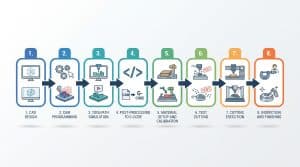
How CNC Cutting Works
CAD Design
Every job starts with design creation in CAD (computer aided design) software, producing a model drawn in two or three dimensions. The file sets out exact dimensions, corner radii and hole locations, along with the tolerances the finished part needs to hold. Common formats for cutting work include DXF, DWG, STEP, IGES and STL, depending on what the CAM software expects.
CAM Programming
The CAD file then moves into CAM (computer aided manufacturing) software, where the actual CNC programming gets planned. Material thickness, cutting speed, feed rate and gas or beam power all get defined at this stage. The software turns these choices into a toolpath, the exact route the cutting head will follow. Nesting also happens here, packing several parts onto one sheet to cut down on offcuts.
Toolpath Simulation
Before any code reaches the machine, most CNC manufacturing shops run a simulation of the toolpath. This checks for collisions, gaps and clearance problems that would otherwise only show up mid-cut. Catching an error here costs nothing. Catching it on the shop floor costs material, machine time and sometimes a damaged cutting head.
Post-Processing to G-Code
A post-processor acts as a code generator, converting the toolpath into G-code files the machine controller can read. G-code handles the motion, telling the machine where to go and how fast. M-code handles auxiliary functions, such as firing the laser or switching on coolant. Together, G-code and M-code make up the programming language every CNC controller reads. Fanuc, Siemens and Heidenhain all read this code slightly differently, so the post-processor has to match the specific controller on the shop floor.
Material Setup and Calibration
The material itself has to be selected, cut to size and fixed in place. A vacuum table, a mechanical clamp or a magnetic table holds it, depending on the material and the process. The machine axes, driven by servo motors on most industrial machines or stepper motors on lighter routers, are then zeroed to set the workpiece origin, and the tool height, nozzle gap or laser focus is calibrated against the material surface.
Test Cutting
A short test cut on scrap material is worth the time it takes. It shows up kerf width, edge angle, and any dross or burrs left on the cut. Speed, gas flow or power settings can still be adjusted cheaply at this point, before a full batch is committed to the machine.
Cutting Execution
Once the settings are locked in, the controller runs the G-code line by line. It drives the linear axes, plus any rotary axis on a multi-axis machine, along the programmed path, with closed loop systems on most machines checking position as they go. Assist gas, high-pressure water, cutting fluid or dust extraction run alongside the cut, depending on the process, with little need for the operator to step in until the machining operation finishes.
Inspection and Finishing
The finished part gets checked against the drawing, using vernier callipers, micrometres or a coordinate measuring machine for tighter tolerances. From there it may go through deburring, edge rounding, shot blasting or anodising, depending on what the part needs. Packaging and shipment come last, once the part has passed inspection.
Types of CNC Cutting
CNC cutting processes split into distinct groups, based on the energy or medium used to separate the material. Choosing the right one depends on stock thickness, material conductivity and how much heat various materials can tolerate.
Mechanical Contact Cutting
Mechanical processes use direct physical contact between a hardened tool or an abrasive wheel and the workpiece.
CNC Milling and Routing
Rotating multi-flute cutters shear away material along a programmed path. CNC milling machines and routers work on rigid metal, timber, engineering plastics and acrylic. They handle flat panel cutting, pocketing and stepped profiles.
CNC Turning
The workpiece rotates while the lathe tool stays still. The tool feeds along an axial or radial path. Turning produces cylindrical shapes rather than flat sheet profiles. Many shops fit live tooling to the same lathe. That lets it mill cross-cuts and slots into shaft stock, without moving the part to a separate machine.
CNC Drilling
Twist drills or carbide insert drills cut round holes at programmed coordinates. Controllers often pair drilling with milling, using a centre drill to spot the hole location before the final bore goes in.
CNC Grinding
A high-speed abrasive wheel strips away material in fine increments. It suits hardened steel and alloys that standard cutting tools cannot handle cleanly. Grinding usually comes after roughing, as the finishing step in the machining process that brings a part to its final tolerance and surface finish.
CNC Sawing
Computer-controlled band saws or cold saws cut bar, tube and structural steel profiles to length. This is usually the first cut a piece of raw stock gets, ahead of any other machining.
Knife Cutting
Drag knives, tangential blades and high-frequency oscillating blades cut soft sheet goods without burning the edge. Signmakers and packaging firms use these machines on rubber, foam, leather, cardboard and vinyl film.
Thermal and Beam Cutting
These processes use heat, an electric arc or an electrical discharge to melt, burn or erode through the material, rather than a physical blade.
Laser Cutting
A focused CO2 or fibre laser beam melts or vaporises material along the cut line. Fibre lasers suit thin to medium-gauge sheet metal, with a narrow kerf and a smooth edge. CO2 lasers handle organic materials better, such as wood, acrylic and paper.
Plasma Cutting
In CNC plasma cutting, an electric arc ionises compressed air or gas into a high-temperature plasma jet. The jet cuts electrically conductive metals, such as carbon steel, stainless steel and aluminium. It cuts medium plate faster than a laser, and at a lower cost. The trade-off is a larger heat-affected zone and a slight bevel on the cut edge.
Oxy-Fuel Cutting
Oxygen and a fuel gas, such as acetylene or propane, preheat the steel first. A high-pressure oxygen jet then oxidises the metal and blows the melt out of the cut. It only works on carbon steel. Even so, it remains the most economical way to cut very thick plate, into the hundreds of millimetres.
Wire EDM and Sinker EDM
Electrical discharge machining, or EDM, also known as spark machining, erodes conductive material with repeated electrical sparks rather than a mechanical force. Wire EDM feeds a thin brass wire through the workpiece, submerged in deionised water. It cuts two-dimensional profiles with extremely fine detail. Sinker EDM uses a shaped graphite or copper electrode instead, immersed in dielectric oil. It burns three-dimensional cavities into tool steel, which is the method behind most mould and die cavities, along with titanium parts that are hard to reach with a cutting tool.
High-Pressure Liquid Jet Cutting
Here, the cutting medium is a jet of water under very high pressure, sometimes carrying an abrasive.
Pure Waterjet Cutting
Water alone, forced into a high pressure stream through a jewelled orifice, cuts soft material cleanly. Most systems run at 50,000 to 60,000 psi, roughly 3,450 to 4,150 bar, though the highest-end pumps push well beyond that. Foam, rubber, paper products and thin gaskets all suit this method, without any rise in temperature.
Abrasive Waterjet Cutting
Adding garnet to the water stream lets it cut hard material as well, including stainless steel, titanium, thick glass, stone and carbon fibre. It leaves no heat-affected zone. That makes it the process of choice for heat-sensitive aerospace alloys, where the metal’s grain structure has to stay intact.
Specialised Cutting Processes
One more method falls outside the three groups above, suited to a narrower set of materials.
Ultrasonic Cutting
A blade vibrating at high frequency lowers friction between the tool and the material as it cuts. That produces clean cuts in honeycomb panels, non-woven textile, dense rubber and pre-preg carbon fibre. It does this without crushing structures that a standard blade would flatten.
Tools Used in CNC Cutting
Each cutting process depends on specific CNC tools or consumables to do the actual work, whether the output is a shaped machine part or a cut sheet profile. Knowing what these are matters for maintenance planning, and for understanding where the running cost of a job actually comes from.
Mechanical Cutting Tools
These tools wear down with use and need periodic replacement or resharpening.
End Mills and Cutting Bits
End mills, ball-nosed cutters, flat-bottom cutters and form tools each carry a multi-flute geometry suited to a particular cut profile. High-speed steel suits general work. Tungsten carbide holds an edge longer on harder material. Polycrystalline diamond and ceramic tooling extend tool life further still, on abrasive stock such as composites.
Drill Bits
Twist drills and indexable carbide insert drills create starting points or clearance holes ahead of a profile cut. Centre drills spot the hole location first, so the final drill does not wander off the mark.
Grinding Wheels
Bonded abrasive wheels finish hard metal. Aluminium oxide suits general steel, while cubic boron nitride and diamond wheels handle hardened tool steel and carbide, where a standard wheel would wear out too fast to be practical.
Saw Blades
Bi-metal band saw blades flex without snapping, and suit general bar and tube cutting. Carbide-tipped blades cost more but last longer through structural tube, beam and solid bar.
Drag Knife and Oscillating Blades
A flat or shaped steel blade sits in a drag holder or a high-speed oscillating actuator. Blade angle and hardness both change with the material. That angle is what decides how clean the edge comes out on rubber, foam, card and paper gasket material.
Thermal Cutting Tools and Consumables
Thermal processes rely less on a physical blade and more on equipment that generates or delivers the cutting energy. Most of that equipment is consumable, and needs regular replacement.
Laser Cutting Heads and Sources
The laser generator produces the beam. On a fibre laser, fibre-optic cable carries it to the cutting head. There, a lens focuses the beam, and a quartz window protects the lens from spatter. The beam exits through a nozzle, and nozzle diameter affects both kerf width and the flow of assist gas around the cut.
Plasma Torch Consumables
On CNC plasma cutters, the torch channels repeated electrical arcs through a stack of wearing parts, a copper electrode with a hafnium insert, a nozzle, a swirl ring and an outer shield cup. These need replacing on a fairly short cycle. A worn set is one of the more common reasons a plasma cut starts coming out rough, or loses its squareness.
Oxy-Fuel Torch Tips
Brass or copper torch tips control the preheat flame and the high-pressure oxygen jet. Technicians change tip size according to the thickness of the carbon steel plate.
EDM Electrodes
Wire EDM runs on brass, zinc-coated or fine molybdenum wire, with the wire diameter setting the achievable kerf width. Sinker EDM instead uses a solid copper or graphite electrode, machined into the shape that needs to be burned into the workpiece through pulsed spark discharge.
Waterjet Cutting Tools and Consumables
The nozzle and the abrasive feed system take most of the wear in a waterjet setup.
Cutting Orifices
Sapphire, ruby and synthetic diamond orifices focus the water into a fine jet. Diamond lasts longest under continuous high pressure, and costs the most. Sapphire and ruby wear out faster but cost less to keep replacing.
Mixing and Focusing Tubes
These combine the water jet with the abrasive stream and focus the mixture before it reaches the material. Tungsten carbide is the usual choice, though a composite ceramic tube lasts longer under continuous use. Both wear down over time, and affect cut quality once they do.
Abrasive Media
Garnet is the most common abrasive. Mesh size affects both cutting speed and the roughness of the finished edge.
High-Pressure System Components
An intensifier pump supplies the working pressure. Seals, check valves and thick-walled high-pressure tubing carry that pressure through the system. These are the parts that see the most wear across the life of the machine, and they drive most of its ongoing maintenance cost.
Workholding and Auxiliary Equipment
None of this cuts the material directly. Without it, though, a job will not run well.
Fixturing
A vacuum bed holds thin sheet material flat. A magnetic table works for ferrous metal, and a mechanical vice or toe clamp handles heavier plate. Which one gets used depends on the material and its thickness.
Tool Changers and Setters
An automatic tool changer swaps between cutters during a milling job, without an operator stepping in. A tool setter measures each tool’s length and offset, while a separate touch probe finds the workpiece zero. Together they cut down on the manual measuring an operator would otherwise do by hand.
Cooling and Extraction Systems
Coolant nozzles flush chips away from milling cutters and keep the cut cool. Dust collectors and fume extractors capture the smoke and debris thrown off by thermal cutting. Both protect the equipment and the operator, and run alongside whichever process is in use.
Applications of CNC Cutting
CNC cutting shows up across industrial applications and production lines that look nothing alike. What connects them is the need to cut a shape accurately, over and over, whether the job calls for custom parts or a long production run, without an operator laying out every part by hand.
Aerospace and Automotive
Aircraft builders use waterjet cutting to section carbon composite skins without fraying the fibres. A mechanical blade or a hot laser would struggle to do that cleanly. Wire EDM and precision milling produce metal parts such as turbine blades, engine brackets and structural airframe components from titanium and high-strength aluminium. Car makers lean on multi-axis laser systems to trim hot-stamped boron steel components. The material hardens during stamping, and becomes too tough for a conventional press to trim afterwards.
Construction and Architectural Metalwork
Plasma cutters and laser systems turn flat steel and aluminium sheet into custom structural brackets, pierced decorative panels and facade cladding. High-power fibre lasers also cut intricate designs into stainless steel and brass panels for interior fit-outs. Staircases and balustrades often start the same way, as a laser-cut pattern that would take a fabricator hours to mark out by hand.
Electronics and Medical Devices
Laser cutting handles the small, delicate parts in this space: enclosures, heat sinks and connector components. Tolerances run tight, and the material is often thin. Micro-laser cutting also produces fine slots and holes in thin-walled stainless steel hypodermic tubing, the kind used in needles and guidewires. Wire EDM and precision milling cover the rest of this space, cutting surgical instruments and implants that need to be biocompatible as well as dimensionally exact.
Woodworking and Signage
CNC routers cut and carve furniture components, cabinetry and architectural mouldings from timber and MDF. The same machines, or a laser instead, cut acrylic and engrave signage, shop displays and awards. Here the finish on the edge matters as much as the shape.
Shipbuilding and Energy Equipment
Oxy-fuel cutting and high-definition plasma systems cut the heavy steel plate that goes into ship hulls, wind turbine tower flanges and pressure vessel shells. Thickness matters more than a fine edge finish in this kind of work. Pipeline fabrication for oil and gas draws on the same processes, for thick-wall pipe fittings.
Mould and Die Manufacturing
Sinker EDM cuts the cavities inside injection mould tooling, working through hardened steel that would blunt a standard cutter. Wire EDM finishes stamping die sets, core pins and ejector components to a tolerance that keeps a production mould running for years.
Packaging and Textiles
Oscillating knife and drag knife cutting handle corrugated board for packaging prototypes and short production runs. The same tools cut foam inserts and technical fabric for upholstery and apparel. Both replace a job that used to run through a die-cutting press or a pattern cutter’s table.
Material Suitability
The sections above start from the process. This one starts from the material instead. Matching the right CNC process to different materials, based on thickness and heat tolerance, is what keeps a job free of distortion, mechanical stress or edge damage.
Metals
Carbon Steel and Stainless Steel
These are the most forgiving metals to cut. Plasma, fibre laser, waterjet, oxy-fuel and milling all handle carbon steel and stainless steel well. Fibre laser suits thin to medium sheet best, while oxy-fuel remains the standard choice once the plate gets thick.
Aluminium
Fibre laser, waterjet and milling all cut aluminium cleanly. None of them adds enough heat to melt or burr the edge. A CO2 laser struggles here. The beam reflects off bare aluminium instead of being absorbed, and that reflection can damage the optics as easily as it fails to cut the material.
Copper and Brass
Copper and brass carry the same reflectivity problem for CO2 lasers. Their high thermal conductivity also carries heat away from the cut faster than a laser can keep up. Waterjet, wire EDM and milling all work instead.
Titanium and High-Temperature Alloys
Waterjet, wire EDM and precision milling are the usual choices here. All three avoid the heat that a laser or plasma arc would add. That matters, because titanium and superalloys can distort, crack under stress, or change properties when they get hot during cutting.
Non-Metals
Timber and Engineered Board
CNC routing and milling handle timber, plywood and MDF directly, cutting clean edges and deep pockets. A laser also works, and can cut and mark a decorative surface in the same pass.
Acrylic and Engineering Plastics
Laser cutting gives acrylic a smooth, almost polished edge straight off the machine. CNC milling works too. It needs the right feed rate, though, to avoid melting the plastic back onto itself.
Stone, Tile, Glass and Ceramic
These materials fracture under mechanical stress or sudden heat. Abrasive waterjet is close to the only mainstream process that avoids both. That is why it dominates this category.
Composites
Carbon fibre and glass fibre composites cut best on abrasive waterjet or ultrasonic equipment, or with a diamond-coated milling cutter designed for the job. Standard tooling tends to leave delamination or a frayed edge, since the fibres and resin behave differently under a blade.
Soft Materials
Foam, Rubber and Leather
Drag knife or oscillating knife cutting, pure waterjet and ultrasonic cutting all suit these materials. None of them relies on heat, which matters since foam and rubber can melt or scorch under a laser.
Textiles and Non-Wovens
Laser cutting seals the edge as it cuts on synthetic fabric. That stops it fraying. Natural fibres do not seal the same way, so ultrasonic cutting or an oscillating knife usually suits those better.
Card, KT Board and Corrugated Board
An oscillating knife or a low-power laser handles these without difficulty. Both are common in packaging prototyping and short-run signage work.
Specialist and Composite Materials
Honeycomb Panels and Laminates
Ultrasonic cutting and waterjet both cut honeycomb structures and composite laminates without crushing the core or delaminating the layers.
Graphite and Conductive Ceramics
These materials conduct electricity but resist most mechanical and thermal cutting methods. Wire EDM does the job without putting any physical pressure on fragile features.
| CNC Milling/Routing | Laser Cutting | |
| Cutting mechanism | A rotating tool physically removes material | A focused beam melts or vaporises material |
| Typical materials | Metal, timber, plastic, acrylic, composites | Metal (thin to medium gauge), acrylic, wood, textiles |
| Thickness range | Handles thick stock well | Best on thin to medium gauge |
| Edge finish | Depends on tool and finishing pass | Narrow kerf, smooth edge straight off the machine |
| Heat effect | None from the cutting action itself | Some heat-affected zone, more on thicker material |
| Best for | Thick parts, 3D features, pockets | Fast, precise 2D profiles in thinner sheet |
CNC cutting only pays off when the process matches the part. Send your drawings to Aria Manufacturing for a recommendation on the right method, along with a straightforward quote.
-100x100.jpg)