

 EU
A CNC machine can only do what its tooling allows. Tools translate the machine’s raw motion into an actual finished feature. The spindle, the axes, and the control software make up the delivery system, but the real cutting happens at the tip of a small, hardened piece of metal. That tip can cost anywhere from a few dollars to several hundred, depending on the job.
Engineers who design parts rarely think about tooling until something goes wrong. A pocket radius that no tool can reach. A hole tolerance that needs a reamer instead of a drill. A thread a supplier cannot cut without ordering a special tool. These problems trace back to tool selection, and understanding it early saves rework later.
This guide covers the main categories of CNC machining tools, the machine tools that carry them, the materials and coatings behind the cutting edges, and a practical framework for choosing between them. It is written for people who specify parts and manage procurement, though machinists will find it useful too.
What is a CNC Machining Tool?

A CNC machining tool is the physical cutter mounted in a mill, lathe, or router that removes material from a workpiece. It stays distinct from the CNC machine itself. The machine positions and drives the tool according to a program, but the tool is what actually touches the metal, plastic, or composite.
Each tool handles a narrow set of jobs. An end mill cuts sideways and down to shape pockets and profiles. A drill bit cuts straight down to make a round hole. A tap cuts threads inside a hole that already exists. Put the wrong tool on the wrong job and the result shows up fast, as a broken cutter, a poor finish, or a part that misses tolerance.
Selecting tooling well is part of the machining process itself, not a side task. Tool geometry, coating, material grade, and how the tool sits in the spindle all affect cycle time, surface finish, and tool life. A shop that understands this spends less time chasing scrap and more time cutting good parts.
How Do CNC Machining Tools Work in CNC Machines
CNC stands for computer numerical control. A part starts as a CAD model. CAM software turns that model into a toolpath, and the toolpath becomes G-code, a set of instructions the machine controller reads line by line.
The G-code tells the machine where to move, how fast to feed, and which tool to load from the carousel or turret. This holds true across CNC machines regardless of make or control brand. The spindle spins the tool, or on a lathe, spins the workpiece against a stationary tool, and material comes away as chips. Coolant usually flows over the cutting edge to control heat and clear those chips.
None of this works without the right tool in the right place. A toolpath calculated for a 6mm end mill will gouge the part if someone loads a 10mm tool by mistake. Tool libraries and setup sheets exist to prevent exactly that. The machine follows the code exactly, so any error in tool selection shows up directly in the finished part, whether the job runs on a single CNC machine or moves across several machine tools during production.
Common CNC Tools Used in CNC Machining Processes
End Mills
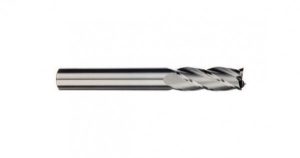
End mills are core cnc milling tools used to remove material from the side, the bottom, or both at once. CNC mills use rotating tools to remove material from a stationary workpiece. A drill only cuts axially, but an end mill moves across the X and Y axes while plunging down the Z axis. This makes it the most versatile of the milling tools on a CNC machine.
Flat end mills have a squared-off bottom. They suit flat-bottomed pockets, slots, and profiles in many cnc milling operations where sharp internal corners are acceptable. Corner radius end mills add a small radius at the cutting edge, which reduces chipping and extends tool life in harder alloys. This is one of several coating and geometry choices shops use to fight tool wear. Roughing end mills use a serrated edge to break chips into smaller pieces, letting the tool remove stock fast without overloading the spindle. Bull nose end mills sit between the flat and ball nose styles, carrying a rounded corner rather than a fully spherical tip. They combine some of the strength of a flat end mill with less risk of a sharp corner chipping under load.
Tool diameter, flute count, and stick-out length all affect how end mills perform. End mills count among the common CNC machining tools, since shops choose different geometries for specific machining tasks. A longer, thinner tool deflects more under load, and that deflection shows up as chatter marks or dimensional drift on the part. Shops generally pick the shortest, stiffest end mill that can still reach the feature, since deflection causes most of the inconsistent tool wear across a batch of parts. Within the broader set of milling cutters, end mills sit alongside face mills and ball nose mills.
Ball Nose Mills

A ball nose mill has a fully rounded cutting tip instead of a flat one. Its tip radius equals half the tool diameter. This suits it to contoured and 3D surfaces such as mould cavities or organic part shapes.
The cutting edge changes speed continuously across the rounded profile. Surface finish depends heavily on step-over distance and spindle speed. A tighter step-over gives a smoother finish but adds machining time. Programmers balance the two against how the surface will be used. Ball nose tools also do most of the work in finishing passes. This comes after a roughing tool has already cleared the bulk of the material.
Drill Bits
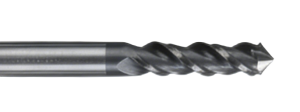
Drill bits are cnc drilling tools that create precise holes by cutting straight into the material as they rotate. A twist drill, with its familiar spiral flutes and conical tip, covers most general hole-making in metal and plastic. Centre drills produce a short, accurate starting dimple that keeps a longer drill from wandering off centre. Step drills cut two or three diameters along a single flute. This suits sheet stock that needs different hole sizes without a tool change.
Hole depth relative to diameter matters more than people expect. Once a hole passes about five times the drill diameter, deep hole drilling becomes its own discipline. Chip evacuation gets difficult too. Shops usually switch to peck drilling, where the drill retracts periodically to clear chips. Or they move to a dedicated deep-hole drilling tool built for exactly that ratio.
Taps & Threading Tools
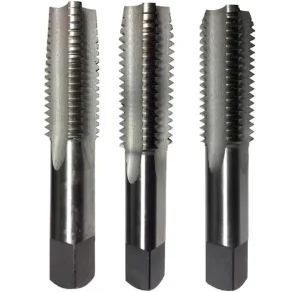
Taps are used to create internal threads in a pre-drilled hole. Cutting taps remove material as they advance, producing chips that need somewhere to go, so they suit through-holes. Forming taps, as forming tools rather than chip-cutting tools, push material outward instead of cutting it, leaving no chips at all. This suits blind holes and softer, ductile metals like aluminium. Forming taps do need a slightly larger starting hole, and they will not work on every material.
Thread mills take a different approach from taps. Rather than cutting a full thread in one pass, a thread mill moves in a helical path around the inside of the hole. This creates internal threads gradually. One thread mill can often cut several thread pitches. The gradual cut also lowers the risk of tool breakage in hard materials like titanium. A snapped tap inside a finished part can ruin the whole job. Shops that cut many thread sizes often standardise on a small family of thread mills. This beats stocking a tap for every pitch.
Reamers
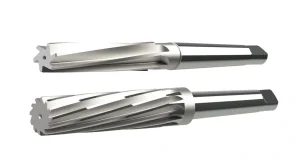
A reamer does not create a hole, it refines one that already exists. It removes a small, controlled amount of material. This brings the hole to a precise final diameter with a smooth wall finish. Drilling alone typically cannot hold the tolerances needed for a bearing seat or a dowel pin fit. The same applies anywhere two parts need to slide or press together cleanly. In that role, reamers are among the essential tools when hole size and finish must be refined after drilling.
Spiral flute reamers pull chips upward and out of the hole, suiting blind holes and tougher materials. Straight flute reamers are simpler and cheaper, and work well on through-holes in softer stock. A reamer removes so little material per pass. The pre-reamed hole needs to sit close to the target size, usually within a few tenths of a millimetre. Otherwise the reamer will struggle to correct it.
Boring Bars
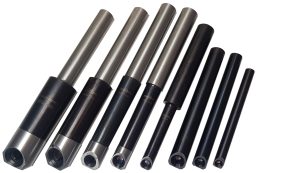
Boring bars enlarge and finish holes that are already roughed out, either by drilling or casting. A reamer follows a fixed size, but a boring bar adjusts to hit a range of diameters. This helps when a hole needs fine-tuning during setup or when tolerances run unusually tight.
Long, slender boring bars are prone to vibration, known as chatter, especially deep in a bore. Damped boring bars fix this with an internal mass that absorbs vibration. They turn up often in aerospace and hydraulic components, where bore straightness and surface finish both matter.
Turning Tools / Inserts
CNC turning tools work on CNC lathes, cutting material from a rotating workpiece rather than a rotating tool. They commonly produce cylindrical parts such as shafts and pins. Most modern turning tools use replaceable carbide inserts clamped into a steel or carbide toolholder. This replaces the older approach of one solid piece of tool steel. Operators can swap a worn or chipped edge in seconds, without pulling the whole tool from the machine.
Insert geometry and grade shift depending on the machining operation. Roughing inserts favour a strong, thick edge that survives heavy, interrupted cuts. Finishing inserts run a sharper edge at lighter depths of cut, aimed at surface quality rather than material removal rate. Shops commonly choose CBN inserts for machining hardened metals. Threading inserts carry a profile matched to a specific thread pitch. Grooving inserts are ground narrow for recesses, undercuts, or parting grooves.
Face Mills
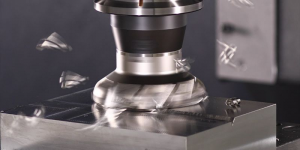
Face mills cut broad, flat surfaces, usually as the first operation on a new block of material. Multiple cutting edges sit around the circumference of the tool body and engage the workpiece at once. This lets face mills clear a large area faster than a smaller end mill on the same flat surface. Those cutting edges wear at different rates depending on where they sit around the body. That is why indexable inserts with several usable edges each are worth the extra upfront cost.
Face milling sets up the reference surface that later operations get measured from. Flatness and finish here carry through the rest of the job. High-feed face mills use a shallow cutting angle that allows faster feeds at lower cutting forces. This suits softer materials or less rigid machine tools. Shops running CNC machines with limited horsepower often lean on high-feed face mills for exactly this reason.
Shell Mills
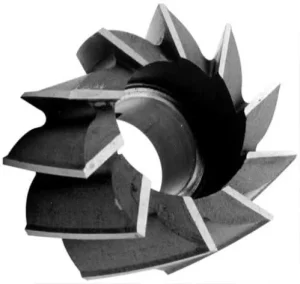
Shell mills are a type of face mill that mounts on an arbour rather than sitting directly in the spindle collet. The body is often reusable across many jobs, while indexable inserts do the actual cutting. This construction suits larger diameters, sometimes well over 100mm. A solid one-piece tool at that size would be heavy and expensive to replace every time an edge wears out.
Because they run at large diameters, shell mills remove a lot of material per revolution. That makes them a common choice on bigger workpieces, plates, blocks, and fixture bases. These need a flat, accurate top surface before finer machining operations begin.
External Round Mill
External round mills use circular inserts rather than the more common square or triangular shapes. The round profile spreads cutting forces over a longer edge length. This lets the insert handle higher feed rates and last longer before needing an index. It suits contoured external surfaces and ramping or high-feed roughing, where a square insert would wear unevenly.
The trade-off is a scalloped surface finish, since the cutting edge is curved rather than straight. Shops usually follow up with a finishing pass from a different tool when the surface needs to be smooth.
Saw Blades / Slitting Tools
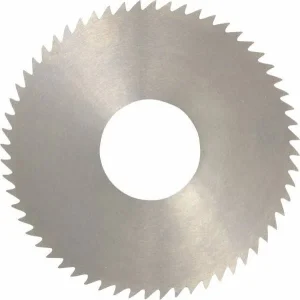
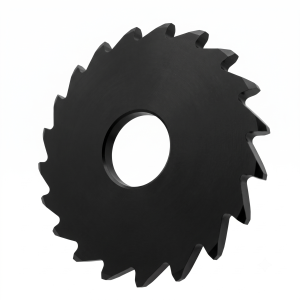
Slitting saws are thin, disc-shaped cutters with teeth around the edge. Shops use them in the cutting process for cutting slots, narrow slotting, and parting work. That can mean parting off material, cutting narrow slots in thin sections, or separating a finished component from stock. Compared with a keyseat cutter doing the same job, slitting saws run thinner and hold a tighter kerf width. This matters when material waste needs to stay low, or when the slot itself needs to be narrow.
Thickness, tooth count, and coating all affect how slitting saws perform in a given material. Thinner blades cut narrower slots but flex more under load, so speed and feed usually drop as blade thickness decreases.
Knurling Tools
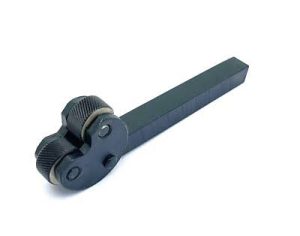
Knurling tools press a patterned roller into a rotating workpiece rather than cutting material away. The result is a textured surface, usually a diamond or straight-line pattern. It improves grip on handles, knobs, and fasteners, or simply adds a decorative finish.
Knurling tools split into two styles. Cut knurling removes a small amount of material to form the pattern, which works across a wider range of metals. Form knurling displaces material instead, raising ridges above the original surface. This can also slightly increase a shaft’s diameter for a tighter press fit.
Fly Cutters
Fly cutters, sometimes just called a fly cutter or cutter fly cutters, are a single-point tool. A fly cutter carries one cutting edge on an arm that spins around the tool centreline. That arm sweeps a wide, shallow path across the workpiece. Where a face mill packs several inserts into one body, a fly cutter does the same job with just one. It trades cutting speed for an exceptionally flat, smooth finish and a much lower tool cost.
Shops reach for fly cutters when a single flat surface needs to look good with no secondary polishing. They also reach for one when a one-off part does not justify buying a full set of face mills. Low-volume shops sometimes keep a fly cutter as their only face-finishing option. The single edge does mean a fly cutter removes material more slowly than a comparable face mill. For machining flat surfaces with a smooth finish, though, it remains a cost-effective choice. That makes it best suited to finishing passes and short runs rather than heavy stock removal.
Gear Cutters
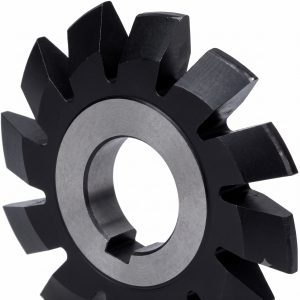
Gear manufacturing needs tooling built specifically for the job, and gear cutters fill that role. A form-relieved gear cutter carries a profile that matches the exact tooth shape being cut. So a shop making several gear sizes needs a matching set, one cutter per tooth count and module.
Hobbing cutters take a different route from form-relieved gear cutters. They generate the tooth profile through a continuous rotary motion rather than stamping it out in one shape. This method scales better for production volume, since a single hob can cut a whole range of tooth counts at a given module. A form cutter, by contrast, is locked to one size.
Countersink Mills and Corner Radius Mills
Countersink mills cut the conical recess around a hole that lets a flat-head screw sit flush with the surface. Most run at a standard 82 or 90 degree included angle, matched to the fastener standard the part uses. A shop with mixed fastener types typically keeps a few angles on hand.
Corner radius mills are sometimes sold alongside corner radius end mills. They cut a controlled fillet into an internal or external corner rather than leaving it sharp. Beyond the tool-life benefit already mentioned for corner radius end mills, this radius also reduces stress concentration in the finished part. That matters on components that see repeated loading in service.
Broach Tools
A broach tool cuts a finished profile, often a keyway, spline, or non-round hole shape. It does this by pulling or pushing a series of teeth through the material in a single pass. Each tooth removes a little more material than the one before it. The full profile appears only after the last tooth has passed through.
Broaching trades flexibility for speed and repeatability. A broach tool is expensive to make and locked to one exact shape. Once that tool exists, though, cutting the feature takes seconds rather than the several passes a milling cutter would need. That is why broaching shows up heavily in high-volume automotive and hardware production.
Deburring Tools
Deburring tools remove the small, sharp ridge of material, the burr, that forms along a cut edge. This happens after drilling, milling, or turning. Left in place, a burr can cut hands during assembly or interfere with mating parts. It can also flake off inside a finished assembly and cause failures later.
Hand deburring tools, essentially a small blade on a swivelling head, handle low-volume or awkward-access edges. Rotary deburring tools mounted in the CNC machine itself, or dedicated deburring stations downstream of machining, handle higher volumes more consistently. Many shops now programme a deburring pass directly into the same tool setup that cut the part. That beats treating it as a manual step afterward.
CNC Cutting Tools Used in CNC Routing
CNC routers run at much higher spindle speeds than CNC milling machines, with lighter cutting forces. The work is often wood, plastic, foam, or composite panels rather than metal. They operate similarly to mills but suit softer materials and sheet goods better. Straight flute bits and spiral upcut or downcut bits are the most common CNC routing tools. Upcut bits pull chips out of the cut, clearing material fast but leaving a rougher top edge. Downcut bits push chips downward instead, giving a cleaner top surface at the cost of slower chip clearance.
Compression bits combine both directions in a single tool. They cut upward through the lower half of the material and downward through the upper half. This leaves a clean edge on both faces of sheet material like plywood or laminate. V-groove and engraving bits are also common routing tools. They are ground to a sharp point to handle lettering and decorative grooves, where fine detail matters more than material removal rate.
What Workpiece Materials Are Used to Make CNC Tools?
Choosing a tool means choosing a material grade as much as a shape. The cutting edge has to survive the heat, abrasion, and impact of the specific workpiece material being machined. Get this wrong and tool life shortens fast, sometimes to just a handful of parts before the edge fails. This shows up first as a change in tool performance, long before the tool visibly breaks.
High-Speed Steel (HSS)
High speed steel tools, usually shortened to HSS, remain a staple among cutting tools for their toughness and low price. Older or lower-volume shops still value that a bench grinder can resharpen them. HSS holds up reasonably well at moderate speeds in softer materials like aluminium, brass, and mild steel. It loses hardness quickly once temperatures climb. That limits how fast it can run compared with carbide. HSS tooling remains common on manual and hobbyist machines even where CNC shops have largely moved on.
Cobalt-alloyed HSS improves heat resistance and extends tool life in tougher steels. It still falls well short of carbide in high-volume manufacturing, though. This is one of many processes where the material trade-off shows up directly in the parts count per tool.
Carbon Steel
Plain carbon steel sits a step below HSS on both price and performance. It lacks the tungsten, molybdenum, and other alloying elements that give HSS its heat resistance. As a result, carbon steel tools lose their edge at comparatively low temperatures. This limits them to slow-speed, low-volume work in soft materials like wood, plastic, and mild aluminium.
The appeal is cost. Carbon steel tools are the cheapest cutting tools a shop can buy. For a one-off job, or a hobbyist machine that never pushes speeds or feeds hard, cost often matters more than tool life. Once a job moves to repeat production or harder workpiece material, most shops step straight up to HSS or carbide. Few try to stretch carbon steel further than it can go.
Carbide
Carbide, more precisely tungsten carbide bonded with a cobalt binder, holds its hardness at much higher temperatures than high speed steel. This allows faster spindle speeds and feed rates. Most production CNC work today runs on carbide tools. These appear as solid carbide end mills and drills, or as replaceable inserts on turning and face milling tools.
Carbide tools are more brittle than HSS, so they chip or fracture under shock loading rather than deforming gradually. Rigid setups and stable clamping matter more here, since vibration or an interrupted cut can crack a carbide edge. That same cut would simply dull a softer tool. This brittleness is also why carbide tool wear tends to show up suddenly, as a chipped edge. HSS, by contrast, shows the slow, gradual wear pattern shops expect.
Ceramics
Ceramic cutting tools, typically based on aluminium oxide or silicon nitride, run at very high cutting speeds and resist heat extremely well. This suits hardened steels and superalloys in aerospace and hard-turning work. The trade-off is fragility. Ceramics tolerate almost no interrupted cuts or vibration, so they stay reserved for stable, continuous turning rather than general milling.
Polycrystalline Diamond (PCD)
Polycrystalline diamond, or PCD, tools bond synthetic diamond particles to a carbide substrate. PCD holds an edge far longer than carbide in non-ferrous, abrasive materials, including high-silicon aluminium alloys, composites, and graphite. Standard carbide wears out fast from abrasion in these materials. PCD tools do not suit ferrous metals. Iron reacts chemically with diamond at cutting temperatures, which accelerates wear rather than reducing it.
Beyond PCD inserts, diamond-tipped tools cover applications where a solid diamond or diamond-coated edge handles particularly abrasive or hard non-metallic materials. Fibre-reinforced composites, ceramics, and some glass-filled plastics are typical examples. These tools carry a higher upfront cost. They tend to appear on higher-volume jobs, where the extended tool life offsets the price over time.
Coated Materials
None of the base tool materials above have to run bare. A thin coating, often just a few microns thick, sits on top of the HSS or carbide substrate. It absorbs the brunt of the heat and abrasion instead of the base material underneath. Coated tools generally outlast their uncoated equivalents by a wide margin, sometimes adding thousands of parts to a tool’s working life. That is why coated carbide has become the default across most production CNC work, rather than the exception.
The right coating depends on the workpiece material, the cutting speed, and whether the operation runs wet or dry. It also depends on the machining materials being cut. The main options follow below.
Common Types of Tool Coatings
Titanium Nitride (TiN) Coated
Titanium nitride, or TiN, is one of the oldest and most widely used coatings on the market. It gives a modest boost in hardness and wear resistance over an uncoated tool. It also carries a lower coefficient of friction, which helps reduce built-up edge in general-purpose work. TiN coated tools remain the cheapest coated option. They are the default choice for shops that need a straightforward upgrade over bare HSS or carbide.
Titanium Carbonitride (TiCN) Coated
Titanium carbonitride, TiCN, builds on TiN by adding carbon to the coating structure. This raises hardness further and improves abrasion resistance. TiCN coated tools suit abrasive, gummy materials such as cast iron and some aluminium alloys. A standard TiN coating wears through faster than the job demands in these cases. Shops commonly apply it on milling cutters used for this kind of work. The trade-off is a lower maximum operating temperature than TiN. TiCN works best at moderate cutting speeds rather than high-heat, high-speed production runs. In abrasive work, the coating also supports longer tool life by improving wear resistance and reducing friction.
Titanium Aluminum Nitride (TiAlN) Coated
Titanium aluminium nitride, TiAlN, handles higher heat than either TiN or TiCN. It is useful across demanding manufacturing processes involving stainless steel and titanium. Flood coolant is not always used in these jobs. As the coating heats up during the cut, it forms a thin, protective aluminium oxide layer on the surface. This lets TiAlN coated tools run hotter and faster without breaking down. That matters in precision machining, where heat control and dimensional stability count. Tool lines often specify it alongside titanium nitride. TiN remains the cheaper default for general-purpose work, while TiAlN gets reserved for harder or dry-machined materials.
Super-life Titanium Nitride (Al-TiN)
Super-life titanium nitride, often labelled Al-TiN, reverses the ratio of aluminium to titanium found in standard TiAlN. This pushes oxidation resistance and hot hardness even further. Al-TiN coated tools tend to outlast standard TiAlN in high-speed, high-temperature machining of hardened steels and superalloys. This makes them a common upgrade for shops running aggressive dry-machining programs. There, tool life, not tool cost, is the limiting factor.
Chromium Nitride (CrN)
Chromium nitride, CrN, trades some of the raw hardness of the titanium-based coatings. In return, it offers better resistance to chemical wear and adhesion. CrN coated tools resist built-up edge particularly well in non-ferrous materials like aluminium, copper, and brass. A gummy workpiece can otherwise weld itself onto a standard coating over time. CrN also holds up well against corrosion. That makes it a common choice for tools that sit in storage between jobs or run with aggressive coolants.
Diamond Coated
Diamond coated tools apply a thin layer of polycrystalline diamond directly onto a carbide substrate through a vapour deposition process. This differs from PCD tools, which bond a solid diamond insert instead. Diamond-like carbon is another low-friction coating option on some CNC tools, used to improve wear resistance and heat dissipation. This gives much of PCD’s wear resistance in abrasive, non-metallic and non-ferrous materials, composites, graphite, and high-silicon aluminium among them. The cost stays lower than a solid PCD insert, which suits smaller or more complex tool geometries. Like PCD, diamond coated tools do not suit ferrous metals. The same chemical reaction between iron and diamond that limits PCD applies here as well.
How to Choose the Right CNC Machining Tools
There is no single tool that fits every job, because different tools are used for different operations and part requirements. Tool selection comes from weighing a handful of factors together, not picking one in isolation. Getting this balance right is what separates a shop that runs efficiently from one that constantly rebuilds setups.
Workpiece material.
This is usually the first filter, since not every tool material survives every job. Aluminium and softer plastics tolerate a wide range of tools, including HSS in lower-volume work, and allow higher spindle speeds. Stainless steel, titanium, and other hard materials need harder, more heat-resistant tooling such as carbide or ceramic. They also need slower, more deliberate feeds to avoid work hardening the surface. Get this wrong and tool life can drop to just a handful of parts. Tool choices also have to suit the machining materials involved.
Type of operation.
The feature being cut narrows the field further, among the common cnc machining tools chosen for specific machining tasks. Facing and pocketing, two of the most common milling operations, call for end mills or face mills. Hole-making calls for drills, followed by reamers or boring bars if the tolerance demands it. Threaded features need taps or thread mills, chosen based on hole type and material ductility.
Some jobs move away from conventional cutting altogether. Detailed sheet work often calls for cnc laser cutting, where focused light beams slice and engrave sheet materials. Heavier conductive metals suit plasma cutting, which uses a high-powered plasma torch. Thick materials that need to avoid heat go to CNC waterjet cutters, which use high-pressure water mixed with abrasives. Matching the tool category to the operation comes before worrying about grade or coating. This step alone usually eliminates most of a catalogue’s worth of options. Separate from those cutting methods, cnc grinding is a highly precise process. Shops use it to refine dimensions and improve surface finish when milling or turning alone is not enough.
Tolerance and surface finish.
These decide how far down the tooling chain a job actually needs to go. A clearance hole for a bolt rarely needs anything past a standard drill. A bearing bore or a sealing surface usually does. That is where reamers, boring bars, and finishing passes with ball nose or corner radius tools come in. Overspecifying tooling for a low-tolerance feature wastes time and money. Underspecifying it for a precision feature risks a part that fails inspection. Some cases call for edm tools, which shape conductive materials with electrical sparks rather than direct cutting contact. CNC EDM machines erode material without physical contact.
Machine rigidity and setup.
This matters more than most engineers expect. A tool rated for aggressive cuts on a heavy, well-supported CNC machine may chatter badly on a lighter one. That holds regardless of the material or coating chosen. At Aria Manufacturing, we check tool selection against the actual machine and fixture setup for each job, not just against a generic spec sheet. The same part can behave very differently depending on which machine tools it runs on.
Cost against tool life.
A more expensive coated carbide tool that lasts through a full production run often costs less overall than a cheaper tool needing frequent changeovers. That holds once downtime and setup time are factored in. For prototype or one-off parts, the calculation flips, and a simpler, cheaper tool usually makes more sense. Tracking tool wear over a production run, rather than replacing on a fixed schedule, often makes the difference. Shops that do it squeeze out the last useful cuts from a set of end mills, instead of discarding tools with plenty of life left.
Balancing these five factors, job by job, is what separates a shop running efficiently from one constantly firefighting broken tools and scrapped parts.
