

 EU
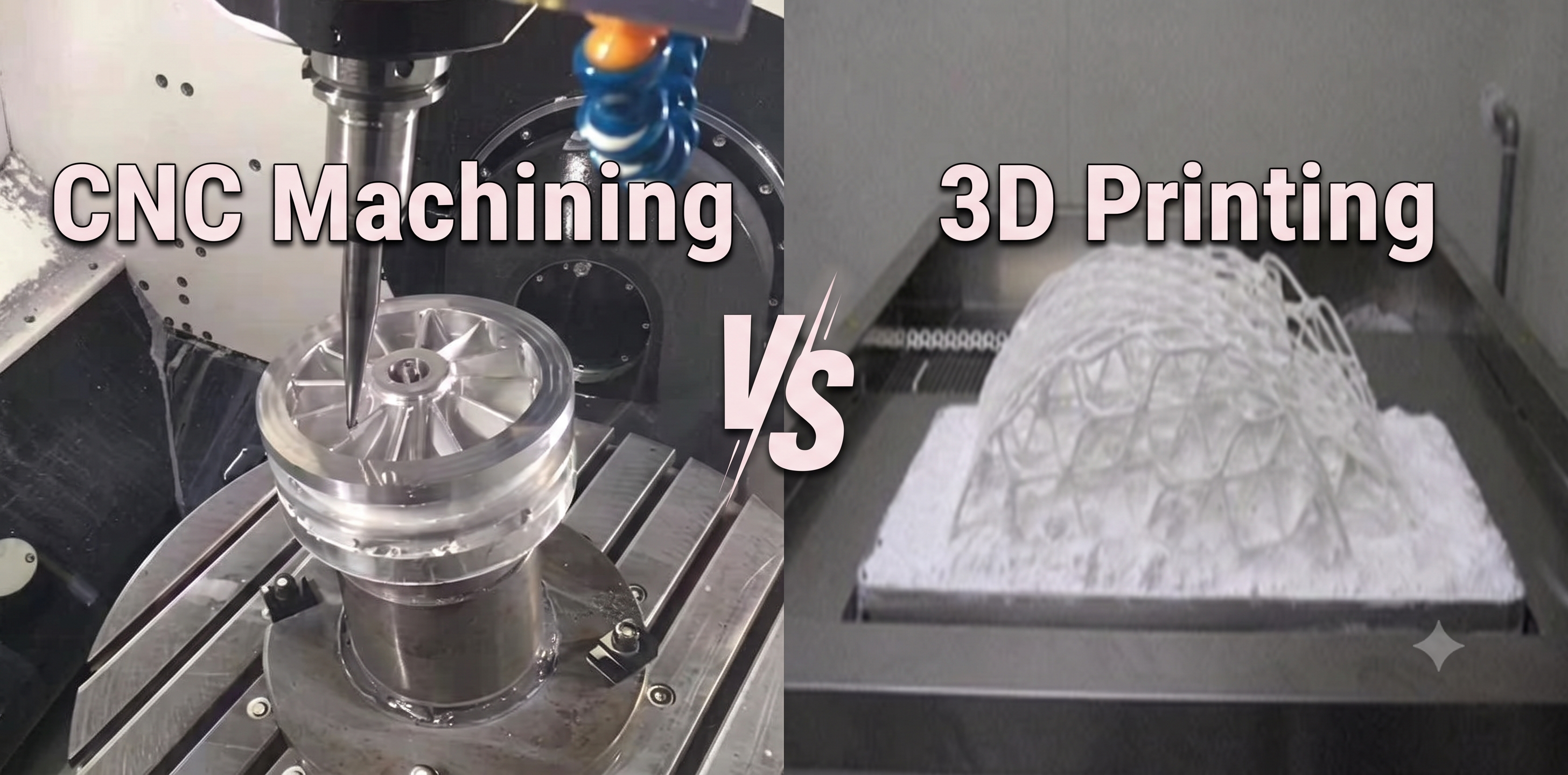
Engineers and designers often have to choose between CNC machining and 3D printing when a design moves into functional testing. Both turn a CAD file directly into a physical part without the production tooling that injection molding needs. CNC machining is subtractive, so cutting tools remove material from a solid block. 3D printing is additive, so the part is built layer by layer. That difference affects lead time, design freedom, material properties, and cost.
| Factor | CNC Machining | 3D Printing |
|---|---|---|
| Process | Subtractive | Additive |
| Geometry | Limited by tool access | Very complex shapes possible |
| Materials | Wide range of metals and plastics | Plastics, resins, some metals |
| Strength | Consistent, same as solid stock | Can vary by build direction |
| Setup | CAM programming and fixturing | Minimal |
| Cost | Better as quantity rises | Better for one-offs and complex parts |
| Volume | Low to high | Mostly low |
| Precision | High, with a good surface finish | Good, but often needs post-processing |
Key Differences between CNC Machining and 3D Printing
Manufacturing Processes
Computer numerical control (CNC) machining is a subtractive process. It starts with a solid block of raw material. A CAM program turns the CAD model into toolpaths. The machine follows them with milling cutters, drills, or lathe tools until only the finished part remains. These are traditional methods, but the computer now runs them automatically. The part is held in a vise or fixture, and complex part geometry often needs several setups.
3D printing starts with an empty build platform. In the additive manufacturing process, software slices the model into thin layers, and the printer builds them one at a time. Common methods include extruding plastic filament, curing liquid resin with light, sintering polymer powder, and fusing metal powder with a laser.
Geometric Complexity
A cutting tool can only cut what it can reach. This limits CNC machining on internal channels, enclosed cavities, and deep narrow pockets. Internal corners also keep the radius of the tool. Five-axis machines reach more surfaces, but not all of them.
3D printing has no tool access problem. Highly complex geometries, such as internal channels, organic structures, and hollow lattices, are practical without added tooling cost. Several components can also be combined into one part. Printing has its own limits. Overhangs need support structures, and trapped powder or resin must be removed from internal cavities.
Comparing Materials
CNC machining works with a broad range of materials, almost any that can be cut. This includes aluminum, stainless steel, brass, titanium, copper, and metal superalloys such as Inconel. Engineering plastics such as acetal, nylon, and PEEK are also common. Aluminum and brass are easily machined. The stock has well-documented properties. The range is broader than printing materials and usually cheaper.
3D printing supports thermoplastics, photopolymer resins, and a smaller group of metal powders. These materials are formulated for the process. Their properties can differ from the same material in conventional form. Material considerations such as strength and thermal properties should be checked on the data sheet before committing to a design.
Strength of Complex Parts
A machined part keeps the original grain structure of the solid stock. There are no layer interfaces, so properties stay consistent throughout the part and strength under heavy load is predictable.
Parts produced by printing are built in layers, so strength can change with build direction. In plastic parts made with FDM, tensile strength is usually lower along the vertical Z-axis than in the horizontal plane. Metal parts can contain porosity, which hot isostatic pressing (HIP) can reduce, while heat treatment relieves residual stress. In return, printing can produce a complex part as one piece, with no joints or welds. For critical load-bearing parts, CNC machining remains the more predictable choice.
Ease of Use and Setup
CNC machining needs more preparation. Someone has to write the CAM program, define toolpaths and cutting parameters, plan the work holding, and set the work offsets. A skilled machinist makes a clear difference in quality and cost.
3D printing is simpler to start. The operator orients the part, adds supports, slices the file, and starts the build. Most machines can then run unattended, and desktop printers let teams print prototypes in house. Industrial metal printing is the exception, since it requires powder handling, process control, and more post-processing.
Cost Considerations
CNC cost is driven by setup, machine time, and material costs. Setup is a fixed cost, so the price per part falls significantly as quantity rises. Part complexity pushes the price up when a shape needs many setups or special tools.
3D printing needs no tooling and little setup, so low volume production is inexpensive. Cost follows part volume, build time, and material, and geometric complexity adds little by itself. For one-offs, printing is often the cost effective option. The price per part falls only slowly with quantity, and post-processing can add a lot to the final figure.
Production Volume and Scalability
CNC machining scales from one part to thousands and suits high volume production once the program and fixtures exist. Larger runs get favorable economies of scale, because setup cost is spread across more parts. Automatic tool changers and multi-axis machines keep repeat runs efficient.
3D printing is strongest for rapid prototyping and small batches. Each part still takes build time, so production speed does not improve much even when many parts are nested in one build. Generally speaking, machining becomes the more cost effective process at higher quantities. The exact crossover depends on the part. For very large runs, other manufacturing processes such as injection molding may beat both.
Precision and Accuracy
CNC machining offers superior dimensional accuracy and a good surface finish straight from the machine. Critical dimensions on bores, threads, bearing fits, and sealing surfaces need high precision, so these features are normally machined.
Printed accuracy depends on the manufacturing method. Shrinkage, warping, and layer lines affect dimensions and surface finish. On extrusion printers, nozzle diameter and layer height also limit fine detail. When a printed part has a few critical features, those features are often finished by machining. This hybrid route combines 3D printing and CNC machining, so the part gets the geometry of printing and the accuracy of CNC.
Advantages and Disadvantages of CNC Machining
Advantages of CNC Machining
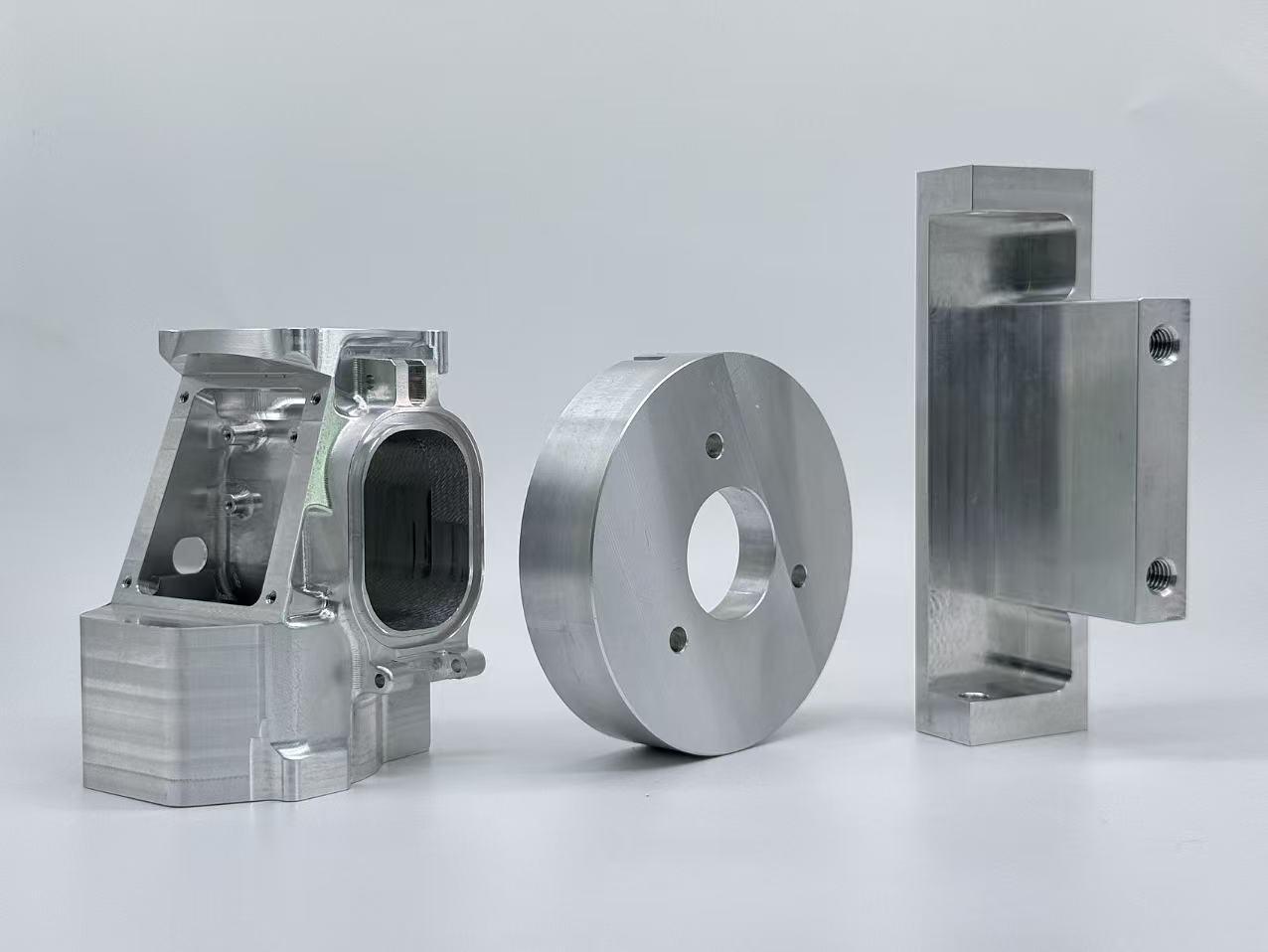
- Consistent Mechanical Properties: Machined parts keep the density and structure of the solid stock, with no layer interfaces, so properties are consistent throughout the part.
- High Dimensional Precision: CNC machining holds tight tolerances, which suits mating parts, bearing seats, threads, and critical enclosures.
- Broad Material Selection: Almost any machinable metal or plastic can be used, including aluminum, stainless steel, titanium, brass, and high-performance plastics such as PEEK and acetal.
- Excellent Surface Quality: Machined parts have smoother surfaces straight off the machine, which suits many sealing requirements with little post-processing. Metal parts also take finishes such as anodizing and powder coating well.
- Cost Drops with Quantity: Setup is a fixed cost, so the price per part falls as volume rises.
- Scales to Production: The same program and fixtures run for one part or thousands.
Disadvantages of CNC Machining
- Geometric Constraints: Cutting tools need direct access to the surface, so complex geometries such as curved internal channels and deep enclosed voids are difficult or impossible to produce. Some undercuts also need special tools.
- Higher Initial Setup Effort: CAM programming, tool selection, and custom workholding are needed before the first part is cut, so one-off parts can take longer to prepare than to cut.
- Material Waste: Cutting a part from a solid block creates chips, which raises material cost for complex or heavily pocketed parts, especially in expensive alloys.
- Higher Cost for Complex Shapes: Parts that need many setups or special tools cost more.
Advantages and Disadvantages of 3D Printing
Advantages of 3D Printing
- Design Freedom: Internal fluid channels, hollow structures, and lattices can be printed without added tooling cost. Several components can often be consolidated into a single part, which removes joints and fasteners.
- Rapid Setup and Iteration: There is no custom fixturing or CAM programming. A sliced CAD file can go straight to the printer, so design changes are quick to test.
- Low Upfront Cost: With no tooling fees, single-unit builds and functional prototypes are inexpensive.
- Less Material Waste: Unlike subtractive methods, printing adds material only where the part needs it, so there are no chips. Supports and unused powder or resin still count as some waste.
- Easy Customization: Custom parts in the same build can each be different, with no change in setup.
Disadvantages of 3D Printing
- Direction-Dependent Strength: Layer bonding can leave parts weaker along the build direction. This is most common in plastic extrusion processes such as FDM, where tensile strength is usually lowest along the vertical Z-axis.
- Narrower Material Choice: Printable plastics, resins, and metal powders are fewer than the stock available for machining. Their properties can also differ from the same material in conventional form.
- Surface Finish and Accuracy: Visible layer lines remain on many raw printed surfaces and add to surface roughness. Shrinkage and warping can also cause dimensional variation. Functional mating surfaces often need sanding, smoothing, or machining.
- Post-Processing: Support removal, powder or resin cleanup, and heat treatment add time and cost, particularly for metal parts.
- Slow at Volume: Each part takes build time, so large runs are slow. The price per part falls only slightly at higher volumes.
- Build Size Limits: Part size is restricted by the build volume of the printer.
When to Choose Which
The right manufacturing process depends on the part, the quantity, and what the part has to do. Neither of the two manufacturing techniques wins in every case.
Choose CNC Machining When
- High Strength Is Required: Structural parts that carry heavy loads, fatigue, or impact need consistent properties.
- Tight Tolerances Are Essential: Bores, threads, bearing seats, and sealing surfaces need accurate dimensions.
- Volume Goes Beyond Low Quantities: Setup cost is spread across the order, so the price per part falls as quantity rises.
- A Specific Material Is Specified: The material requirements call for a defined alloy, grade, or engineering plastic.
- A Good As-Cut Finish Is Needed: Surfaces must be smooth with little or no post-processing.
- Geometry Is Simple to Moderate: Plates, blocks, and turned parts are easy for a cutting tool to reach.
Choose 3D Printing When
- Complex Geometries Are Needed: The design has internal channels, lattices, or organic shapes that tools cannot reach.
- Fast Iteration Is the Priority: Design changes need to be printed and tested without fixturing or CAM programming.
- Volume Is Very Low: One-off parts and small batches avoid tooling and setup cost.
- Weight Reduction Is Critical: Hollow or lattice structures reduce weight by placing material only where the load needs it.
- Part Consolidation Is Desired: Several components can be printed as one part, which removes fasteners and joints from the final product.
When a part needs both, print the shape and machine the critical surfaces.
Not sure which process fits your part? Send your CAD file or drawing to Aria Manufacturing. Our engineers will review the geometry, material, and quantity, and recommend the most cost-effective route. Request a quote for your CNC machined parts today.
