

 EU
EUTapping and thread milling both cut internal or external threads, but they work in different ways, cost differently, and fail differently when something goes wrong. Picking the wrong method costs more than a few extra minutes on the clock; it can mean scrapped parts, shortened tool life, or thread quality that fails inspection. This guide is written for mechanical engineers, product designers, and procurement managers who need to match the right tool to a specific part, not just learn the theory behind precision CNC machining. Below, we explain how each method works, compare them directly, and lay out exactly when to choose one over the other.
What is Thread Milling?
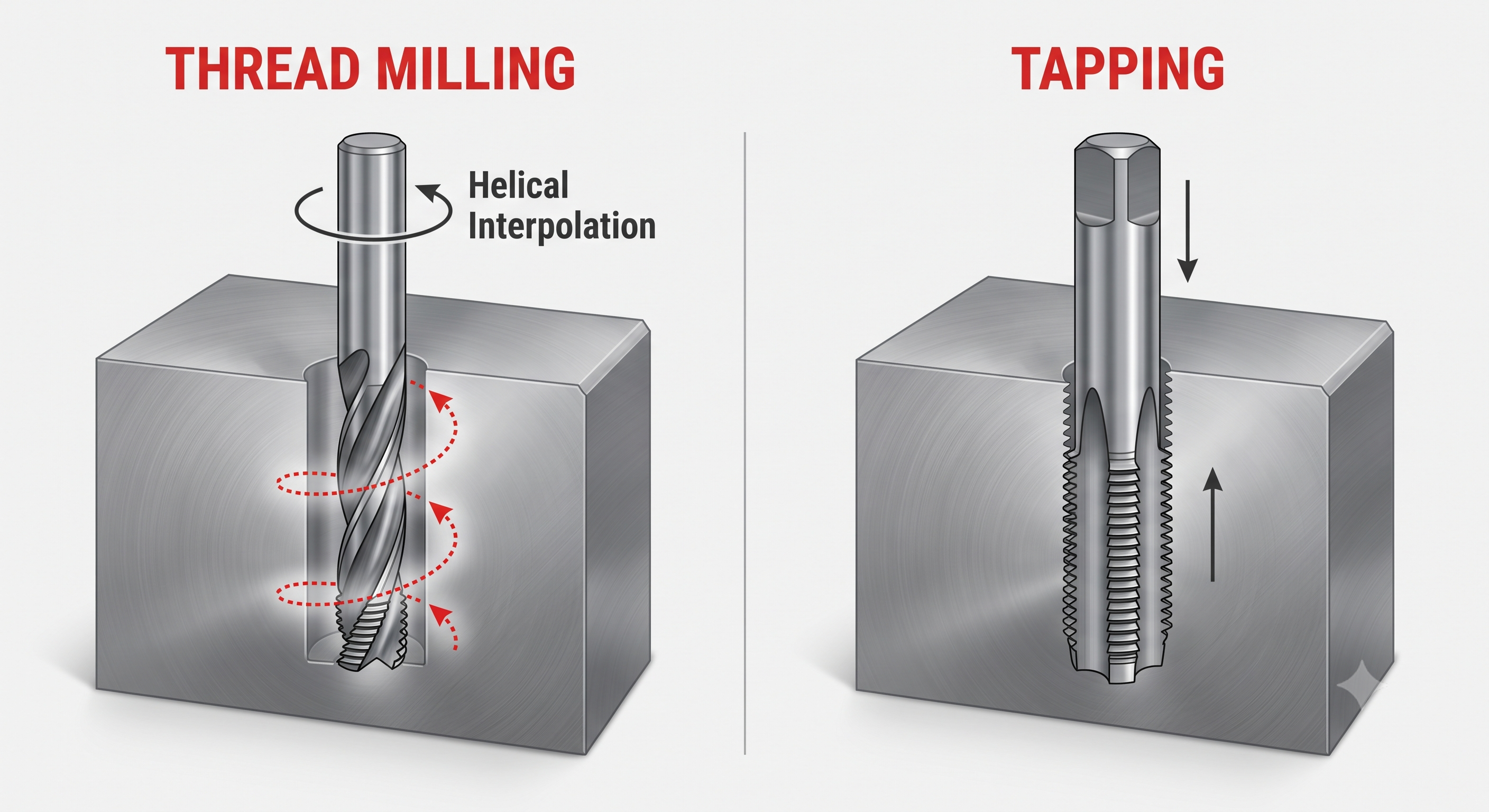
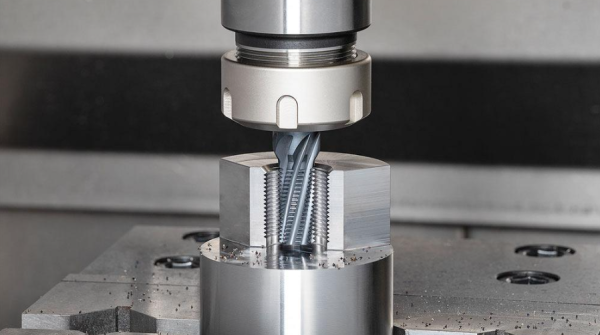
Thread milling is a precision CNC process that cuts internal or external threads through simultaneous multi-axis motion, typically three-axis helical interpolation. This combined motion is often described as circular interpolation extended along the Z-axis, since the thread milling cutter follows a spiral path rather than a straight line. The cutter enters a pre-drilled hole, orbits the centre axis in the X-Y plane, and feeds along the Z-axis at a rate that matches the required pitch exactly. Unlike tapping, the cutter diameter stays smaller than the hole, so the thread profile builds up progressively rather than forming in one straight cut.
Common Thread Mill Types
- Single-Point Thread Mills: Cut one groove of the thread per revolution, slow but highly adaptable for custom threads and unusual pitches.
- Full-Profile (Multi-Form) Thread Mills: Carry the entire thread form on the cutter and complete a hole in a single helical pass, the default choice for most shops.
- Single-Plane Thread Mills: Trace the thread top to bottom over multiple passes, used on very small threads where a full-profile tool will not fit.
- Indexable Thread Mills: Carry replaceable carbide inserts rather than a solid body, suited to large threads and higher-volume work.
Pros
- Multiple Thread Sizes: A single tool machines a range of hole diameters, left- and right-hand threads, and both internal and external threads at the same pitch.
- Lower Tool Breakage Risk: Because the cutter is smaller than the hole, broken tools do not lock into the workpiece and can be removed without damaging the part.
- Clean Chip Evacuation: Produces short, manageable chips and lets pitch diameter tolerances be fine-tuned through CNC offsets, holding tight tolerances for a higher quality thread.
- Reaches Blind Hole Bottoms: Cuts nearly full-depth, closer to the bottom of a blind hole than a tap can reach.
- Lower Long-Term Cost: Longer tool life and reuse across sizes can lower the cost per part on repeat or high-mix work.
Cons
- Slower Thread Milling Cycle: Helical movement covers more travel distance than a straight plunge, so cycle time per hole runs longer, especially across large production runs.
- Higher Upfront Cost: Needs a CNC machine capable of rigid helical interpolation, a more involved CNC program, and a pricier tool than a standard tap.
What is Tapping?
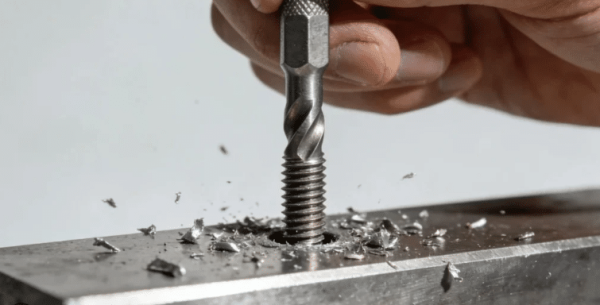
Tapping is the traditional method used to produce internal threads. A tap, a fixed-dimension cutting tool matched to one specific thread size, drives straight into a pre-drilled hole along its central axis, cutting the thread in a single pass. Threads form either by cutting away material to cut threads, or with a form tap, by displacing it instead.
The motion is single-axis. Spindle rotation and axial feed stay locked at a 1:1 ratio matching the thread pitch, so a 1/4″-20 tap advances 0.05″ per revolution, no more, no less. On modern CNC machines, this synchronised motion is known as rigid tapping, since the spindle encoder tracks position directly rather than relying on a floating tap holder to absorb any mismatch. The tap’s outer diameter matches the finished thread size directly, unlike a thread mill, which cuts undersized and builds the profile through motion.
Common Tap Types
- Spiral Point Taps: Push chips forward ahead of the tool, suited to through-holes.
- Spiral Flute Taps: Pull chips up and out of the hole, suited to blind holes.
- Bottoming Taps: Carry almost no lead chamfer and finish the last threads at the base of a blind hole.
- Forming (Form) Taps: Forms threads by displacing material instead of cutting it, produces no chips, limited to ductile materials.
- Carbide Taps: Cost more than standard high-speed steel taps but hold an edge longer in abrasive or harder materials.
Pros
- Fast Cycle Time: A single pass produces a full-depth, complete thread, well suited to high volume production.
- Simple Setup: Runs on a drill press, tapping machine, or by hand, needing only basic programming on almost any machine tool.
- Lower Tool Costs: Standard taps for standard threads are widely available and standardised, keeping the unit price down.
Cons
- No Flexibility: One tap size cuts exactly one diameter, one pitch, one orientation, with no adjustment afterwards.
- Higher Risk on Tool Failure: If a tap breaks in a tough material or a deep hole, it binds tightly into the hole wall and is notoriously difficult to remove without scrapping the part.
- Chip Clogging: Produces long, continuous chips that can pack tightly inside blind holes, causing deep hole threads to fail.
Differences Between Thread Milling and Tapping
The sections above explain thread milling and tapping individually. The key differences below compare thread milling and tapping across six areas that matter most when picking the right tool for a threaded hole.
Machining Kinematics
Thread milling relies on multi-axis CNC helical interpolation. An undersized cutter follows a spiral path, orbiting the hole centre in the X-Y plane while feeding along the Z-axis.
Tapping uses single-axis movement instead. The tool drives straight into the hole, with spindle rotation and axial feed locked at a 1:1 ratio matching the pitch.
Cycle Speed and Throughput
Thread milling needs a longer, more intricate tool path, so cycle time per hole runs longer. This gap barely registers on a short run, but it compounds fast once volume climbs into the thousands.
Tapping completes a thread in one plunge and retract pass, which makes it significantly faster per hole and the default choice for high-volume mass production.
Tool Versatility
A single tool can machine a range of hole diameters, cut internal or external threads, and switch between left-hand and right-hand, provided the pitch stays the same, producing multiple threads without a tool change.
Taps offer none of that flexibility. One tap size cuts exactly one thread diameter, one pitch, one direction, which is worth factoring into tool-inventory planning for anyone speccing multiple thread variants across a part family.
Chip Control and Process Security
Thread milling produces small, manageable chips that clear easily with standard coolant. Because the cutter sits smaller than the hole, a broken tool does not lock into the workpiece.
The tapping process produces long, continuous chips that can clog blind holes. A snapped tap binds tightly against the hole wall, carrying a much higher risk of scrapping the part.
Thread Depth and Tolerance Adjustment
Thread mills can cut full threads right to the bottom of a blind hole, and pitch diameter tolerances can be fine-tuned through CNC offsets.
Taps leave an unthreaded lead chamfer at the bottom of a blind hole. Once the thread is cut, there is no adjusting it on the machine.
Material and Application Suitability
Thread milling performs well in tough or challenging materials such as titanium, hardened or stainless steel, and nickel-based superalloys, and it suits complex geometries and large thread diameters without strain.
Tapping suits softer materials, including aluminium, brass, mild steel, and cast iron, and works best on small-to-medium standard thread sizes rather than anything harder or larger.
Which One Should We Use?
The right choice comes down to the part’s material, geometry, and production volume, not personal preference. For high-value or hard-to-machine parts, thread milling is often the preferred method, while tapping remains the practical default for standard, high-volume work. The table below pairs each factor with the better-suited method.
| Factor | Thread Milling | Tapping |
| Best for parts | High-value parts (titanium brackets, manifolds) | High-volume parts (cast iron blocks, electronics) |
| Best for materials | Tough, difficult materials (Inconel, superalloys, hardened steel) | Softer, free-machining materials (aluminium, mild steel) |
| Best for holes | Large diameters, deep or blind holes (M20+), larger holes | Standard through-holes, small threads (M3 to M12) |
| Best for production | Low-volume, high-mix, fewer tool changes | Budget or older machines, no helical interpolation |
Thread milling or tapping, the right process comes down to your part’s material, tolerance, and volume. Aria Manufacturing runs both in-house and can help you choose without the guesswork.
Upload your drawing or CAD file for a free quote, and our team will get back to you with pricing and lead time.
-100x100.jpg)