

 EU
EUEDM machining is a specialized way to shape hard, conductive metals. Shops turn to it when a part needs tight tolerances, complex internal features, or extreme hardness that standard cutting tools cannot handle.
What Is EDM Machining?
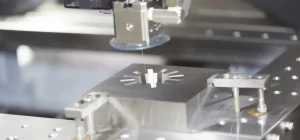
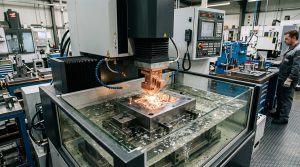
Electrical Discharge Machining (EDM) is a thermal, non-contact process that shapes conductive materials with rapid, high-frequency electrical sparks. It does not rely on mechanical cutting force. Instead, it uses electrical energy to machine high-hardness metals with high precision and tight tolerances. It also produces complex internal geometries that conventional tools cannot reach.
How Does the Process Works?
When a high-frequency pulsed voltage jumps across the gap and forms a spark, the resulting flash of heat instantly melts, and in some cases vaporizes, a tiny amount of the local material. The circulating dielectric fluid then cools the area and flushes away the eroded debris. Because the electrode never physically touches the workpiece, the process generates no cutting force. This is the key distinction between EDM and conventional machining methods like milling or turning.
This capability makes EDM useful for thin-walled or delicate parts that would deflect or distort under a conventional tool. It also lets EDM machine a part after heat treatment. The discharge doesn’t care how hard the surface is. It only responds to how conductive the material is.
What Are the Main Types of EDM Machining?
Wire EDM
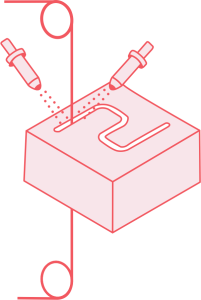
Wire EDM uses a continuously moving thin metal wire, typically brass, as the electrode. It works something like an extremely fine, programmable band saw, following a defined path to cut complex outer profiles, two- and three-dimensional geometries, and thick metal plate. Because the wire itself continuously feeds through the cutting zone, a worn or slightly eroded section of wire is always being replaced with fresh wire, which helps keep dimensional accuracy consistent even on long, complex cutting paths.
Sinker / Ram EDM
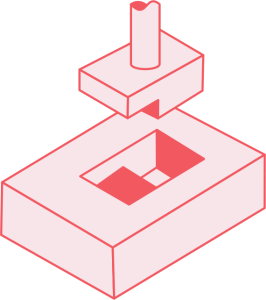
Sinker EDM uses a pre-shaped three-dimensional electrode, usually graphite or copper, that is pressed into the workpiece. As it discharges, it effectively burns a mirror image of its own shape into the material, making it the go-to method for complex mold cavities, deep slots, and blind pockets that conventional tooling can’t reach or simply can’t produce. Because the electrode itself has to be machined first, sinker EDM carries more upfront tooling cost than wire EDM, but that electrode can then be reused across an entire production run of identical cavities.
Hole-Drilling EDM
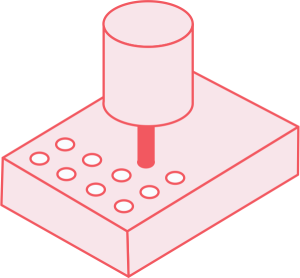
Hole-drilling EDM uses a tubular electrode paired with high-pressure internal flushing that clears eroded debris out through the center of the tool. It’s built specifically for fast, precise drilling of tiny, extremely deep, or angled holes in hard-to-machine materials like carbide and superalloys. Of the three EDM types, it is the most specialized and typically the fastest for its narrow use case. It’s also commonly used as a first step before wire EDM, since it can quickly create a starting hole for the wire to thread through when a cut needs to begin somewhere other than the edge of the stock.
| EDM Type | Tooling / Electrode | Key Uses & Applications |
| Wire EDM | Continuously feeding thin brass wire electrode | Complex 2D/3D outer profiles, thick plate through-cuts, and precision blanking dies. |
| Sinker / Ram EDM | Custom 3D pre-shaped electrode (graphite or copper) | Blind cavities, deep slots, 3D mold pockets, and sharp internal corners. |
| Hole-Drilling EDM | Small tubular electrode with internal fluid flushing | Fast, micro/deep hole drilling in hard metals; starter holes for wire EDM. |
Materials Suited for EDM Machining: A Comparison
Whether EDM can process a given material comes down to electrical conductivity, not hardness. Here is how different material categories fare in the process:
Conductive Metals (Well Suited)
Hardened tool steels, tungsten carbide, titanium alloys, and Inconel are ideal candidates. Efficiency depends on conductivity and melting point. Metals with lower melting points erode faster per discharge.
Highly Conductive Metals (Parameter Tuning Needed)
Copper, aluminum, and brass process smoothly, but high thermal and electrical conductivity rapidly dissipates energy. Discharge parameters must be adjusted to minimize electrode wear.
Non-Conductive Materials (Not Suitable)
Electrical insulators like ceramics, plastics, and glass cannot complete a discharge circuit, making direct EDM machining impossible.
Advantages and Disadvantages of EDM Machining
While conventional milling and turning rely on physical shear force to cut away material, EDM operates on a fundamentally different thermal mechanism. This non-contact approach grants it unique capabilities in modern manufacturing, along with specific operational trade-offs that every engineer and buyer should understand.
Advantages
Hardness-Independent Machining
Because material is eroded thermally rather than cut mechanically, EDM handles fully hardened tool steels, tungsten carbide, titanium alloys, and nickel superalloys with ease, no matter how hard the workpiece is.
Zero Cutting Force & Mechanical Stress
Without physical contact between tool and workpiece, the process leaves zero residual mechanical stress. Thin walls, delicate webs, and fragile micro-features won’t deflect, flex, or snap during machining.
Complex Geometries & Tight Internal Corners
EDM routinely produces features that mechanical cutters simply cannot reach: deep narrow slots, blind rectangular pockets, sharp 3D internal corners, and intricate internal die profiles.
Extreme Precision & High Surface Finish
Precision EDM setups can hold tight dimensional tolerances down to ±0.005 mm (0.0002 in) while producing ultra-smooth surface finishes as fine as Ra 0.2 µm, often eliminating downstream manual polishing.
Burr-Free Results & Post-Heat Treatment Processing
Since the material is vaporized and flushed away, parts come off the machine entirely free of mechanical burrs. Furthermore, components can be fully heat-treated before EDM machining, avoiding post-machining heat distortion.
Disadvantages
Exclusive to Conductive Materials
Because the process relies on completing an electrical circuit, non-conductive materials like ceramics, plastics, and glass cannot be directly processed with EDM.
Lower Material Removal Rates (MRR)
EDM removes material more slowly than conventional CNC milling. It excels at precision and high-hardness features rather than bulk stock removal.
Electrode Wear & Custom Tooling Costs
In sinker EDM, the electrode wears down alongside the workpiece and must be accounted for in programming. Preparing custom graphite or copper electrodes also adds upfront tooling costs and setup time.
Formation of a Recast Layer
The rapid thermal cycle leaves a thin recast layer (white layer) of re-solidified metal on the surface. Heavy roughing passes can introduce micro-cracks in this layer, requiring fine finishing passes or chemical etching for fatigue-critical parts.
Higher Energy Consumption & Industrial Requirements
Sustaining high-frequency electrical spark discharges requires substantial energy. Additionally, unlike 3D printers or small CNC mills, EDM machinery is strictly industrial equipment, requiring specialized power, dielectric fluid management, and filtration systems.
EDM vs. Conventional CNC Machining
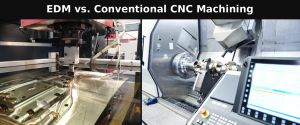
While both EDM and conventional CNC machining (milling and turning) are vital to modern manufacturing, they serve distinctly different purpose.
Material Flexibility
Conventional CNC machining works on both conductive and non-conductive materials (including plastics, wood, and composites), but struggles or experiences heavy tool wear when cutting extremely hard metals. EDM easily processes metals of any hardness (such as carbide or hardened tool steel), but is strictly limited to conductive materials.
Machining Force & Delicate Features
CNC milling applies direct mechanical cutting forces to the workpiece, which can distort thin walls or snap fragile features. EDM is a non-contact thermal erosion process, creating zero mechanical stress, making it the preferred choice for delicate micro-features, thin webs, and heat-treated parts.
Geometric Limitations
CNC milling tools are round, meaning they cannot produce perfectly sharp internal 90° corners or extremely small-radius internal cavities without specialized relief features. EDM excels at sharp 3D internal corners, deep square slots, and complex blind pockets that cutting tools cannot physically reach.
Speed & Material Removal
CNC machining offers significantly higher material removal rates (MRR) for bulk material removal and high-volume production. EDM is slower and generally reserved for high-precision, intricate details, or materials that are impossible to machine with standard cutting tools.
EDM vs. Laser Cutting
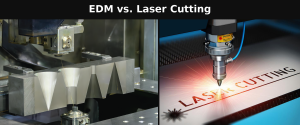
EDM and laser cutting both use concentrated energy instead of mechanical force to remove material. They rely on different physics, so each process fits different jobs.
Material Requirements
Laser cutting works on both conductive and non-conductive materials. It can process plastics, wood, and composites as well as metal. EDM only works on conductive materials, so it is limited to metal and a few other conductive substances.
Heat Affected Zone
Laser cutting produces intense, concentrated heat. This often leaves a wider heat affected zone and more thermal distortion on the cut edge. EDM also relies on thermal energy, but the discharge is much more controlled. Its heat affected zone stays thinner as a result.
Precision and Detail
EDM holds tighter tolerances than laser cutting. It also produces a finer surface finish, especially on complex 3D shapes and internal features. Laser cutting favors speed over precision and works best on simple 2D profiles.
Speed and Cost
Laser cutting runs faster and costs less for thin sheet metal in high-volume jobs. EDM runs slower and costs more, but it delivers a level of precision that laser cutting cannot reach on hardened metals or intricate cavities.
Key Applications of EDM Machining
Precision Tool & Die Manufacturing
The foundational application of EDM. Sinker EDM burns intricate mold cavities, cores, and deep ribs for injection molding and forging dies, while wire EDM cuts hardened blanking dies and punch plates with extreme accuracy.
Thick Metal & Sheet Fabrication
Wire EDM plays a critical role in slicing, slotting, and punching thick metal plates made of hardened stainless steel or carbide, where traditional mechanical punching would shear, warp, or destroy the tooling.
Aerospace Engineering
Aerospace components combine high-temperature superalloys (Inconel, René alloys, titanium) with complex geometry. EDM is used to cut turbine blade cooling holes, fuel nozzles, keyway splines, and complex disk slots.
Medical Devices & Implants
Biocompatible alloys like titanium and cobalt-chrome require absolute precision with zero structural distortion. EDM is widely used to machine orthopedic implants, delicate surgical instruments, and micro-stents.
Microelectronics & Precision Hardware
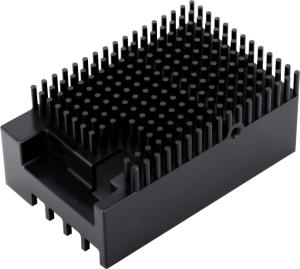
For miniature connectors, relay contacts, sensor housings, and micro-switches, EDM’s micro-machining capabilities achieve minute feature sizes that conventional cutters would simply crush.
Automotive Systems
Essential for producing high-precision automotive components such as fuel injection nozzles, hardened internal gears, valve guides, as well as high-durability stamping tools for body panels.
Rapid Prototyping for Hard Materials
EDM allows engineers to rapidly prototype single-unit or short-run functional components directly from hardened bar stock or exotic alloys without waiting for soft-state machining followed by heat treatment.
Intricate Consumer Goods
From high-end watchmaking components and luxury eyewear frames to custom mechanical hardware, EDM delivers fine aesthetic details, sharp logos, and pristine surface textures.
Troubleshooting Common EDM Machining Problems
Wire Breakage (Wire EDM)
When wire breakage occurs, start by checking whether tension is too high, flushing pressure is too low, or the discharge across the gap is excessive. These three causes account for most wire breaks, and working through them in order usually pinpoints the problem quickly. It’s also worth checking for a worn wire guide or contact block before assuming the problem is purely a parameter issue, since a damaged guide can create a stress point that snaps an otherwise properly tensioned wire.
Unstable Discharge or Arcing
Unstable discharge or arcing typically calls for cleaning the dielectric fluid, checking whether the filtration system is clogged, and then adjusting the discharge gap or lowering discharge energy. Some combination of these adjustments usually restores stable discharge. Contaminated fluid is by far the most common root cause. Once debris concentration in the dielectric climbs too high, the fluid can no longer de-ionize properly between discharges, and arcing becomes far more likely.
Excessive Recast Layer
If the recast layer, the layer of resolidified material left on the surface, comes out too thick, lowering the roughing energy and adding one or two finishing passes with finer parameters will noticeably improve both surface roughness and recast layer thickness. On parts subject to fatigue loading, this step is worth taking seriously, since an untreated recast layer can act as a starting point for micro-cracks under repeated stress.
Choosing the right EDM process, and knowing how to maintain it and troubleshoot it when something goes wrong, is the foundation for machining complex parts reliably. Getting comfortable with all three EDM types, rather than defaulting to whichever machine happens to be free, tends to pay off the most on parts with mixed features. A mold base, for example, might need a starting hole from hole-drilling EDM, a cavity from sinker EDM, and a finished outer profile from wire EDM, all on the same component. If you have a specific EDM project or question, feel free to send us your drawings for an instant quote and expert advice.
-100x100.jpg)