

 EU
EUWhat Is Swiss Machining?
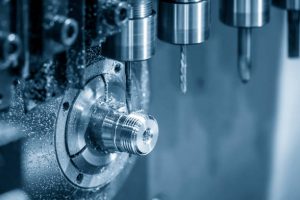
Swiss machining is a specialised CNC turning process. The bar of material is supported right at the point where the tool cuts it, and slides through that support point as machining continues. A collet feeds the bar through a guide bushing, the tool sits close to the bushing, and only a tiny section of material is ever left unsupported during the cut.
This differs from most lathe processes, where the workpiece sits still, and the tool travels along it. The technique dates to 1870s Swiss watchmaking, where Jakob Schweizer built a sliding headstock lathe to turn tiny screws and pinions, parts too slender for the lathes of that era to hold accurately. The name stuck, even though modern Swiss machines now serve industries far beyond watchmaking.
How Swiss CNC Machining Works
The Role of the Sliding Headstock
A conventional CNC lathe uses a fixed headstock, holding the workpiece still while the tool moves along it. A Swiss lathe reverses this with a sliding, moving headstock. The headstock rides on the Z axis, or longitudinal axis, and pushes the bar forward through the guide bushing as cutting proceeds. The tool barely moves; the workpiece travels to it. Rather than roughing a full profile and finishing it later, the machine cuts each section to final size as the bar slides past, supporting precision turning and helping produce parts one short segment at a time.
The Function of the Guide Bushing
The guide bushing clamps around the bar just ahead of the cutting zone, preventing the material from deflecting under cutting force. The gap between bushing and tool is small, typically 0.020 to 0.080 inch, so the unsupported length is never more than a sliver.
This short support distance eliminates the chatter and taper that would otherwise show up on slender parts, and lets Swiss lathes cut deeper and faster because the cutting tool works very close to the support point, reducing deflection. In some cases, that support also allows an operation to be completed in a single pass. Final precision still depends heavily on the raw bar itself, which is why shops specify centreless ground or SMQ stock. The guide bushing can only properly support material that is already close to round and straight.
Swiss CNC Lathes vs Conventional Lathes: Key Differences
Headstock:
Conventional lathes have a fixed headstock; the tool moves while the part stays still. Swiss lathes have a sliding headstock that feeds the bar forward through the guide bushing, so the workpiece moves and the tool barely does; this machine is also called a swiss type lathe, one of the Swiss style lathes.
Workpiece support:
A conventional lathe grips the part in a chuck at one end only. A Swiss lathe supports the bar right at the cut, which stops thin parts from flexing away from the tool.
Length to diameter ratio:
Conventional lathes start to deflect past roughly 3:1 to 4:1 without tailstock support. Swiss lathes are especially effective when machining small, long-diameter work and other slender parts with high length-to-diameter ratios, routinely handling 10:1, and some specialised setups exceed 20:1 on extremely slender components.
Machining approach
Conventional lathes finish a profile in passes along the full length of the part. Swiss lathes cut each section to final dimensions as the bar advances, with tools cut at each stage in an approach known as swiss style machining, closer to a segmented, assembly-line style of turning.
Coolant
Conventional lathes generally run water based coolant, good for heat but weak on lubrication. Swiss machines mostly run cutting oil, which has a lower heat capacity than water but lubricates the tight clearance inside the guide bushing better.
Cost and cycle time
Swiss machines need a higher initial investment and take longer to set up, sometimes several hours of programming and tooling adjustment for a complex job, and many machines are configured for unattended operation once setup is complete. In return they need far less manual intervention, and parts rarely need secondary operations, which helps reduce labor costs and makes Swiss turning cost-effective at higher volumes.
Types of CNC Turning Machines on Swiss
Main Spindle Operations
The main spindle does the primary machining. The bar first passes through the guide bushing here as metal stock, and the spindle handles turning, front drilling, and front tapping. Outer diameters, tapers, threads, and the main bores are all cut at this stage, with the bar still fully supported by the bushing.
Sub Spindle (Back Spindle) Operations
The sub spindle takes over once the front side is finished. It moves in behind the part, grips it, and synchronises with the main spindle for parting off. From there it carries the part away to work the back face, drilling, tapping, or grooving what was previously inaccessible, and ejects the finished piece on its own. This automated handoff removes the need for manual reloading, while automatic bar feeding keeps raw material moving continuously during long unattended runs.
Live Tooling and Multi-Axis Capability
Live tooling brings milling capability into the turning cycle, letting multiple tools handle cross drilling, cross milling, thread whirling, and flat milling in the same setup, without a separate milling stage and the fixturing error that would come with it.
Traditional lathes typically run two to five axes. A well equipped Swiss machine runs seven to thirteen, and its advanced design supports simultaneous operations across the main spindle, sub spindle, and multiple tooling stations, with multi axis capabilities that keep cycle times short even on intricate parts.
Materials Used in Swiss Machining
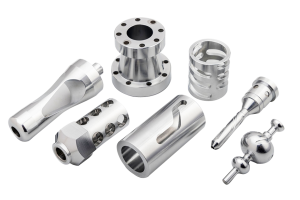
Free-machining and carbon steels
Carbon steel grades such as 12L14 and 1215 cut fast with short, manageable chips, and these free-cutting grades are commonly chosen when shops want efficient chip control and clean finishes on Swiss machines.
Stainless steel
303 machines easily and is widely used for general parts; 304 and 316 cover corrosion-resistant applications, including some medical grades.
Titanium
Grade 5 and similar alloys are common in implants and aerospace parts, but conduct heat poorly and wear tools quickly, so spindle speeds have to come down.
Aluminium
Grades like 6061 and 7075 run at high spindle speeds with good surface finish, though the soft, gummy chips need attention during cutting.
Brass and copper
Cut fast with excellent surface finish and are a common choice where speed and finish matter more than strength.
Nickel and cobalt alloys
Used mainly in implant-grade and high-performance parts; these are hard on tools and generally run at reduced speeds.
Engineering plastics
Nylon, polycarbonate, PEEK, and acetal machine well at higher spindle speeds than metal, but need careful heat management since they deform at far lower temperatures.
Precision Parts and Tolerances Achievable with Swiss Machining
A well maintained Swiss machine can achieve high precision with very tight tolerances, often holding production tolerances of ±0.0002 to ±0.001 inch, with surface finishes of 16 to 32 microinch Ra common without secondary polishing.
These figures depend on more than the machine’s rated accuracy. Spindle runout, thermal stability across a run, tooling rigidity, tool wear, and the straightness of incoming bar stock all feed into the result. Producing consistent tight-tolerance parts is as much about controlling these secondary variables as it is about the machine itself, especially for demanding work that calls for extremely tight tolerances.
Benefits of Swiss Machining Over Conventional CNC Machining
- Higher dimensional accuracy and repeatability: Continuous support at the guide bushing keeps deflection negligible from the first part to the last. A run of thousands of contact pins holds tolerance far more consistently than the same part cut on a conventional lathe.
- Fewer secondary operations: Parts often leave the machine complete, turned, drilled, and threaded on both ends. A bone screw with features on both faces can drop into the bin ready for cleaning, with no second setup needed.
- Better suited to long, slender, or complex parts: High length to diameter ratios are not a problem, and cross holes or milled flats on complex components are cut in the same cycle rather than a separate operation.
- Higher spindle speeds with less vibration: Since the workpiece cannot flex away from the tool, speeds can run higher without chatter, improving surface finish and cycle time together.
- Continuous bar feeding for high volume: Automatic bar feeders let the machine run unattended for extended periods, suiting production from a few hundred parts up to tens of thousands, and on suitable jobs that can mean producing over 30 parts per hour.
- Wide material range: A shop can move from stainless steel to PEEK on the same platform without switching machines.
Limitations and Costs of Swiss CNC Machining
- Limited bar diameter: Capacity generally runs 2mm to 38mm, and most machines on the market max out around 1.25 to 1.5 inch. A part with a 50mm diameter body will not pass through a standard guide bushing.
- Higher equipment and tooling cost: Swiss machines need specialised gang plates and live tooling stations, and advanced tooling options add to the investment, on top of a higher purchase price than an equivalent conventional lathe.
- Longer setup and programming time: A complex multi-axis part can take two to eight hours to set up, which makes Swiss turning a poor fit for a handful of prototypes, even though that same part might require more than one setup on other machines.
- Weaker economics at low volume: A run of ten pieces cannot justify a four-hour setup. Avoiding multiple setups is a big reason Swiss becomes economical only when part complexity and volume are high enough; otherwise, conventional lathes stay cheaper for short runs even with longer per-part cycle times.
- Not suited to large or non-round geometry: Large prismatic blocks and deep pocket milling need a standard CNC mill instead. A large flanged housing, for example, is not Swiss work.
Industry Applications of Swiss machining
Medical Devices
Bone screws, orthodontic implants, medical implants, and surgical instrument shafts are among the most demanding parts Swiss machines produce for medical devices and many industries, and surgical screws are another common example. Medical-grade titanium conducts heat poorly and wears tools quickly, and implant tolerances leave almost no margin for error. The sliding headstock also handles the multi-lead threads that many bone implants require.
Aerospace and Defence
The aerospace industry relies on this process for custom fasteners, fuel system fittings, aerospace components, and lightweight structural pins. Traceability and repeatability matter as much as the tolerance itself, since every batch needs to perform identically across thousands of cycles.
Electronics
Connector pins, sensor housings, and contact probes fit the Swiss profile well. These parts are thin relative to their length and need a fine surface finish straight off the machine.
Automotive, Firearms, Musical Instruments
Automotive manufacturers use Swiss turning for fuel injectors, sensors, and miniature valves, usually in volumes that justify the investment easily. Firearms need the same repeatability for firing pins and bolt components. Musical instrument builders source small brass valves, tuning pegs, and keys the same way, along with applications in other industries.
When to Choose Swiss CNC Turning vs Standard CNC Lathes
Part slenderness
A high length to diameter ratio points toward Swiss turning, since the guide bushing helps produce small, slender parts by controlling deflection a conventional lathe cannot. A thin 15:1 shaft needs a Swiss machine; a short, thick spacer does not.
Tolerance requirements
Tight tolerances on slender geometry hold more consistently on a Swiss platform. If a standard lathe already meets the print comfortably, there is little reason to pay for Swiss setup.
Production volume
Setup cost is fixed regardless of batch size. Five hundred parts can justify the programming time; ten pieces usually cannot.
Part complexity
Features on multiple faces, cross holes, or threads on both ends push the decision toward Swiss machining, since it can handle complex geometries and intricate components in one cycle instead of several setups.
Cost per part over the full run
A conventional lathe often wins on a simple, low-volume order. A Swiss machine wins once part complexity or volume is high enough that fewer secondary operations and lower per-part cost outweigh the setup hours.
Conclusion
Swiss machining, often done on swiss type cnc lathes, suits a fairly specific category of parts: small diameter, often slender, tightly toleranced, and needed in real volume. It is ideal when shops need high precision on small parts across a broad range of applications, because the sliding headstock and guide bushing solve a deflection problem conventional turning was never built to handle, and the main spindle, sub spindle, and live tooling combination removes most of the secondary handling that would otherwise add time and cost.
Parts outside that range may not justify the setup overhead. Deciding usually comes down to diameter, material, tolerance, and total volume, and working through those questions with a manufacturing partner who runs this kind of equipment day to day tends to point toward the right answer faster than guessing alone.
