

 EU
EURivets are one of the oldest mechanical fasteners in existence — they held together everything from medieval armor to the Titanic’s hull, and they still hold together aircraft, bridges, and electronics today. But not all rivets work the same way. Some install from one side, some need access to both; some carry structural loads, others are made for leather and fabric. Choosing the wrong type can mean a weak joint, damaged material, or an installation you simply can’t complete — so it pays to know how the eight main types differ before you drill the first hole.
What Is a Rivet?
A rivet is a permanent mechanical fastener consisting of a smooth cylindrical shaft (the shank) with a head on one end. During installation, the rivet is placed through a pre-drilled hole and the tail end of the shank is deformed — by hammering, compression, or a pulling mandrel — so it expands into a second head, called the shop head or buck-tail. The two heads clamp the materials together permanently.
Unlike screws and bolts, rivets cannot be removed without destroying them, which makes them ideal for joints that must never loosen. They excel under shear loads, resist vibration far better than threaded fasteners, and work in materials too thin or too soft to hold threads.
The three parts of a rivet:
- Head – the pre-formed end that sits on the surface of the material
- Shank (body) – the cylindrical shaft that passes through the hole
- Tail / shop head – the end that deforms during installation to lock the joint

8 Types of Rivets
1. Solid Rivets
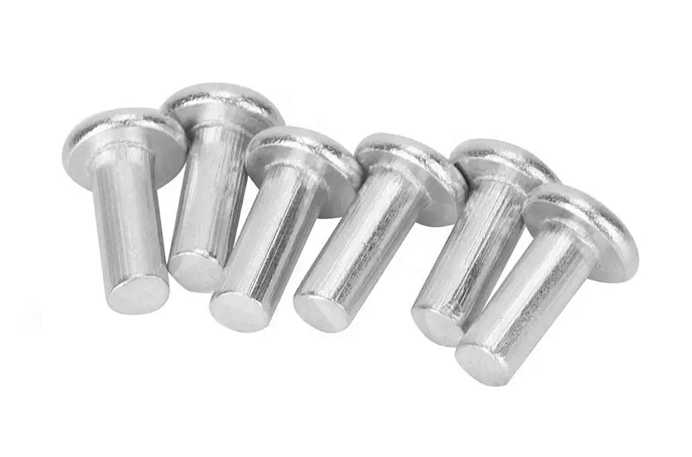
Solid rivets are the oldest and simplest rivet design: a solid metal shaft with a head. They’re installed by placing the rivet in a hole and deforming the tail with a hammer, rivet gun, or hydraulic squeezer while a bucking bar backs up the other side.
Because there’s no hollow section or mandrel, solid rivets are the strongest and most reliable rivet type — which is why they remain the standard fastener in aircraft structures. A single commercial airliner can contain over a million solid rivets. Aerospace solid rivets are manufactured to strict MIL-spec and NAS/AN standards, with material and head style encoded in the part number.
- Installation: requires access to both sides of the joint
- Strength: highest of any rivet type; excellent shear and fatigue resistance
- Typical uses: aircraft fuselages and wings, structural steelwork, bridges, military hardware
Best for: maximum-strength structural joints where both sides are accessible.
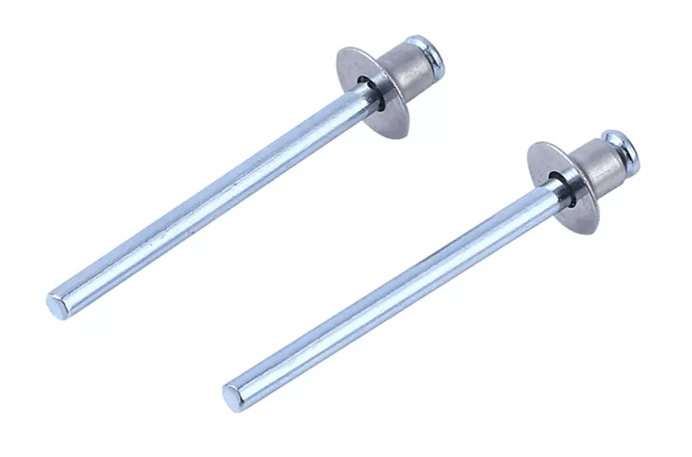
2. Blind Rivets (Pop Rivets)
Blind rivets — widely known by the trade name “pop rivets” — are the most commonly used rivet type today. Their defining advantage: they install entirely from one side of the workpiece, no access to the back required.
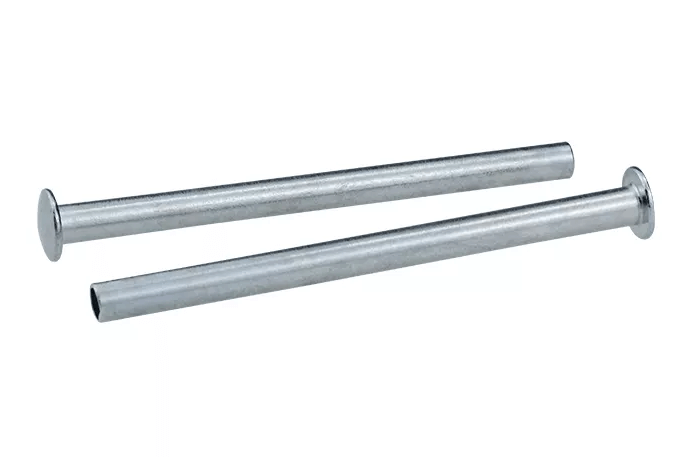
A blind rivet is a hollow rivet body assembled on a metal mandrel. A rivet gun grips the mandrel and pulls it; the mandrel head expands the rivet body against the blind side of the material until the mandrel snaps off with a characteristic “pop.”
Blind rivets come in several sub-types:
- Open-end – the standard, economical general-purpose version
- Closed-end (sealed) – a cup-shaped body that seals against liquid and gas; used in marine, gutter, and tank applications
- Multi-grip – accommodates a wide range of material thicknesses with one rivet size
- Structural blind rivets – locking mandrel designs (e.g. Monobolt, Hemlok styles) that retain the mandrel for much higher shear and tensile strength
- Tri-fold / peel type – splits into wide legs on the blind side for soft or brittle materials like plastics and fiberglass
- Installation: one-sided, with a hand, cordless, or pneumatic rivet gun
- Strength: moderate; structural versions approach solid-rivet performance
- Typical uses: sheet metal work, HVAC ducting, automotive panels, trailers, signage, DIY repairs
Best for: fast fastening when you can only reach one side of the joint — the default choice for most sheet-metal and general-purpose work.
3. Tubular and Semi-Tubular Rivets
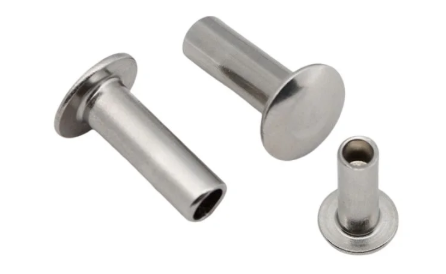
Semi-tubular rivets look like solid rivets but have a shallow hole drilled into the tail end. That hollow tip is the key: during installation, only the thin walls of the tail roll outward, so setting the rivet requires roughly 25% of the force needed for a comparable solid rivet.
The rolled clinch also acts like a smooth pivot, which is why semi-tubular rivets are the classic choice for joints that need to rotate — pliers, scissors, folding hardware, and brake shoes. Full tubular rivets have a deeper hole, can punch through soft materials themselves, and suit thicker or softer stack-ups like leather and plastics.
- Installation: compression set with a rivet setter or press; both sides accessible
- Strength: good; close to solid rivets in shear once set
- Typical uses: brake linings, clutch facings, hinges and pivots, lighting fixtures, ladders, leather goods, electronics
Best for: high-volume production and pivot joints where low setting force matters.
4. Split Rivets (Bifurcated Rivets)
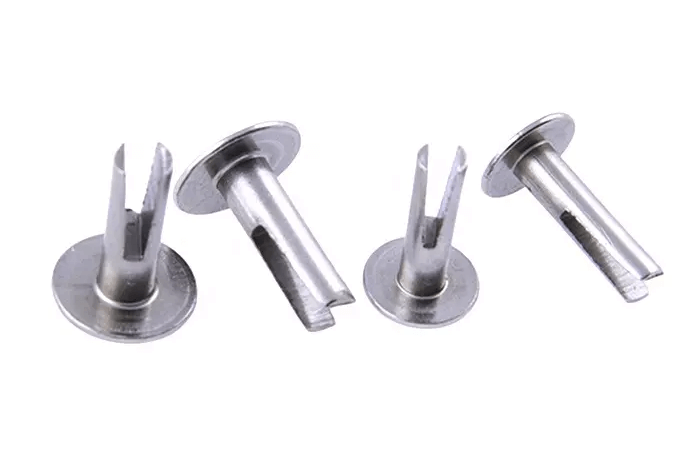
Split rivets have a sawed or split tail that forms two legs. Driven into soft material, the legs pierce through and fold outward on the back side to grip the material — often without a pre-drilled hole.
The prongs make split rivets unsuitable for metals or structural loads, but perfect for soft, fibrous materials.
- Installation: hammer-driven or set with a splitting tool; self-piercing in soft materials
- Strength: low; not for load-bearing joints
- Typical uses: leather belts and bags, wood, canvas, textiles, plastics, bookbinding
Best for: leather, fabric, and wood projects where a clean, low-force fastening is needed.
5. Flush Rivets (Countersunk Rivets)
Flush rivets use a countersunk head that sits inside a matching countersunk hole, leaving the finished surface completely smooth. They’re technically a head style applied to solid or blind rivets, but they’re used distinctly enough to treat as their own category.
The smooth exterior surface reduces aerodynamic drag, which is why flush riveting is standard on aircraft skins and appears on high-speed vehicles and anywhere a snag-free or cosmetic surface is required.
- Installation: requires countersinking or dimpling the hole first; otherwise set like a solid or blind rivet
- Strength: comparable to the underlying rivet type
- Typical uses: aircraft exterior skins, race cars, boats, architectural panels, consumer products
Best for: surfaces that must stay smooth for aerodynamic or aesthetic reasons.
6. Drive Rivets
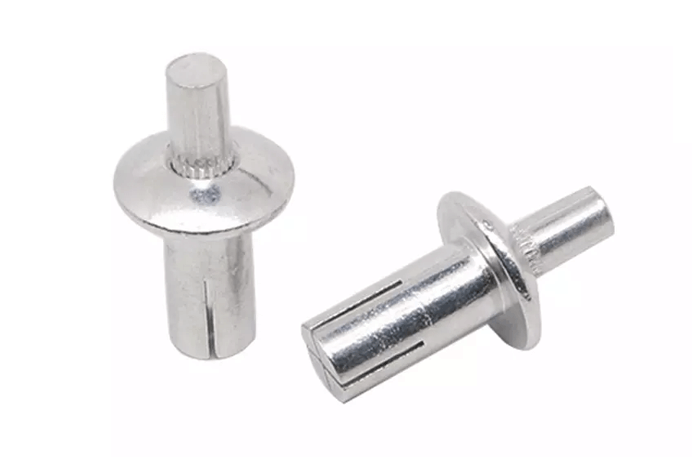
Drive rivets are blind rivets with a short protruding pin instead of a full-length mandrel. Insert the rivet in the hole, strike the pin with a hammer, and the pin drives inward, flaring the rivet body against the hole walls.
They don’t produce as strong a clamp as pulled blind rivets, but they need no special tool — just a hammer — and only shallow blind-side clearance.
- Installation: one-sided, hammer only
- Strength: low to moderate; grips the hole rather than clamping a wide area
- Typical uses: nameplates, signs, wall anchoring in masonry, decorative trim, plastic housings
Best for: quick tool-free fastening of signs, plates, and trim.
7. Self-Piercing Rivets (SPR)
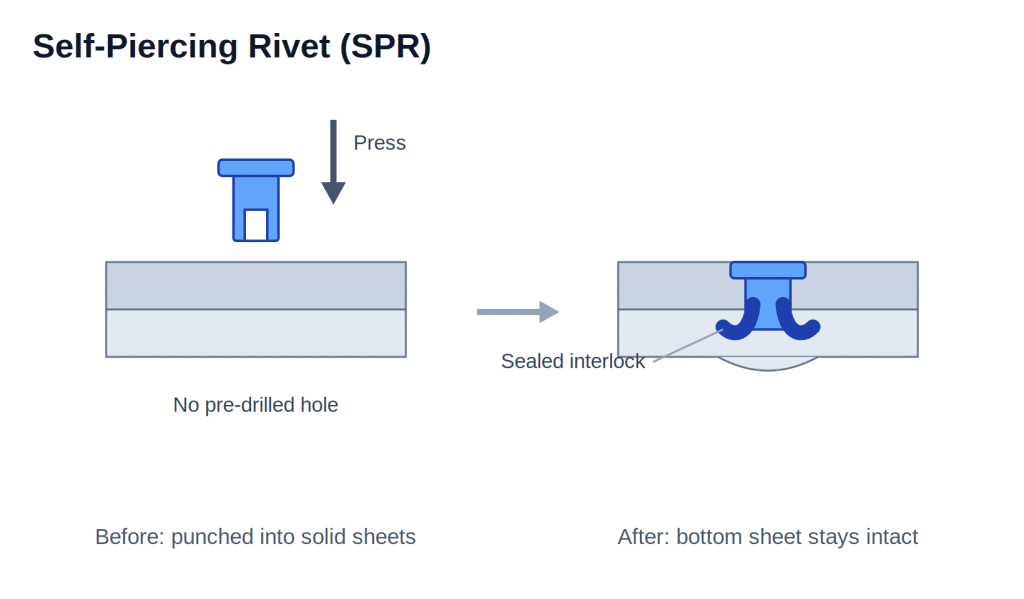
Self-piercing rivets need no pre-drilled hole at all. A hydraulic or servo-driven press punches the semi-tubular rivet through the top sheet; the rivet then flares inside the bottom sheet without breaking through it, forming a sealed, button-shaped interlock.
SPR technology has become a cornerstone of modern automotive manufacturing — especially for aluminum body structures that are difficult to spot-weld and for joining dissimilar materials like aluminum to high-strength steel.
- Installation: machine press only; not a hand-tool process
- Strength: high; excellent fatigue performance, watertight joint
- Typical uses: automotive body-in-white assembly, EV battery enclosures, appliances, mixed-material joining
Best for: high-volume production joining of sheet materials, especially dissimilar metals.
8. Rivet Nuts (Threaded Inserts)
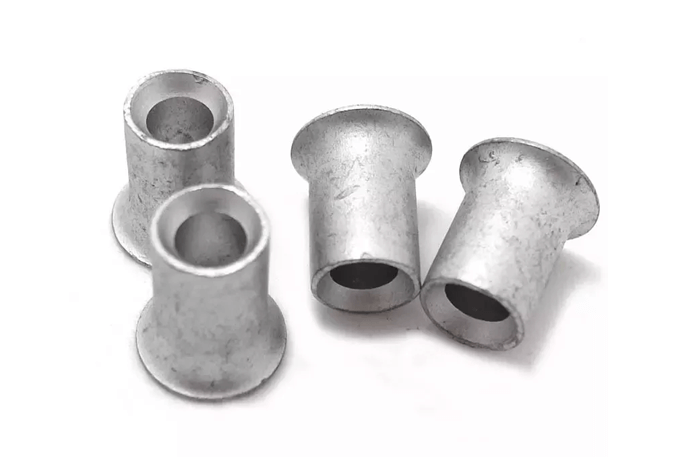
Rivet nuts (also called rivnuts or blind nuts) are one-piece internally threaded inserts that install like a blind rivet. Once set, they provide strong machine threads in panels too thin to tap — and unlike a rivet, they create a removable fastening point for bolts or screws.
Well nuts are a related rubber-bodied version that adds sealing and vibration isolation.
- Installation: one-sided, with a rivet nut tool
- Strength: depends on thread size; provides reusable threads rather than a permanent joint
- Typical uses: mounting accessories to sheet metal, automotive interiors, bicycle frames, electronics enclosures
Best for: adding strong, reusable threads to thin-walled material.
Rivet Head Types
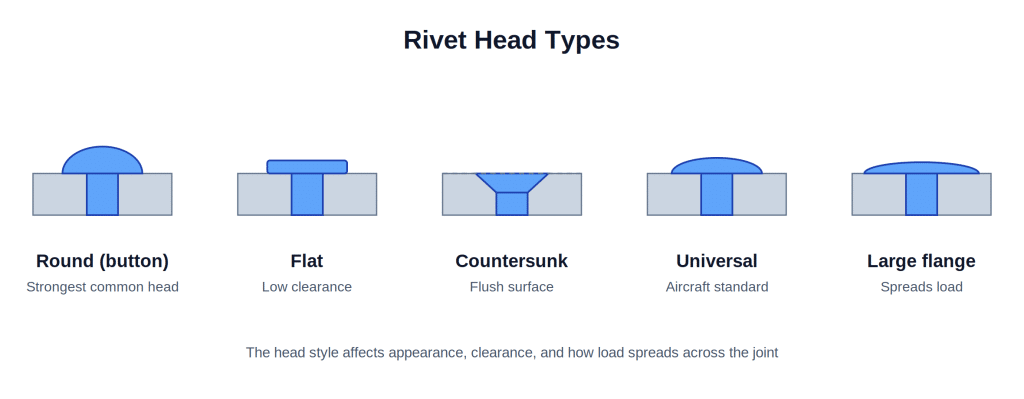
Beyond the body style, rivets come in several head shapes. The head affects both appearance and load distribution:
| Head type | Profile | Best use |
|---|---|---|
| Round (button) head | Domed, protruding | General purpose; strongest common head |
| Flat head | Low, flat top | Softer look, lower clearance |
| Countersunk (flush) head | Angled, sits in the hole | Smooth finished surfaces |
| Universal head | Compromise dome | Aircraft standard for non-flush joints |
| Large flange head | Extra-wide flange | Soft or brittle materials needing load spread |
Rivet Materials Compared
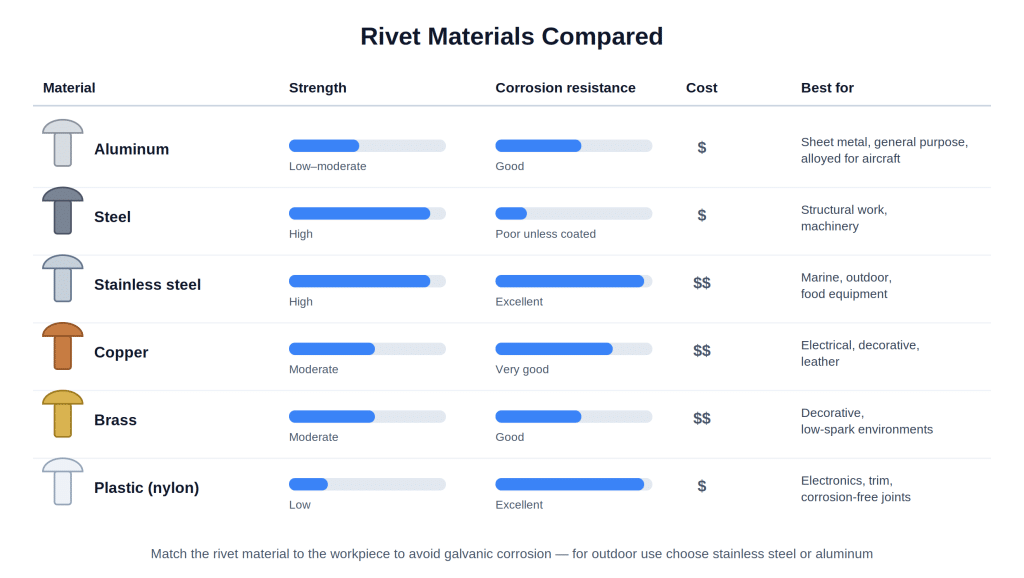
Rivet material determines strength, corrosion resistance, and compatibility with your workpiece. As a rule, match the rivet material to the material being joined to avoid galvanic corrosion.
| Material | Strength | Corrosion resistance | Cost | Common applications |
|---|---|---|---|---|
| Aluminum | Low–moderate | Good | Low | Sheet metal, general purpose, aircraft (alloyed) |
| Steel | High | Poor (unless coated) | Low | Structural work, machinery |
| Stainless steel | High | Excellent | Moderate | Marine, outdoor, food equipment |
| Copper | Moderate | Very good | Moderate | Electrical, decorative, leather |
| Brass | Moderate | Good | Moderate | Decorative, low-spark environments |
| Plastic (nylon) | Low | Excellent | Low | Electronics, trim, corrosion-free joints |
Strongest option for metal joints: structural steel or stainless steel rivets — solid rivets for ultimate strength, structural blind rivets when you only have one-sided access.
Best for outdoor use: stainless steel first, aluminum second. Avoid plain steel unless it’s zinc-plated, and avoid mixing dissimilar metals (e.g. steel rivets in aluminum sheet) in wet environments.
How to Choose the Right Rivet
Work through these five questions:
- Can you access both sides of the joint? One side only → blind rivet, drive rivet, or rivet nut. Both sides → solid, tubular, or split rivets become options.
- What are you joining? Structural metal → solid or structural blind rivets. Thin sheet → standard blind rivets or SPR. Leather, fabric, wood → split or tubular rivets. Need threads → rivet nut.
- How much strength does the joint need? Rank, roughly: solid > self-piercing > structural blind > semi-tubular > standard blind > drive > split.
- What’s the environment? Outdoor or marine → stainless steel or aluminum, sealed (closed-end) bodies for watertightness.
- What tools and volume? Hammer only → drive or split rivets. Hand rivet gun → blind rivets. Production line → semi-tubular or SPR with press equipment.
Sizing tip: rivet diameter should be roughly 3× the thickness of the thickest sheet being joined, and the hole should be just 0.1 mm or so larger than the rivet body. Check the rivet’s grip range against your total material thickness — too short and it won’t clinch; too long and the joint will be loose.
Rivets vs. Other Fastening Methods
Rivets vs. welding: Welding produces stronger, seamless joints in compatible metals but requires skilled labor, heat (which can warp thin sheet), and similar materials on both sides. Rivets are faster, cheaper, need no power at the joint, work across dissimilar materials, and are easier to inspect — each rivet either holds or it visibly doesn’t.
Rivets vs. screws and bolts: Threaded fasteners are removable and adjustable but loosen under vibration without thread-lockers. Rivets are permanent, lighter, cheaper per joint, install faster in volume, and never back out. Choose bolts where you’ll need disassembly; choose rivets where you won’t.
FAQ
Which rivet is the most commonly used? The blind rivet (pop rivet) is by far the most common. Its one-sided installation, low cost, and simple hand tooling make it the default for sheet metal, construction, automotive repair, and DIY work.
What are the strongest rivets for metal? Solid rivets made of steel or stainless steel are the strongest, which is why aircraft and structural steelwork rely on them. If you only have single-side access, structural blind rivets with locking mandrels are the strongest one-sided option.
What are the three main types of rivets? Most classifications start with three core families: solid rivets, blind (pop) rivets, and tubular rivets. Split, flush, drive, self-piercing rivets and rivet nuts are specialized designs built on those foundations.
Do rivets work on leather and fabric? Yes — use split rivets, double-cap tubular rivets, or copper burr rivets rather than metal-working rivets. They set with low force and won’t tear soft materials.
Can you remove a rivet? Rivets are permanent, but they can be destroyed for removal: drill into the head with a bit matching the rivet diameter until the head pops off, then punch out the shank. The rivet cannot be reused.
The right rivet comes down to three things: which sides of the joint you can reach, what materials you’re joining, and how much load the joint must carry. Blind rivets cover most everyday jobs; solid rivets rule structural and aerospace work; tubular, split, drive, and self-piercing designs each own their niche; and rivet nuts bridge the gap between riveting and threaded fastening. Match the material to your workpiece, size the rivet to your stack-up, and a riveted joint will outlast almost any alternative.
