

 EU
EU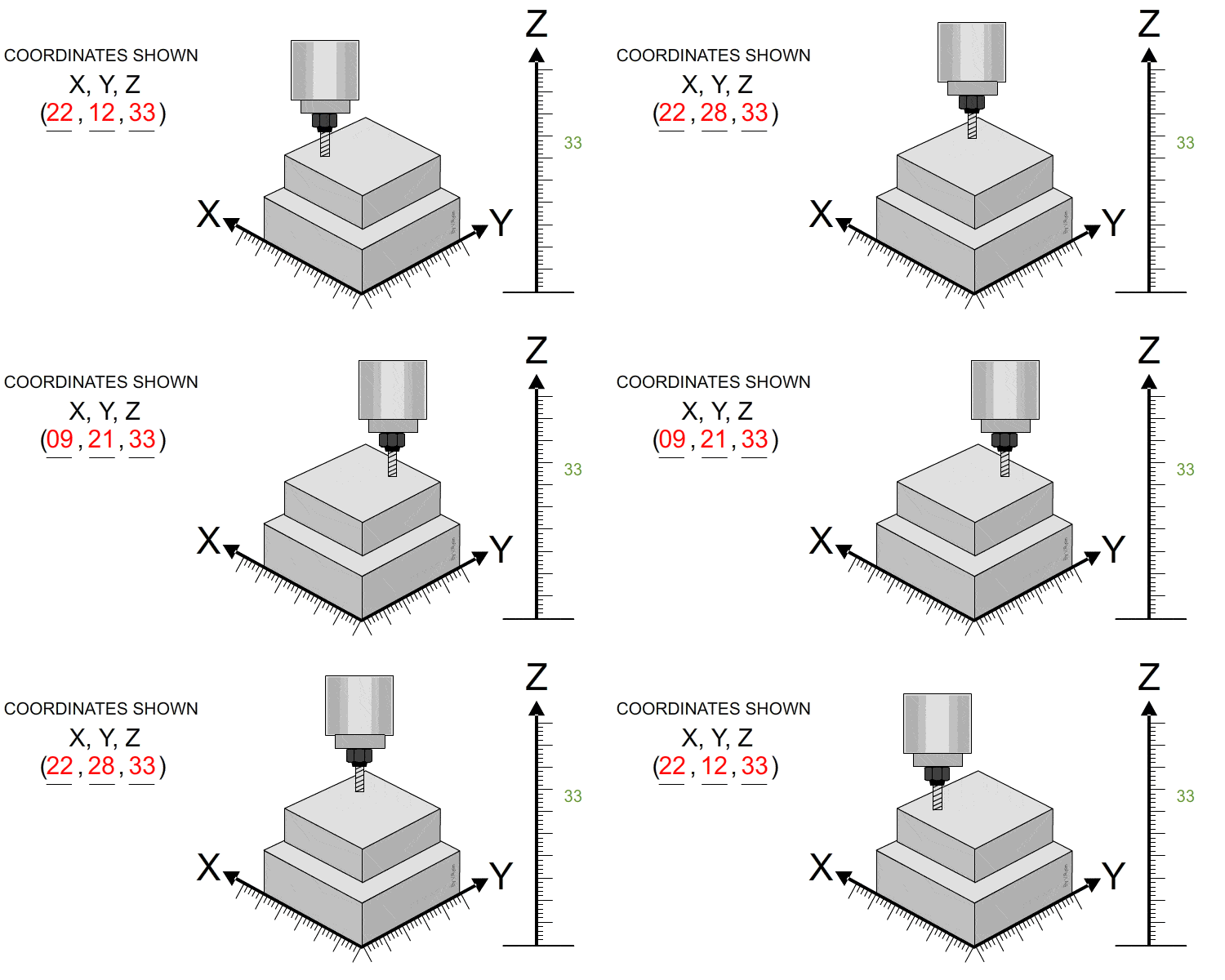
What Does CNC Mean?
CNC stands for Computer Numerical Control. It refers to the automated operation of machining tools using pre-programmed computer software embedded within a dedicated machine controller. The controller translates digital designs into precise tool movements, replacing manual machining with repeatable, computer-driven accuracy. CNC technology is the foundation of modern manufacturing, used across industries to produce complex parts with extreme precision.
You design a part in CAD software. CAM software converts that design into G-code. The CNC machine reads the G-code and moves the cutting tool along exact paths to remove material from a solid block. The result is a finished part with precise dimensions and tight tolerances. This manufacturing process eliminates human error and delivers consistent results from the first part to the last.
No manual handwheels. No operator guiding each cut by hand. The CNC system handles the motion, speed, feed rate, and tool changes automatically.
Quick Overview
| Full Name | Computer Numerical Control |
| Process Type | Subtractive Manufacturing (material removal) |
| Programming Language | G-code & M-code |
| Input | CAD/CAM digital design files |
| Predecessor | NC (Numerical Control, punched tape) |
| Common Materials | Metals, plastics, wood, composites |
| Key Industries | Aerospace, automotive, medical, electronics |
How Does the CNC Process Work?
The CNC process follows a digital-to-physical workflow. A part starts as a design file and ends as a finished component through a series of automated steps.

Step 1: CAD Design
The process begins with a 3D digital model created in CAD (Computer-Aided Design) software. The model defines the part geometry, dimensions, and tolerances. Common CAD programs include SolidWorks, Inventor, and Fusion 360.
Step 2: CNC Programming
CAM (Computer-Aided Manufacturing) software takes the 3D digital model and generates toolpaths. The CNC programmer selects cutting tools, defines spindle speeds, feed rates, depths of cut, and machining sequences. The software processes these parameters into a set of digital instructions the CNC system can execute. This is the core of CNC programming, where every movement and operation is defined before the machine starts cutting.
Step 3: G-code and M-code Generation
The CAM software converts the toolpaths into G-code and M-code, the standard computer code that drives CNC equipment. G-code controls tool movement, positioning, and feed rates. M-code handles auxiliary functions like spindle on/off, coolant on/off, and tool changes. Together, they form the pre-programmed computer software that tells the CNC controller exactly what to do at every point in the machining process.
Step 4: Machine Setup
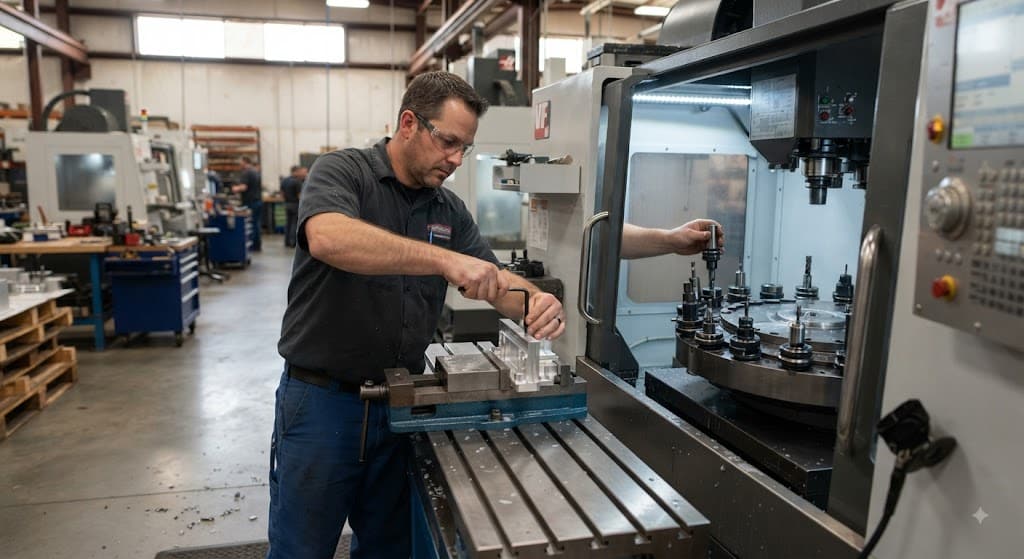
The CNC machinist clamps the raw stock material into a vise or fixture on the machine bed. Cutting tools are loaded into the tool carousel. The operator sets the work coordinate system and zeroes the tool offsets. This step ensures the machine knows exactly where the material is and where to start cutting.
Step 5: Machining
The CNC controller reads the G-code line by line and sends digital instructions to servo or stepper drives. These drives move the cutting tool along the X, Y, and Z axes following the programmed toolpath. The spindle rotates the cutting tool (in milling) or the workpiece (in turning). Material is removed layer by layer until the final shape is reached. Coolant flows during cutting to manage heat and chip evacuation.
Step 6: Quality Control
After machining, the part goes through quality control. It is measured against the design specifications. Common inspection tools include calipers, micrometers, CMM (Coordinate Measuring Machines), and surface roughness testers. Parts that fall outside tolerance are rejected or reworked.
Types of CNC Machines
CNC Milling Machine
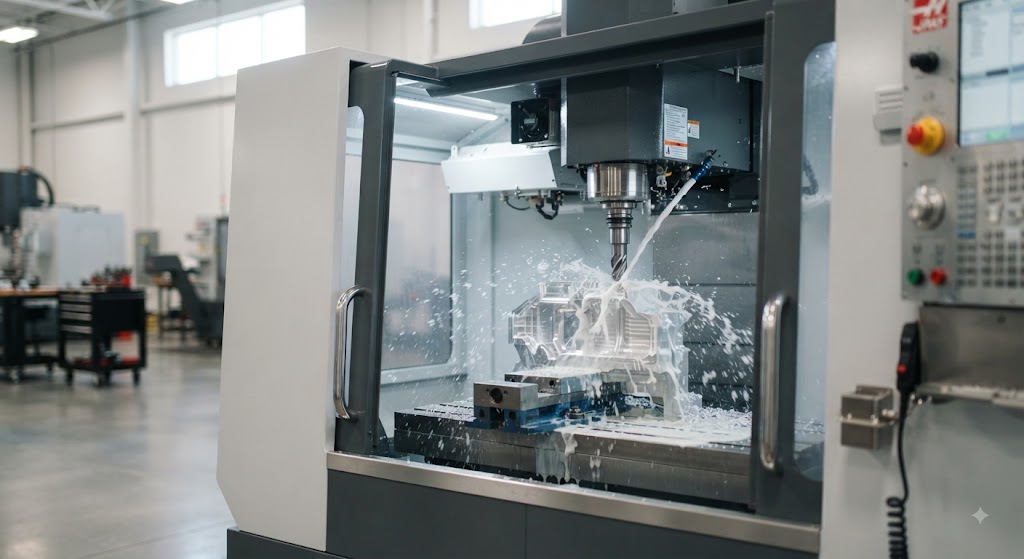
A CNC mill uses rotating multi-point cutting tools to remove material from a stationary workpiece. The tool moves along 3 to 5 axes to cut flat surfaces, slots, pockets, and complex 3D contours. CNC milling is the most common CNC process. CNC mills handle everything from simple brackets to multi-feature aerospace components. Available in vertical (VMC) and horizontal (HMC) configurations.
CNC Lathes (Turning Center)
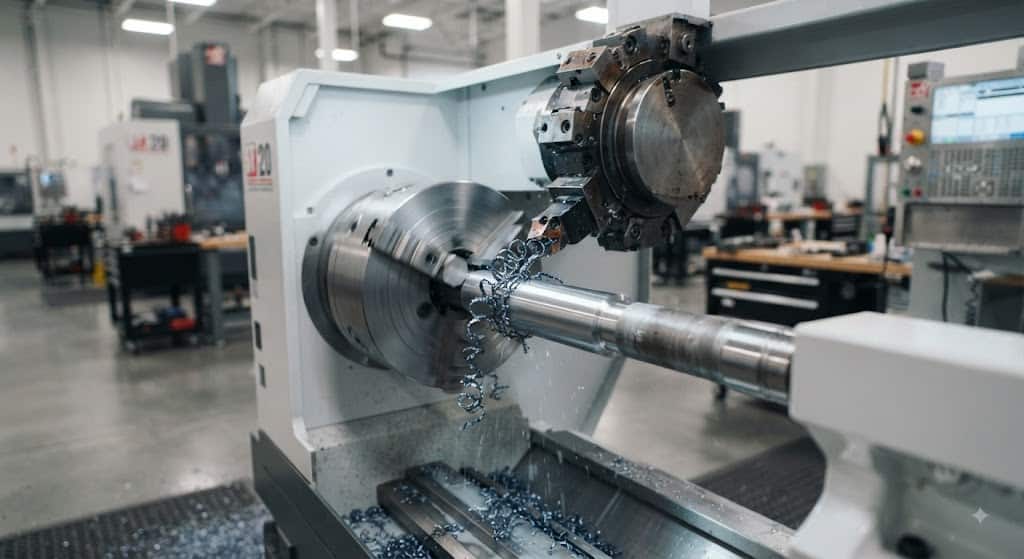
A CNC lathe rotates the workpiece against a stationary single-point cutting tool to form symmetrical cylindrical parts. CNC turning produces shafts, pins, bushings, and threaded fasteners. Modern CNC lathes with live tooling can also perform milling, drilling, and tapping without moving the part to a second machine.
CNC Drilling Machine
CNC drilling machines create precise holes at programmed locations, depths, and angles. They are widely used in PCB manufacturing, large structural plates, and any application that requires high-volume hole-making with repeatable accuracy.
CNC Grinding Machine
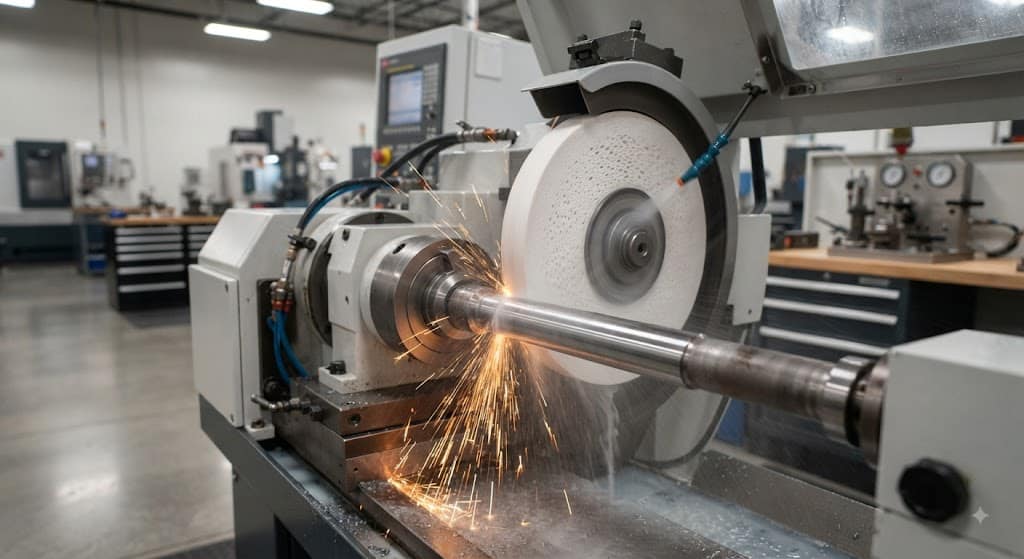
CNC grinders use abrasive wheels to achieve tight tolerances and fine surface finishes. They are used for finishing hardened steel parts, bearing races, tool inserts, and precision shafts where surface roughness below Ra 0.4 μm is required.
CNC Routers
CNC routers are high-speed spindle machines designed for high-feed cutting of softer materials like wood, plastic, foam, and aluminum sheet. They work on larger workbeds than CNC mills and are common in signage, cabinetry, furniture, and panel fabrication.
CNC EDM (Electrical Discharge Machine)
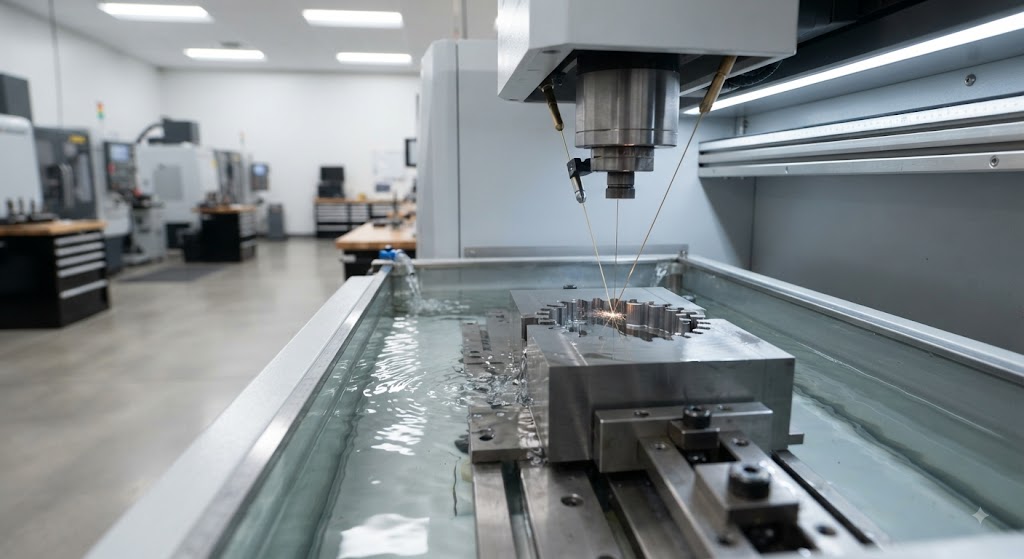
EDM uses controlled electrical sparks to erode material from ultra-hard metals or cut delicate features. Wire EDM cuts complex shapes and 2D profiles in hardened metals. Sinker EDM creates cavities for mold and die tooling. EDM handles materials that are too hard for conventional cutting tools.
CNC Plasma Cutters
CNC plasma cutters use a high-temperature plasma arc to cut through steel, stainless steel, and aluminum plate. They are used for heavy plate cutting in structural fabrication, shipbuilding, and construction.
CNC Laser Cutter
CNC laser cutters use a focused laser beam to cut or engrave thin sheet metal, plastic, and wood. They produce clean edges with minimal heat-affected zones. Common applications include sheet metal fabrication, signage, and electronics enclosures.
CNC Waterjet Cutter
CNC waterjet cutters use a high-pressure stream of water mixed with abrasive particles to cut through metal, stone, glass, and composites. Waterjet is a cold cutting process. It produces no heat-affected zone, making it ideal for heat-sensitive materials that would warp or harden under thermal cutting methods.
5-Axis CNC Machine
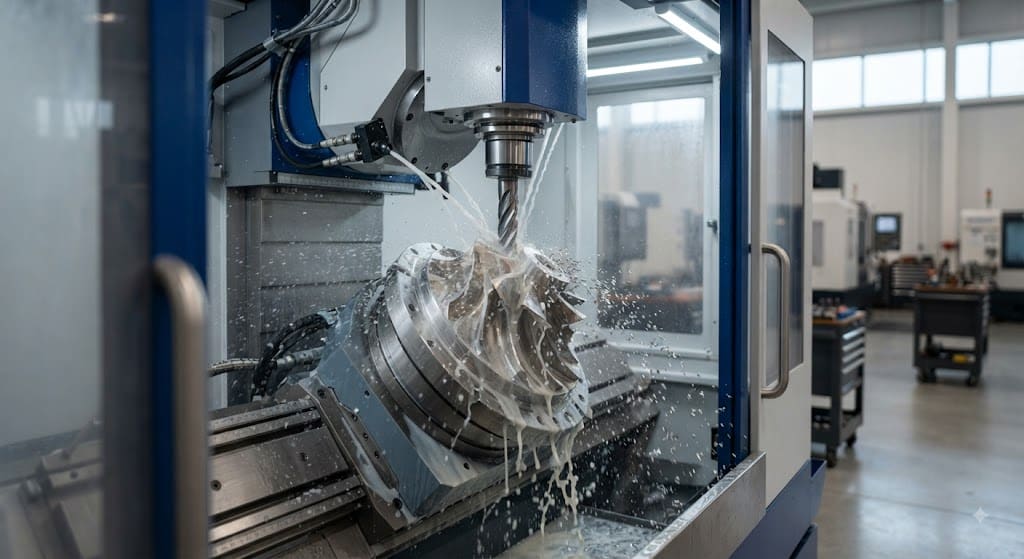
A 5-axis CNC machine moves the cutting tool or workpiece along multiple axes simultaneously. This allows machining of complex, curved surfaces in a single setup. It is used for turbine blades, impellers, medical implants, and aerospace structural parts where multi-angle access is required.
Benefits of CNC Machining
High Precision and Tight Tolerances
CNC machines follow programmed toolpaths with positioning accuracy down to ±0.0005 inches (±0.0127 mm). Every cut follows the exact same coordinates. This level of extreme precision is critical for aerospace components, medical implants, and electronic housings where even a small deviation causes part failure.
Repeatability
The first part and the thousandth part come out identical. Once the program is verified, the machine reproduces the same dimensions on every cycle. Manual machining depends on operator skill and fatigue, which introduces human error. CNC does not.
Faster Production Speed and Continuous Operation
CNC machines run at high spindle speeds and feed rates, boosting production speed significantly. They perform multiple operations in a single setup. Multi-axis machines can mill, drill, and tap a part without repositioning. CNC equipment also runs 24/7 with minimal operator intervention, pausing only for tool changes or routine maintenance. This cuts cycle time and boosts throughput compared to manual methods.
Reduced Labor Dependency
One operator can monitor multiple CNC machines simultaneously. The machine handles the cutting, tool changes, and coolant flow on its own. This lowers labor costs per part and reduces the impact of workforce shortages.
Complex Shapes and Geometry
3-axis, 4-axis, and 5-axis CNC machines produce compound curves, deep pockets, undercuts, and internal features that are difficult or impossible to cut by hand. These complex shapes require multiple axes of movement. A 5-axis machine can reach nearly any surface of a part in a single setup, eliminating multiple repositioning steps. This capability makes CNC machining essential for producing intricate parts across aerospace, medical, and automotive sectors.
Material Versatility
CNC machining works across a wide range of materials with different material properties. Aluminum, steel, titanium, brass, copper, engineering plastics like PEEK and Delrin, and even wood and composites. The same machine handles different materials by adjusting tooling, speeds, and feeds.
Less Material Waste
CAM software optimizes toolpaths to minimize unnecessary cuts and reduce material waste. Nesting strategies make efficient use of raw stock. Compared to manual machining, CNC generates less scrap and lowers material costs over long production runs.
What Can You Do with a CNC Machine?
CNC machining has a wide range of industrial applications. Here are the key industries that rely on it.
Aerospace and Defense
CNC machines produce turbine blades, engine components, structural brackets, landing gear parts, and satellite hardware. These components require tight tolerances, complex designs, and high-strength materials like titanium and Inconel. Multi-axis CNC machining handles these demands consistently across production runs.
Automotive
Engine blocks, transmission cases, brake components, suspension parts, and custom interior trim all rely on CNC machining. The automotive industry needs high-volume repeatability with consistent quality. CNC delivers both for prototype development and mass production.
Medical and Dental
Surgical instruments, orthopedic implants, bone screws, dental crowns, and prosthetic components are CNC machined from biocompatible materials like titanium, medical-grade stainless steel, and PEEK. The tolerances on these intricate parts are extremely tight because they must fit the human body precisely.
Electronics
CNC machines produce heat sinks, enclosures, connectors, mounting brackets, and PCB drilling. Aluminum and copper are common materials. Parts are small, features are fine, and dimensional accuracy is critical for proper assembly and thermal management.
Mold and Die Making
Injection mold cavities, cores, metal stamping dies, and die casting tooling are all CNC machined. These factory tools require mirror-like surface finishes and micron-level accuracy because any error in the mold transfers directly to every part it produces.
Rapid Prototyping
Engineers use CNC machining to produce complex parts and functional prototypes from production-grade materials. Unlike 3D printing, CNC prototypes match the material properties of the final part. This allows real-world testing before committing to full production tooling.
General Industrial
Fixtures, jigs, shafts, gears, hydraulic manifolds, valve bodies, and custom brackets are everyday CNC work. Components machined from engineering plastics like Delrin, PTFE, and carbon fiber composites are also common in industrial automation and chemical processing equipment. Any industry that needs precision metal or plastic parts relies on CNC machining for its industrial applications.
History of CNC Technology
1940s-1950s: Numerical Control Is Born
The concept of numerical control (NC) started in the late 1940s. John T. Parsons and Frank Stulen at the MIT Servomechanisms Laboratory developed a system that used punched paper tape to control machine movements. The U.S. Air Force funded the project to produce complex helicopter rotor blade contours that were impossible to machine manually. By 1952, MIT demonstrated the first working NC milling machine. The technology was patented in 1958. Early NC was expensive and limited to defense and aerospace contractors.
1960s: Digital Computers Enter the Picture
Digital computers began replacing analog systems. Electronic program storage simplified CNC programming and eliminated much of the manual coordinate calculation required by punched tape. NC machines spread beyond military applications into commercial manufacturing. Computer-aided design systems also began to emerge in basic form during this period.
1970s-1980s: The Birth of Modern CNC
Microprocessors were integrated directly into CNC controllers. This was the shift from NC to true Computer Numerical Control. Programs could now be stored, edited, and reused digitally. Hardware costs dropped significantly, making CNC systems accessible to smaller shops. In 1976, the first CAD systems became available to create 3D models for generating machine G-code. CAM software followed shortly after. Engineers could design a part on screen and generate toolpaths automatically, eliminating manual G-code writing for most applications. By 1989, CNC machining had become the standard for large-volume manufacturing.
1990s: Multi-Axis and High-Speed Machining
5-axis CNC machines entered mainstream production. High-speed machining (HSM) pushed spindle speeds and feed rates far beyond previous limits. Automatic tool changers, pallet systems, and robotic loading became common. Manufacturers could run lights-out operations with minimal human intervention.
2000s to Present: Smart Manufacturing
CNC machines now integrate with IoT sensors, real-time monitoring, and adaptive control systems. Machine learning algorithms optimize cutting parameters on the fly. Digital twins simulate the CNC process before cutting begins. CNC technology continues to evolve as a core pillar of Industry 4.0.
CNC vs. NC: What’s the Difference?
CNC (Computer Numerical Control) and NC (Numerical Control) both automate machine tool movements using pre-programmed instructions. The core difference is how those instructions are stored and processed.
NC machines read instructions from punched paper tape or cards. The program runs in a fixed sequence. If you need to change a dimension or toolpath, you punch a new tape. There is no on-board memory. No editing capability. Every modification requires physical media replacement.
CNC machines store programs digitally in an on-board computer. Operators can edit, copy, and reuse programs directly on the machine controller. Changes take seconds, not hours. The computer also enables features that NC cannot support: tool compensation, canned cycles, subroutine calls, and real-time error correction through closed-loop feedback systems.
Key Differences at a Glance
| Feature | NC | CNC |
|---|---|---|
| Control System | Hardwired circuits reading punched paper/plastic tape | Integrated microcomputer running software programs |
| Program Storage | No internal memory | Solid-state memory, USB drives, and network integration |
| Editing | Requires punching a new physical tape | Edit directly on controller in seconds |
| Program Reusability | Not reusable | Programs saved, copied, and reused across jobs |
| Feedback System | Open-loop (no correction) | Closed-loop (real-time servo feedback) |
| Complexity | Simple, repetitive operations | Complex multi-axis operations |
| Accuracy | Lower (no position feedback) | Higher (servo feedback with real-time correction) |
| Operator Skill | Higher skilled operator required | Lower skill threshold with computer interface |
| Cost | Lower machine cost, higher maintenance | Higher machine cost, lower maintenance and per-part cost |
