

 EU
EUAlodine and Anodizing are two of the most common surface finishes for aluminium parts in CNC machining, aerospace, and electronics. Many engineers confuse the two and end up choosing the wrong one. This leads to wasted costs, failed conductivity, or premature wear.
The core difference comes down to process: Anodizing is an electrochemical process that builds a durable oxide layer, while Alodine (Chem Film) is a chemical conversion coating applied without electric current.
Quick Comparison Table: Alodine vs. Anodize
| Feature | Alodine (Chem Film) | Anodizing (Type II / Type III) |
|---|---|---|
| Process Type | Chemical conversion | Electrochemical oxidation |
| Military Spec | MIL-DTL-5541 | MIL-A-8625 |
| Coating Thickness | 0.25 to 0.75 μm (negligible) | Type II: 5 to 25 μm; Type III: 25 to 100 μm |
| Electrical Conductivity | Conductive | Non-conductive (insulator) |
| Thermal Conductivity | Preserved | Reduced |
| Hardness | Soft, easily scratched | Type II: 200 to 400 HV; Type III: 400 to 700 HV |
| Wear Resistance | Poor | Excellent (high hardness) |
| Corrosion Resistance (ASTM B117) | 168 to 336 hours | 336 to 1,000+ hours |
| Colour Options | Gold, iridescent greenish-gold, or clear | Black, red, blue, green, gold, etc. |
| Impact on Tolerances | None | Requires pre-machining allowance |
| Processing Time | Minutes | 20 minutes to several hours |
| RoHS Compliance | Type II (yes), Type I (no) | Yes (Type II/III) |
| Relative Cost | Lower | Higher |
| Best For | Grounding, EMI shielding, paint base, tight tolerances | Wear resistance, decorative colour, outdoor durability |
What Is Alodine?
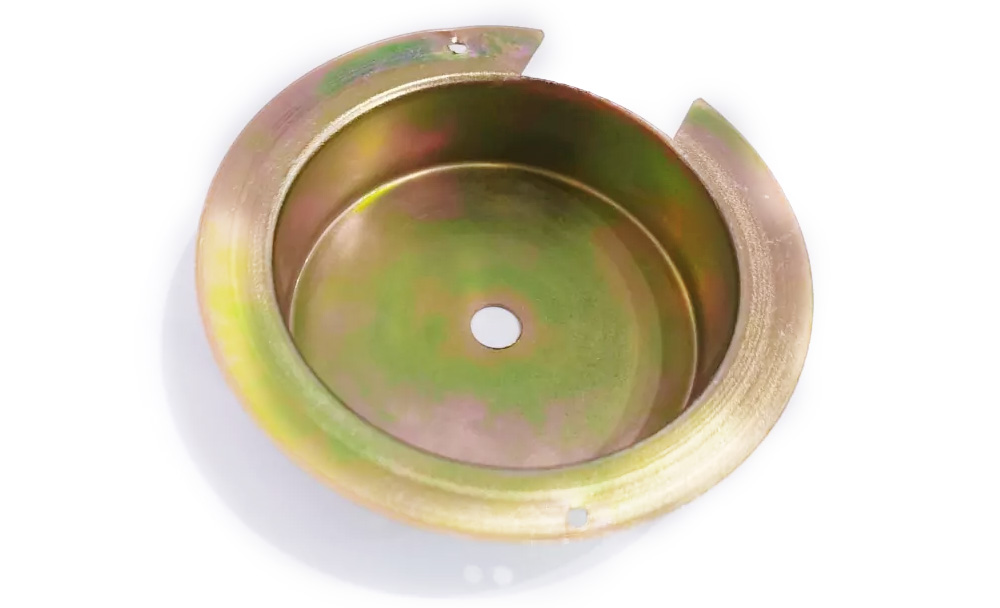
Alodine, also known as Chem Film or Chromate Conversion Coating, is a non-electrolytic chemical surface treatment for aluminium. It is a purely chemical immersion process. It reacts with the aluminum surface to form an ultra-thin, protective chromate film. The resulting film is extremely thin, typically 0.25 to 1 μm (about 0.00001 to 0.00004 inches).
Alodine coatings serve three main purposes: corrosion protection, electrical conductivity retention, and improved paint adhesion.
Pros
- Preserves Electrical & Thermal Conductivity: Excellent for electronic grounding and EMI/RFI shielding.
- Zero/Negligible Dimensional Impact: Film thickness is extremely thin, maintaining tight CNC machining tolerances.
- Cost-Effective & Fast Processing: Simple immersion process with short processing cycles and lower cost per part.
- Excellent Paint/Primer Base: Serves as an ideal prep layer for liquid paint or powder coating adhesion.
- Easy Touch-Up: Can be re-applied or repaired locally in the field using Alodine touch-up pens.
Cons
- Low Abrasion Resistance: Soft chemical layer easily scratches under physical wear or friction.
- Inferior Corrosion Protection Compared to Hard Anodize: Offers good corrosion resistance, but less durable in harsh environments than thick anodized layers.
- Limited Color Options: Typically only yields gold/iridescent yellow, or clear/transparent finishes.
What is Anodizing?
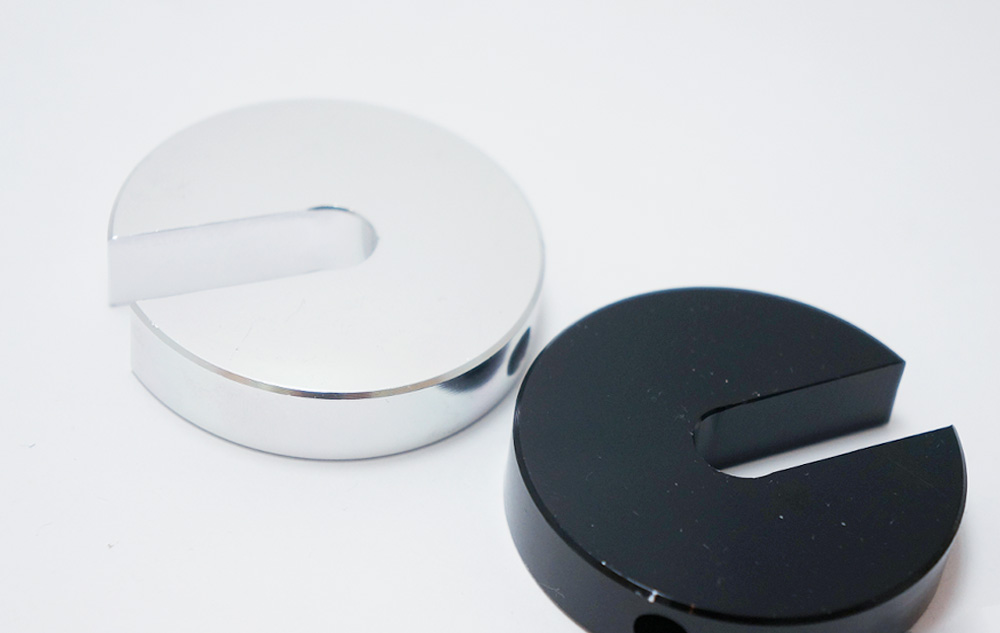
Anodizing is an electrochemical process that converts the aluminum surface into a decorative, durable, and corrosion-resistant aluminum oxide film.
In this process, the aluminum part is immersed in an acid electrolyte bath (usually sulfuric acid) and acts as the anode in an electrical circuit. Electric current passes through the bath, causing controlled oxidation that grows into the metal substrate rather than just plating on top.
Pros
- Exceptional Wear & Abrasion Resistance: Creates a hard ceramic-like oxide layer (Type III Hardcoat can reach up to 60-70 Rockwell C).
- Superior Corrosion Resistance: Fully seals the aluminum substrate against moisture, salt spray, and harsh chemicals.
- Versatile Aesthetic Options: The porous unsealed oxide layer can absorb organic dyes, offering vibrant colors (Black, Red, Blue, Gold, Clear, etc.).
- Durable Electrical Insulation: Acts as a natural dielectric insulator.
Cons
- Loss of Electrical Conductivity: Anodized aluminum becomes electrically non-conductive (insulative).
- Dimensional Growth: Adds measurable thickness (5–50+ µm depending on type), requiring pre-machining tolerance adjustments.
- Higher Cost & Complexity: Requires dedicated electrical equipment, higher power consumption, and longer processing times.
- Brittle Coating: Can craze or crack under heavy thermal expansion or fatigue flexing.
Differences Between Alodine and Anodizing
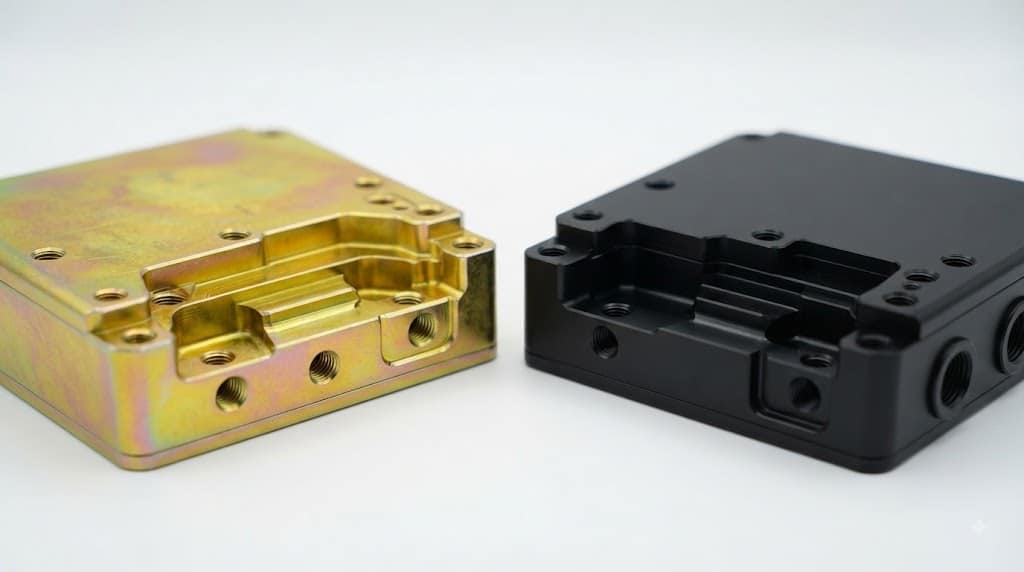
How it Works
Alodine is a purely chemical process. The aluminium part is dipped into a chromate solution at room temperature. The solution reacts with the surface and forms a thin chromium oxide film. No electricity is involved. The entire process takes just a few minutes from dip to dry.
Anodizing is an electrochemical process. The aluminium part is submerged in an acid electrolyte bath and connected as the positive electrode (anode). Direct current drives oxygen ions into the surface, growing a thick aluminium oxide layer from the metal itself.
Conductivity & EMI Shielding
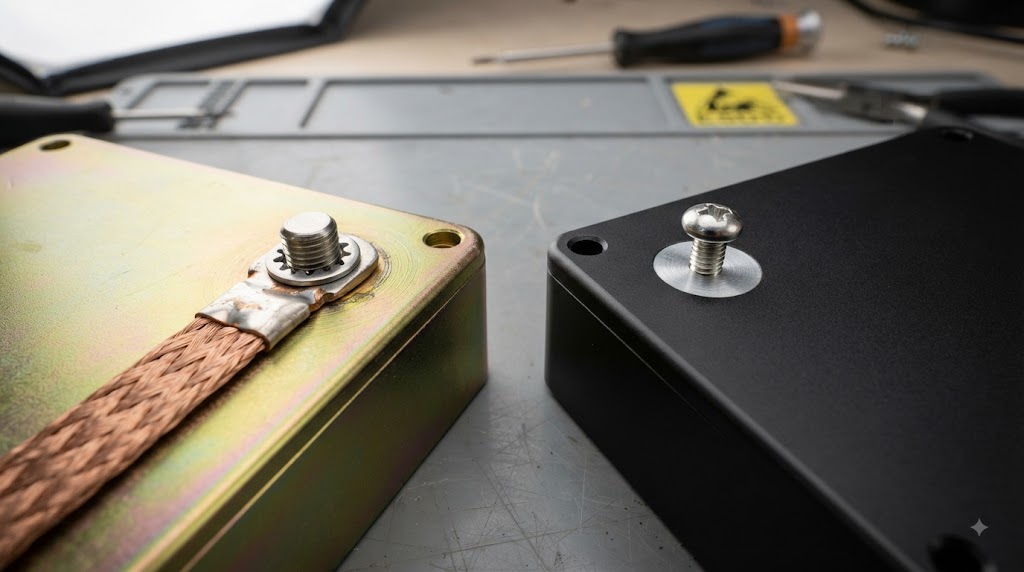
Alodine: Maintains high surface conductivity and low electrical contact resistance, making it the industry standard for grounding, bonding, and EMI shielding enclosures.
Anodize: Creates an insulating oxide layer. If electrical grounding is needed on an anodized part, specific contact areas must be masked off during plating or post-machined.
Dimensional Tolerance
Alodine: adds virtually zero thickness, typically 0.00001 to 0.00003 in (0.25 to 0.75 µm). Precision press-fits, fine threads, and tight geometric tolerances are unaffected. No tolerance compensation is needed.
Anodizing: adds noticeable thickness. The oxide layer grows in both directions from the original surface, roughly 33% to 50% outward and 50% to 67% inward depending on the anodizing type and process conditions. Type II typically adds 0.0002 to 0.0008 in per surface. Type III hard anodizing can add 0.001 to 0.002 in. Critical dimensions must be machined undersize before anodizing to hit final tolerances.
Wear Resistance and Hardness
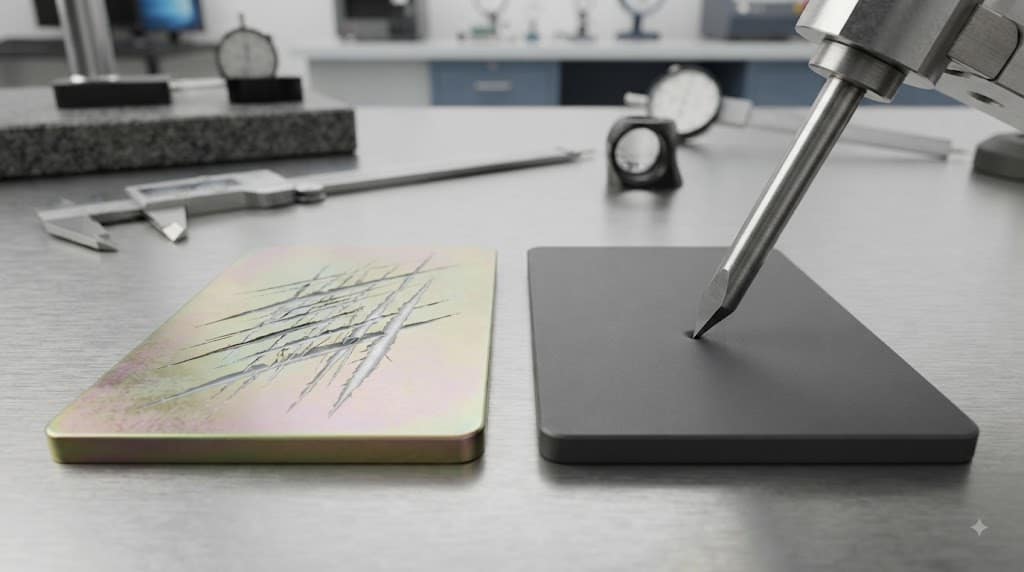
Alodine: offers almost no wear protection. The film is too thin and soft to resist scratching, sliding contact, or abrasion.
Anodizing: is far superior here. Type II produces a coating with hardness around 200 to 400 HV. Type III hard anodizing reaches 400 to 700 HV (approximately 60 to 70 HRC), harder than tool steel. For hydraulic cylinders, sliding guides, firearm components, or any high-friction application, anodizing is the only viable option.
Corrosion Resistance
Alodine: Provides solid indoor and moderate outdoor salt-spray resistance (typically up to 168 hours of salt spray testing per military standards).
Anodize: Superior long-term corrosion resistance, especially Type III or sealed Type II finishes (can exceed 336–1000+ hours of salt spray exposure).
Aesthetics and Colours
Alodine: offers very limited visual options. Type I (hexavalent chromium) produces a gold or iridescent yellow film. Type II (trivalent chromium) produces a clear or near-invisible finish. No dyeing is possible.
Anodizing: accepts a wide range of dye colours before sealing: black, red, blue, green, gold, purple, and more. Combined with surface textures like bead blasting or brushing before anodizing, it delivers full control over both colour and finish.
Cost
Alodine: costs less in almost every scenario. No power supply, no electrolyte bath, no sealing step. Processing is fast and equipment is minimal. For high-volume production where the finish only needs to provide corrosion protection or paint adhesion, Alodine is the most economical choice.
Anodizing: costs more. It requires specialised tanks, rectifiers, temperature control, and a separate sealing process. Custom colour dyeing adds further cost.
Processing Time
Alodine: Very fast. The entire cycle from cleaning to finished part takes minutes. Large batches can be processed in a single dip. This makes it ideal for quick-turn prototyping and high-volume production where turnaround matters.
Anodizing: Longer cycle times,Type II typically requires 20 to 60 minutes in the bath alone. Add racking, rinsing, dyeing, and sealing, and the total cycle extends further. Type III hard anodizing can take one to several hours depending on required thickness.
Environmental Compliance
Traditional Alodine (MIL-DTL-5541 Type I) uses hexavalent chromium, which is toxic and restricted under RoHS and REACH. Many manufacturers are shifting to trivalent chromium alternatives (Type II) to stay compliant.
Anodizing (Type II and Type III) uses sulphuric acid with no chromium compounds involved. For manufacturers exporting to Europe, anodizing is the cleaner choice.
Industry Standards and Specifications
Alodine: MIL-DTL-5541 (formerly MIL-C-5541)
- Type I: Hexavalent chromium. Traditional gold/brown appearance. Non-RoHS.
- Type II: Trivalent chromium. Clear/iridescent appearance. RoHS compliant.
- Class 1A: Maximum corrosion protection. Used as final surface or paint base.
- Class 3: Low electrical resistance. Used for grounding and electrical bonding.
Anodize: MIL-A-8625
- Type I: Chromic acid anodizing. Ultra-thin. Used for fatigue-critical aerospace parts.
- Type II: Sulphuric acid anodizing. Standard decorative and protective finish.
- Type III: Hard anodizing. Thick, highly wear-resistant industrial coating.
- Class 1: Non-dyed (natural colour).
- Class 2: Dyed (coloured).
Drawing callout examples:
Alodine: “CHEM FILM PER MIL-DTL-5541, TYPE II, CLASS 3”
Anodize: “ANODIZE PER MIL-A-8625, TYPE II, CLASS 2, BLACK”
Application

Use this reference guide to quickly determine the ideal finish for your aluminum parts:
| Industry / Component | Recommended Finish | Key Reason |
| Electronics & EMI Shielding Enclosures | Alodine (MIL-DTL-5541 Type II Class 3) | Requires electrical grounding and EMI shielding with zero dimensional change. |
| Optical & Consumer Electronics Housings | Anodize (MIL-A-8625 Type II, Black/Clear) | Requires premium cosmetic look, rich color choices, and scratch resistance. |
| High-Precision Mating CNC Parts & Threads | Alodine | Preserves exact machined dimensions and tight tolerances without thread binding. |
| Industrial Wear Plates & Sliding Components | Hard Anodize (MIL-A-8625 Type III) | Requires high surface hardness and maximum friction/wear resistance. |
| Under-Paint / Powder Coat Base Layer | Alodine (MIL-DTL-5541 Class 1A) | Provides optimal paint adhesion and prevents corrosion under scratched paint. |
| Outdoor Marine & Harsh Environment Structural Parts | Anodize (Type II or Type III, Sealed) | Maximum resistance to saltwater corrosion and harsh outdoor weathering. |
Can You Combine Alodine and Anodize on One Part?
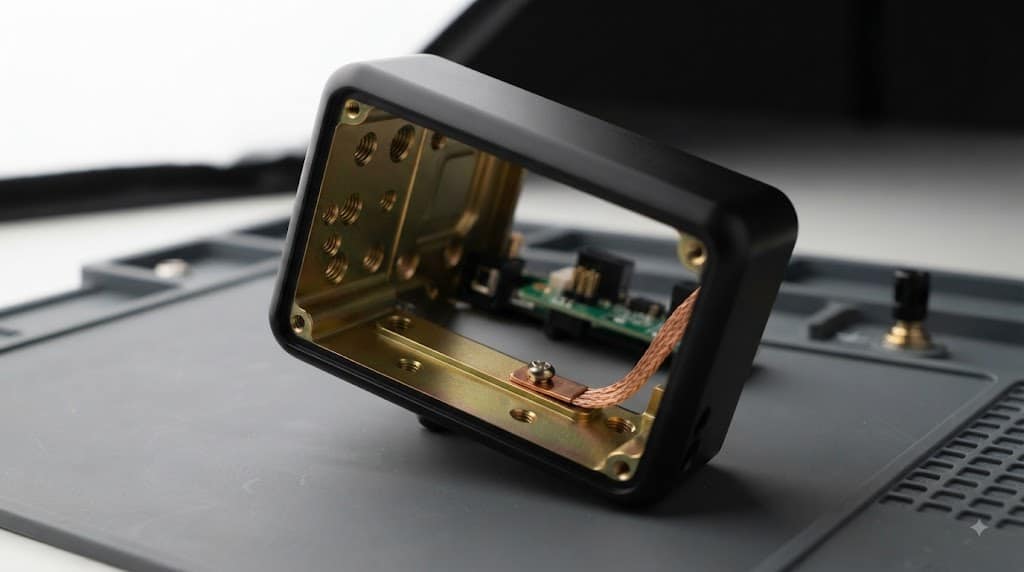
Yes! Combining both surface finishes on a single aluminium part is a common engineering practice. This is especially true for complex electronic enclosures and aerospace components.
Why Combine Them?
An engineer may need the wear and corrosion resistance of anodizing on the exterior of a chassis, but requires electrical conductivity (Alodine) inside a thread hole or along a grounding strip for PCB mounting.
Conclusion: Which Finish Should You Choose?
Choose Alodine if your aluminum part requires electrical grounding, EMI shielding, tight tolerance control, fast turnarounds, or a pre-paint corrosion barrier.
Choose Anodizing if your part demands high surface hardness, wear resistance, long-term corrosion protection, or vibrant cosmetic dyes.
Still unsure which finishing option best fits your CNC aluminum components? Consult with our engineering team today for technical guidance and instant manufacturing quotes!
