

 EU
EUMost plating problems reach us the same way. A drawing says “zinc plate” and nothing else, the parts come back, and the threads no longer accept the mating fastener. Or a hardened steel pin cracks two weeks after assembly because nobody specified a bake.
Electroplating is easy to order and easy to get wrong. This guide covers what actually has to appear on your drawing: which plating metal suits the job, how thick it should be, what it does to your tolerances, and where the cost sits.
What Is Electroplating?
Electroplating is an electrochemical process that deposits a thin layer of metal onto the surface of a part by passing direct current through an electrolyte. The part acts as the cathode, and metal ions in the bath are reduced onto its surface as solid metal.
The deposited layer is usually between 1 and 25 microns thick. It changes how the surface behaves without changing the bulk material underneath, which is why it is used to add corrosion resistance, hardness, conductivity, solderability or appearance to a part that already meets its structural requirements.
Unlike anodising, electroplating adds material on top of the substrate rather than converting the substrate itself. Every surface that contacts the bath grows outward. That single fact drives most of the design rules later in this guide.
How the Electroplating Process Works
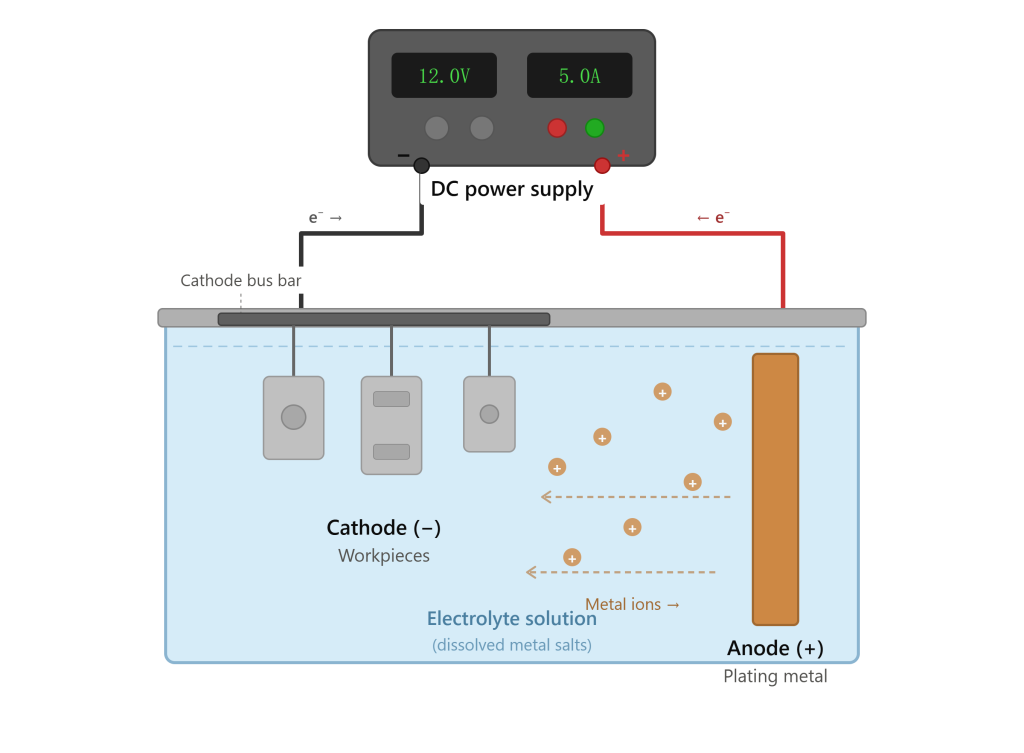
The Electroplating Circuit
Every electroplating process runs inside an electrolytic cell built from four parts:
- Cathode(-): the part being plated, wired to the negative terminal of the power supply.
- Anode(+): usually a block of the coating metal wired to the positive terminal, or an inert conductor when the metal is replenished from the bath chemistry.
- Electrolyte solution: a bath of dissolved metal salts that supplies the metal ions to be deposited.
- Power supply: a DC rectifier that drives the electric current and sets the deposit rate.
Current pulls positive metal ions to the cathode, where they gain electrons and deposit as a solid coating. A metal anode dissolves to replace those ions and keep the bath balanced. The same chemistry applies to zinc, nickel, copper or gold; only the salts and bath differ.
The Process Step by Step
- Cleaning and pre-treatment. Parts are degreased, then electrocleaned, then acid activated. This is where most adhesion failures are created. Oil, oxide, buffing compound or chip residue left on the surface will cause blistering or bare patches later.
- Racking or loading. Parts are hung on racks or loaded into a barrel, depending on size and quantity.
- Plating. Parts are immersed and current is applied. Deposit thickness is a function of current density and time, and typical rates run from a few microns per hour for decorative baths up to 25 microns per hour for high speed engineering baths. [VERIFY: confirm Aria’s own line rates]
- Rinsing. Parts are rinsed to carry the plating chemistry off the surface before any further treatment.
- Baking, if required. High strength steels are baked to drive out absorbed hydrogen. This must follow rinsing but come before any passivate step, since the film would be damaged by the baking temperature. See the hydrogen embrittlement section below.
- Post-treatment. Zinc gets a chromate or trivalent passivate here, and often a sealer. Copper and silver may get an anti-tarnish dip.
- Inspection. Thickness by X-ray fluorescence or magnetic gauge, adhesion by bend or scribe test, appearance against a boundary sample, and salt spray on a sample basis.
Advantages of Electroplating
Electroplating is specified to give a part a surface property its base metal cannot provide on its own. The main purposes are:
- Corrosion protection: a sacrificial or barrier layer, usually zinc or nickel, helps prevent corrosion of the base metal even where the coating is scratched.
- Wear resistance: a hard coating such as chrome or electroless nickel extends the life of parts under friction.
- Electrical conductivity: gold, silver or copper surfaces conduct electricity with low resistance, letting a cheap base metal perform like the precious metals sitting on its surface.
- Solderability: tin or copper makes otherwise difficult surfaces easy to solder or join.
- Appearance: bright, colored or matte metallic finishes, where aesthetic appeal matters as much to the buyer as protection.
- Dimensional repair: hard chrome or nickel can build worn or undersized surfaces back to spec.
Common Uses
Because it delivers these properties on top of a cheaper base metal, electroplating is used across numerous industries:
- Automotive industry: trim, wheels, fasteners and under-hood parts (zinc, chrome, nickel).
- Electronics industry: connectors, PCB contacts and electrical components (gold, tin, copper).
- Aerospace industry and defense: hard coatings and cadmium-alternative finishes on high-strength parts.
- Medical devices: biocompatible and corrosion-resistant surfaces.
- Consumer goods and jewelry: decorative gold, silver and chrome finishes.
- Industrial hardware: zinc-plated screws, brackets and fittings by the millions.
These are only a few of the various industries that rely on electroplating to make everyday products work and last.
Types of Electroplating Process
There are four main electroplating methods, and the right one depends on part size, quantity and how tightly the finish has to be controlled.
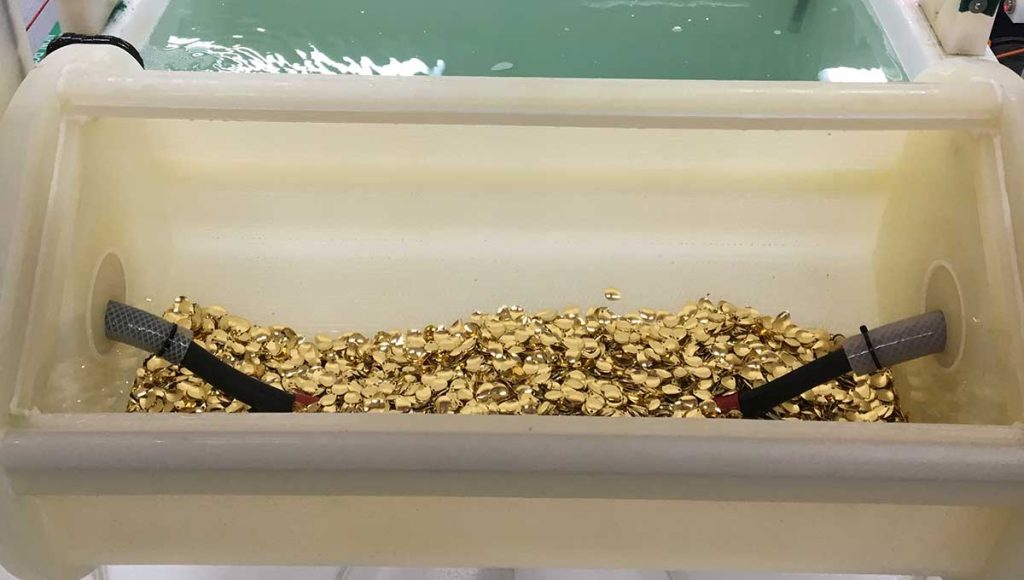
Barrel plating tumbles parts in a rotating perforated drum. It is the cheapest method per part and the right choice for small fasteners, clips and stampings in the thousands. Because parts touch each other, barrel plating leaves contact marks and is not suitable for delicate parts, which tangle or deform.
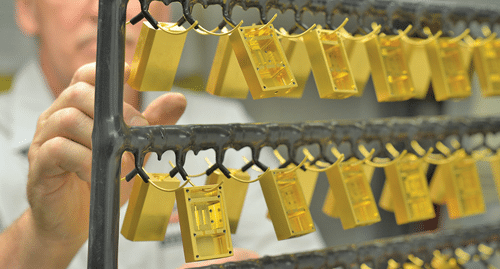
Rack plating fixes each part individually onto a jig. Rack plating gives better thickness control, no contact damage and the ability to mask features, at a much higher cost per part. Machined components, large sheet metal panels, delicate parts and anything cosmetic go on a rack.
Continuous or reel-to-reel plating pulls strip, wire or tube through successive baths. This method is used for connector strip and stamped terminals at very high volume, and it allows selective plating of only the contact area, which is how gold cost is controlled on connectors.
In-line plating integrates the plating cell directly into a stamping or forming line, cutting handling and work-in-progress. Each electroplating method trades cost against control, so the choice follows the part, not habit.
Types of Plating Metal
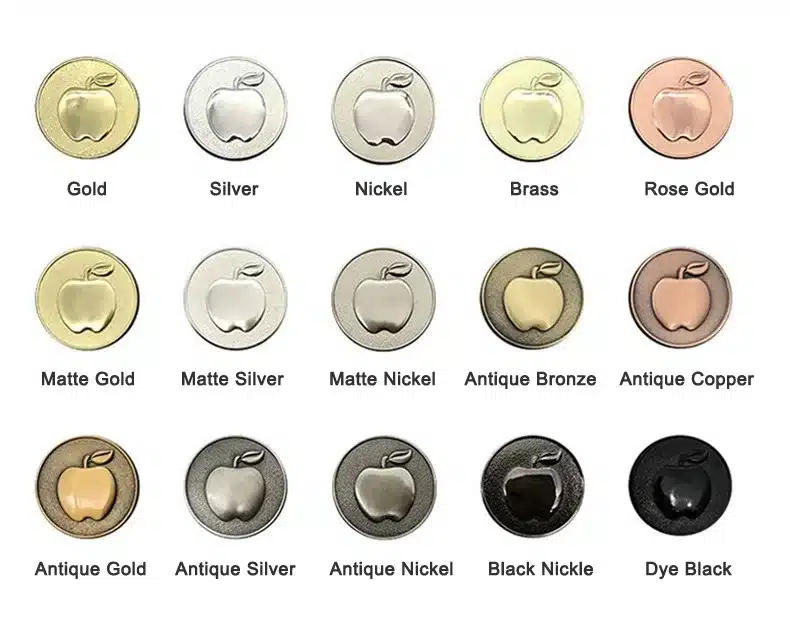
This is the part of the specification that matters most, and the part most often left blank. The plating metal determines the performance you get, and different metals suit different jobs. Color is a by-product.
Zinc Plating
Zinc is the default for steel parts that need corrosion protection at low cost. It protects sacrificially, which means it corrodes in place of the steel even where the coating is scratched. That behavior is unique to zinc among the other metals here and is the reason it dominates fasteners, brackets and sheet metal hardware.
Zinc plating is almost never specified alone. The passivate applied over it does most of the corrosion work. A clear trivalent passivate is the cheapest and gives the least protection. Yellow or iridescent gives more. Black is chosen for appearance and needs a sealer to perform.
Zinc-Nickel Plating
Zinc-nickel with 12 to 15 percent nickel is the step up when zinc alone cannot meet the salt spray requirement. It is standard in automotive underbody and connector applications, covered by ASTM B841, and routinely reaches 500 to 1000 hours to red rust in ASTM B117 testing.
It costs meaningfully more than zinc and the bath is harder to control. Specify it when the environment is genuinely aggressive, not as a default upgrade.
Nickel Plating
Electrolytic nickel gives corrosion resistance plus real wear resistance, at around 200 to 400 HV for a bright deposit. It is also the standard underlayer beneath decorative chrome and beneath gold on connectors.
Bright nickel is leveling, so it will improve the apparent finish of a moderately machined surface. Sulfamate nickel is low stress and is used where the deposit will be thick or where the part will be subsequently formed.
Hard Chrome Plating
Hard chrome, a heavy-duty form of chromium plating, is a functional coating, not a decorative one. It is applied thick, typically 20 to 250 microns, and reaches roughly 800 to 1000 HV. Hydraulic rods, shafts, mold cores and printing rollers are the classic applications.
Hard chrome is almost never used at the as-plated dimension. The standard route is to plate oversize, commonly 50 to 100 microns beyond final size, then grind to the drawing dimension. Hard chrome is porous by nature and its corrosion protection is modest. It also introduces hydrogen, so high-strength substrates require a relief bake.
Decorative Chrome Plating
Decorative chrome is a very thin chromium plating flash, usually 0.25 to 0.8 microns, applied over a nickel layer of 10 to 40 microns. The nickel does the corrosion work and provides the leveling. The chrome provides the blue-white color and the tarnish resistance.
Because the chromium layer is so thin, decorative chrome adds almost nothing dimensionally. The nickel underneath is what you have to account for.
Copper Plating
Copper plating is used as an underlayer, as a conductive layer, and as a stop-off mask for selective carburizing. Copper electroplating deposits with excellent leveling and covers well into recesses, which is why acid copper is the first layer in most multi-layer decorative stacks. Copper electroplating is also used to build up thickness on worn parts before final machining.
On its own, copper tarnishes quickly and needs a topcoat or lacquer.
Tin Plating
Tin is chosen for solderability and for food-contact and electrical applications. Typical thickness is 5 to 15 microns.
The design risk with tin is whisker growth. Bright tin deposits on brass or steel can grow conductive filaments over months or years and short adjacent contacts. Matte tin, a nickel underlayer, or a post-plate anneal are the usual mitigations. If the part goes into fine-pitch electronics, this needs to be discussed before the bath is chosen.
Gold Plating and Silver Plating
Gold and silver are the precious metals most often used in electroplating. Gold plating is applied at very low thickness, from 0.05 microns for a cosmetic flash up to around 1.25 microns for a hard cobalt-hardened contact finish, covered by ASTM B488. It does not tarnish and holds low, stable contact resistance, and because it is priced by weight, thickness control is a direct cost lever.
Silver plating has the highest electrical conductivity of any plating metal and is used on busbars, RF components and high-current contacts at 5 to 25 microns. It tarnishes in sulfur-bearing atmospheres and usually needs an anti-tarnish treatment. Platinum and other precious metals are plated for specialist catalytic and electrode surfaces, though far less often than gold or silver.
Quick Selection Table
| Plating metal | Typical thickness | Hardness | Main reason to specify | Relative cost |
| Zinc | 5 to 25 µm | Soft | Cheapest sacrificial corrosion protection on steel | Low |
| Zinc-nickel | 8 to 15 µm | Moderate | High salt spray requirement, automotive | Medium |
| Nickel | 5 to 50 µm | 200 to 400 HV | Corrosion plus wear, underlayer for chrome and gold | Medium |
| Hard chrome | 20 to 250 µm | 800 to 1000 HV | Maximum wear and abrasion resistance | High |
| Decorative chrome | 0.25 to 0.8 µm over nickel | Hard, very thin | Bright appearance, tarnish resistance | Medium |
| Copper | 5 to 25 µm | Soft | Conductivity, leveling underlayer, masking | Low |
| Tin | 5 to 15 µm | Soft | Solderability, food contact | Low |
| Gold | 0.05 to 1.25 µm | Soft or hardened | Stable contact resistance, no tarnish | Very high |
| Silver | 5 to 25 µm | Soft | Highest conductivity | Hig |
Which Materials Can Be Electroplated?
Electroplating needs a conductive metal surface, so most metals plate directly, and non-conductors have to be treated so they can conduct electricity first. What changes between materials is the prep, and getting the prep wrong is the most common reason a coating fails adhesion.
- Carbon and alloy steel: the most commonly electroplated substrate, plated directly after cleaning and acid activation.
- Aluminum: forms an oxide layer instantly, so it needs a zincate immersion step to lay down a thin zinc film that the plating can bond to.
- Stainless steel: its passive chromium-oxide film blocks adhesion, so it needs a Wood’s nickel strike to activate the surface first.
- Brass and copper alloys: frequently electroplated, and often used as the base for gold or silver.
- Plastic parts (ABS is the standard choice): the surface is chemically etched to create microscopic keying, made conductive with an electroless copper or nickel layer, then electroplated normally. ABS plates well because its butadiene phase etches cleanly, which is why plated plastic parts are almost always ABS or ABS blends.
Design Rules for Plated Parts
This is where most plating problems are actually created, long before the part reaches the tank. A coating is a physical layer with real thickness, so it interacts with your tolerances and geometry.
- Add the coating into your tolerances. Plating grows the surface. On a diameter, an outside dimension increases by about twice the coating thickness and a hole decreases by about twice the thickness. For a press fit, a thread, or a bearing bore, that shift can put the part out of tolerance if it was not accounted for on the drawing.
- Expect uneven thickness on complex shapes. Current concentrates on edges and corners and starves in recesses, blind holes, and deep pockets, so those areas plate thinner. If a recessed surface is critical for corrosion, say so, because the bath will not fix the geometry for you.
- Mask the surfaces that must not be plated. Threads, sealing faces, bearing surfaces, and electrical grounding points are commonly masked. Call them out clearly.
- Relieve hydrogen embrittlement on high-strength steel. Before you apply electroplating to a hardened part, plan the relief bake. Acid cleaning and plating can drive hydrogen into hardened steel and cause sudden cracking under load. Parts above roughly 1000 MPa tensile strength should be baked soon after plating (per ASTM B849 / B850, typically around 190 to 220 C for several hours). This is a safety item, not an optional one.
- Design for drainage and contact. Avoid geometries that trap solution, and give rack or barrel operators a logical, non-critical place to make electrical contact.
- Put the full callout on the drawing. A complete plating spec names the metal, the standard, the thickness or service class, any conversion coating, and the critical surfaces. “Zinc plate” alone leaves too many decisions to the shop.
Common Electroplating Defects and Their Causes
Blistering and peeling is a pre-treatment failure almost every time. Residual oil, oxide, buffing compound or an inadequate activation step prevents the deposit from bonding. Because every plated part joins two metals, the adhesion between them is decided in cleaning, not in the tank.
Bare patches or thin low-current areas occur in recesses, blind holes and shielded faces. Better racking, auxiliary anodes or a change to electroless nickel are the fixes.
Burning, roughness and nodules at edges and corners come from excessive local current density, or from particulate contamination in the bath. Breaking sharp edges and improving bath filtration both help.
Shade variation between batches comes from drift in the chemical composition of the bath, temperature swing, brightener depletion or inconsistent time under current. It is controlled statistically, not eliminated.
Staining and bleed-out on cast, sintered or welded parts happens when solution trapped in porosity weeps out after rinsing and dries on the surface. Sealing porous parts before plating is the standard countermeasure.
Dimensional rejection almost always traces back to threads, bores or press fits that were toleranced without an allowance for the coating.
Electroplating Across Manufacturing Processes
CNC Machined Parts
Machined parts arrive with tight tolerances already established, so the plating decision is a tolerance decision. Confirm which features are plated and which are masked, allow for coating growth on threads and fits, and specify a bake if the material is hardened.
Plated coatings are microns thick, so on general tolerance features they change nothing. On H7 bores, running fits and gauged threads they change everything.
Sheet Metal Fabrication
Zinc and zinc-nickel dominate here. Enclosures, brackets and chassis parts need both atmospheric corrosion resistance and reliable earthing, and plating provides both, which is why plated rather than painted contact points are specified for grounding.
Watch for entrapped solution in hems, seams and spot welded joints. These trap electrolyte and cause bleed-out staining weeks later. Drain holes solve it. [internal link: sheet metal fabrication service page]
Injection Moulded Plastics
Plating on ABS turns a light, low-cost moulding into a part with a metallic appearance, a harder surface and EMI shielding capability. It is standard for automotive interior trim, appliance controls and cosmetic housings.
The constraints come from the moulding side. Material must be a platable grade, wall sections should be even to avoid stress-induced adhesion failure, gate and ejector marks will telegraph through a bright deposit, and racking points have to be designed into the part.
Rapid Prototyping and Low Volume
Bath setup is a fixed cost, so small quantities carry a high per-part charge unless they share a run. Parts of different geometry can be plated in the same batch as long as they share the same finish specification, and grouping prototype parts this way is the practical way to keep low-volume plating affordable.
Electroplating vs Anodizing
Both use an electrolytic cell, but they do opposite things: electroplating adds a separate metal onto the part, while anodizing turns the part’s own surface into an oxide layer.
- Materials: electroplating works on most metals and even plastics, while anodizing works only on aluminum and a few reactive metals like titanium.
- Dimensions: electroplating builds fully outward, while anodizing grows about half into the part, so it changes size less.
- Conductivity: electroplated surfaces stay conductive, while anodized surfaces are insulating.
- Best for: electroplating for steel protection, wear and electrical contacts, anodizing for aluminum housings and heat sinks.
Frequently Asked Questions
How thick is a typical electroplated coating?
Most functional coatings fall between 5 and 25 microns. Decorative chrome is far thinner at under 1 micron, and hard chrome is far thicker at 20 to 250 microns before grinding.
Does electroplating change part dimensions?
Yes. Every wetted surface grows by the coating thickness, so shaft diameters increase and bore diameters decrease by twice that value. External thread pitch diameter grows by roughly four times the coating thickness.
Can plastic parts be electroplated?
Yes, once the surface is made conductive. ABS is the standard platable plastic. The part is etched, catalysed with palladium, given an electroless metal layer, and then electroplated conventionally.
What is the difference between zinc plating and galvanising?
Zinc plating is electrodeposited, thin and even, and gives a smooth finish suitable for machined and threaded parts. Hot dip galvanising is molten immersion, far thicker at 45 microns and above, and gives much longer outdoor life but a rougher surface that will clog threads.
Which plating is best for salt spray performance?
Among common finishes, zinc-nickel with a suitable passivate and sealer is the practical choice for high salt spray requirements on steel, reaching several hundred hours to red rust. High phosphorus electroless nickel is the alternative where a non-sacrificial barrier coating is acceptable.
How long does electroplating take?
Bath time itself is usually measured in tens of minutes. Total lead time is driven by batching, any bake cycle and testing.
