

 EU
EUWhether you need to clear stubborn rust from structural steel, strip layers of old automotive paint, or condition a machined metal surface for powder coating, sandblasting is a proven and widely used manufacturing solution.
What is Sandblasting?
Sandblasting, also known as abrasive blasting, is a mechanical surface treatment process that uses a high-velocity stream of compressed air to propel abrasive particles onto the surface of a workpiece. This high-energy impact physically removes surface contaminants like paint and rust, smooths out machining tool marks, and creates an even surface texture across the entire part.
In manufacturing, sandblasting is a key method for surface preparation before painting, anodizing, plating, or powder coating. This article covers how sandblasting works, what media to use, its advantages and limitations, and the industry standards you should know when specifying surface treatment for your parts.
Note: The smaller the abrasive particles, the smoother the final surface of the part; conversely, the larger the abrasive particles, the rougher the final surface will be.
How Does the Sandblasting Process Work?
Once the machinery and safety measures are in place, the actual execution of a sandblasting project follows a precise, five-step sequence:
Step 1: Surface Pre-treatment (Cleaning)
The raw workpiece must first be degreased and cleared of heavy oils or wet contaminants. If oils are left on the surface, they will contaminate the blasting media, causing it to clump and clog the nozzle. Common pre-cleaning methods include solvent wiping and alkaline degreasing. The cleaning process can vary with part condition and material type.
Step 2: Media Loading & Moisture Filtration
The chosen dry abrasive material (such as aluminum oxide or steel grit) is loaded into the blasting pot or suction hopper. To prevent media clumping, a high-efficiency moisture filter ensures the compressed air powering the system remains completely dry.
Step 3: Pressure Calibration (PSI & CFM)
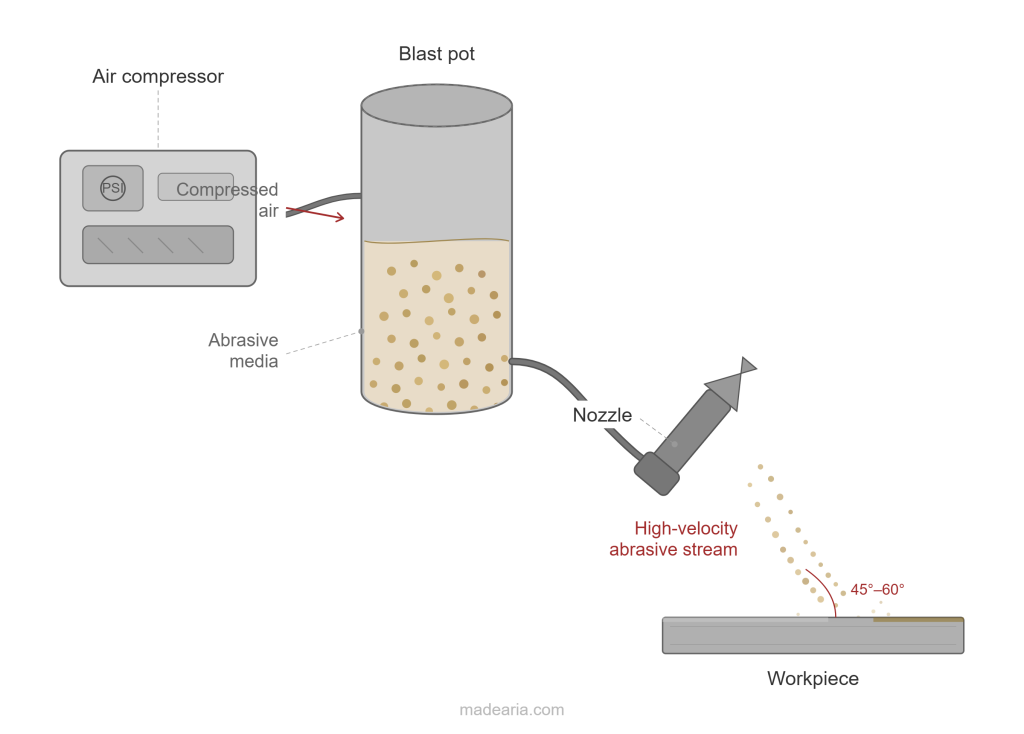
The operator adjusts the air compressor to a specific air pressure and flow rate, typically between 40 and 100+ PSI. This setting depends on the workpiece material and the desired finish. For example, softer metals like aluminum typically need only 40 to 60 PSI, while heavy steel descaling may require 80 to 100+ PSI.
Step 4: Stream Execution & Angle Sweeping
The operator (or an automated robotic arm) directs the blast nozzle at the workpiece. The nozzle is swept across the surface at a fixed distance and angle (usually 45 to 60 degrees) to ensure consistent texture without warping or pitting the metal. By adjusting the nozzle angle and standoff distance, the operator can create either a smooth surface or a rougher profile depending on the media and finish target.
Step 5: Post-Treatment Blow-Off
After blasting is complete, the part is covered in fine abrasive dust. Operators use a dedicated high-pressure air blow-off to thoroughly remove all residual dust, ensuring a clean surface that is ready for secondary treatments like painting, anodizing, or powder coating.
Sandblasting Equipment
To understand how sandblasting works, you first need to understand the hardware behind it. A standard abrasive blasting system typically relies on four core components working in unison:
- Air Compressor: Provides the necessary high-pressure, continuous airflow (measured in CFM and PSI) to propel the media. Larger blast operations require industrial compressors capable of sustaining high CFM output.
- Blast Pot / Pressure Tank: Stores and dispenses the abrasive media into the high-speed air stream. Blast pots are commonly used in portable setups, while suction/siphon systems are more common in cabinet blasters.
- Blasting Nozzle: Controls, accelerates, and directs the high-speed air-media stream onto the target surface. The media travels through a blast hose before reaching the nozzle. Nozzles are made from wear-resistant materials like ceramic or tungsten carbide. Harder nozzle materials last longer, especially when used with aggressive abrasive media.
- Safety Gear / Blast Cabinet: Encloses the process to protect the operator and contain fine particles. Cabinets are used for small-to-medium indoor parts, while open-site blasting requires full personal protective equipment (PPE).
Different blast systems may be portable, enclosed, or fixed. Larger operations may use a dedicated blast room with built-in dust collection and media recycling systems. Some setups use vacuum blasting for dust-sensitive work because the system recovers media during operation. Wet blast equipment is also used when gentler impact and dust control are priorities.
Common Uses
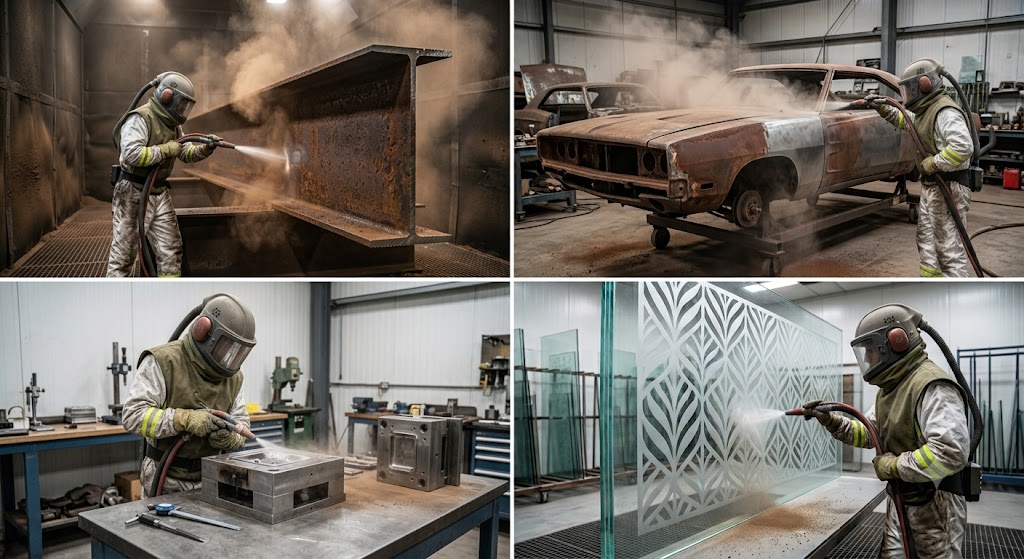
Sandblasting is widely used for surface treatment across multiple industries:
- Surface Preparation: Removing mill scale, weld spatter, and oxides to create a microscopic rough profile that helps paint and powder coatings adhere properly. Surface cleaning before coating is the most common industrial application of the abrasive blasting process.
- Rust and Paint Removal: Stripping heavy corrosion, rust, and old multi-layer coatings from steel structures, pipelines, bridges, and ship hulls. Sandblasting can remove paint and rust far faster than manual methods.
- Automotive Restoration: Blasting car bodies, chassis frames, and engine parts to quickly clear away old paint, road grime, and thick undercoating. Similar sandblasting applications are also common on boats and industrial machinery.
- Industrial Maintenance: Cleaning severe carbon or resin residue from injection molds, die-casting dies, and production tooling without damaging the metal surface.
- Aesthetic Etching: Using masking stencils to create frosted decorative patterns on architectural glass, shower doors, and stone monuments.
- Aerospace Component Preparation: Preparing titanium, aluminum, and nickel alloy parts for bonding, coating, or inspection using precisely controlled abrasive media.
- Log Home and Antique Restoration: Sandblasting is also used to clean log homes every five to seven years, and antiques can be restored using either wet or dry sandblasting depending on the surface condition and fragility.
Common Types of Blasting Media
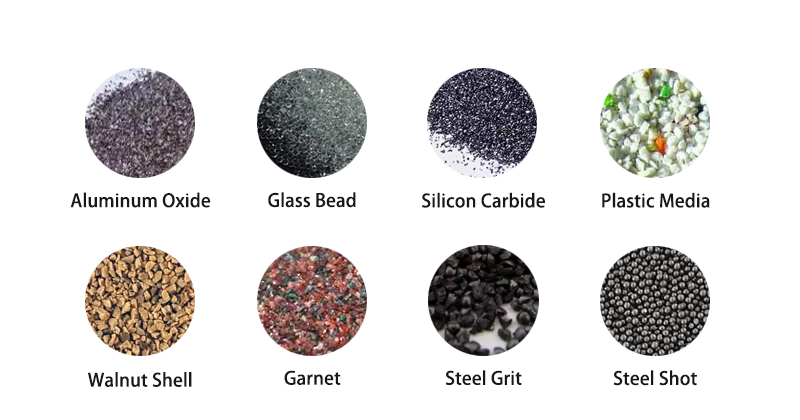
The choice of blasting media dictates how aggressive the sandblasting process will be. Choosing the right abrasive blasting media affects cutting action, finish quality, and overall cost. In current practice, modern abrasive materials have largely replaced sand because they offer better safety and process control. Here are the most commonly used sandblasting media:
Aluminum Oxide
Extremely sharp, highly angular, and very hard (Mohs 9.0). It is highly recyclable (10 to 12 cycles) and excellent for heavy-duty metal rust removal and creating a rough “anchor pattern” for paint adhesion. Aluminum oxide is the go-to choice for CNC machined parts that need aggressive surface preparation before coating.
Steel Grit / Shot
Heavy, dense, and packed with massive impact force (Mohs 7.0 to 8.0). As a category, steel abrasives (including both angular steel grit and spherical steel shot) are valued for heavy-duty surface cleaning because they strip material quickly. Steel grit is used heavily in structural steel descaling and foundry casting cleaning, while steel shot is commonly chosen for peening and finishing on metal surfaces. Both are highly reusable at over 100 cycles, making them cost-effective for high-volume industrial applications.
Glass Beads
Perfectly spherical particles (Mohs 5.5 to 6.0) that deliver a gentle, non-cutting impact. Fine glass beads are preferred when you need gentle cleaning or finishing on delicate parts without cutting deeply into the substrate. They produce a smooth surface with a satin or matte cosmetic texture on metals without changing dimensional tolerances. This makes glass beads ideal for precision parts that require a uniform, non-reflective appearance. Glass beads are reusable for 5 to 10 cycles.
Walnut Shells / Plastic Media
Ultra-soft, lightweight media (Mohs 3.5) with zero cutting force on hard substrates. When working with sensitive materials, softer abrasives like walnut shells or plastic media are often chosen to preserve the substrate. They are perfect for stripping paint off delicate automotive body panels or cleaning injection molds without scratching the underlying metal. Walnut shells are reusable for 4 to 5 cycles.
Silicon Carbide
Extremely hard and fast-cutting (Mohs 9.5), often chosen for precision applications in aerospace and for removing tough coatings from hard alloys. Its angular shape creates an aggressive profile quickly, but it is more expensive than aluminum oxide.removal.
How to Choose the Right Blasting Media
Choosing the right media is critical to achieving the desired result without damaging the workpiece. Consider these factors:
- Substrate hardness: Harder workpiece materials (steel, stainless steel) can withstand aggressive media like aluminum oxide or steel grit. Softer materials (aluminum, brass, plastics) require gentler media like glass beads or walnut shells. Also consider whether rough surfaces need heavier profiling or just light cleaning.
- Desired surface profile: If you need a deep anchor pattern for heavy-duty coatings, choose angular media (aluminum oxide, steel grit). For a smooth, cosmetic finish, use spherical media (glass beads).
- Coating requirements: Many coatings (such as epoxy or powder coat) require the surface to have a specific roughness level. Check the coating manufacturer’s specifications and choose a media grit size that matches.
- Reusability and cost: For high-volume production, steel grit (100+ cycles) offers the lowest per-use cost. For one-off or low-volume jobs, less expensive disposable media may be more practical.
- Environmental and safety considerations: Sand is rarely used today because of health and regulatory concerns. Avoid silica-based sand due to silicosis risk, and choose media that meets your local environmental and health regulations.
Types of Sandblasting
Depending on the environment, equipment enclosures, and required finish, sand blasting methods are divided into several main types. Each abrasive blasting process variant suits different materials and project conditions:
Dry Blasting
The most traditional method is dry abrasive blasting, which relies purely on compressed air and dry abrasive media. It is highly effective and leaves little residual moisture, but the dust produced is a major drawback because it requires filtration and containment. Dry blasting is best suited for metals where moisture could cause flash rusting.
Wet / Vapor Blasting
This method mixes water with the abrasive media before it exits the nozzle. The water cushions the impact, reduces heat generation (preventing thin metals from warping), and completely suppresses airborne dust. Wet blasting is ideal for delicate parts, heat-sensitive jobs, and environments where dust containment is a concern.
Cabinet Blasting
A completely sealed box enclosure equipped with glove ports, viewing windows, and built-in dust collectors. This is ideal for small-to-medium parts processed indoors, and allows for easy media recycling. Cabinet blasting provides a controlled environment that is well-suited for precision CNC machined components.
Open / Site Blasting
Used for massive, unmovable structures like bridges, buildings, or ship hulls. Operators must wear full positive-pressure blast helmets and specialized PPE. This method requires thorough site preparation and containment measures to comply with environmental regulations.
Centrifugal Wheel Blasting
Uses a motorized, fast-spinning wheel to mechanically hurl media by centrifugal force rather than compressed air. Highly aggressive, fast, and exclusively used for high-volume, massive structural steel profiles. It is also called shot blasting when metal shot is used as the media.
Advantages of Sandblasting
Surface Preparation
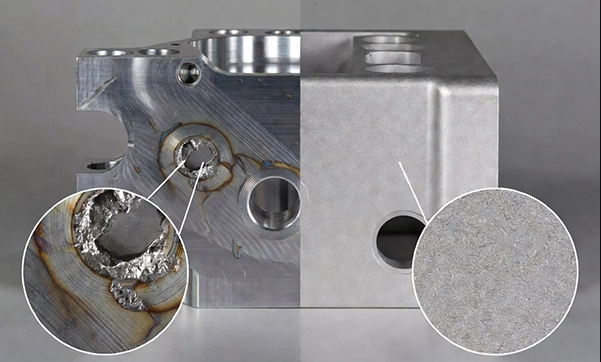
Sandblasting removes rust, old paint, and other surface contamination quickly. This makes it effective for preparing surfaces before coating by creating a clean, uniform surface profile that improves coating adhesion. Paints, powder coatings, and plating bond better to sandblasted surfaces than to mechanically or chemically cleaned ones.
Speed and Efficiency
It covers large surface areas fast. Compared to manual sanding or chemical stripping, sandblasting finishes the job in a fraction of the time. This makes it cost-effective for high-volume production.
Versatility
It works on metals, plastics, glass, wood, and composites. Common sandblasting applications range from removing paint, rust, and surface contaminants on cars, boats, and machinery to gentler cleaning or cosmetic texturing on delicate parts. You can adjust the abrasive type and pressure to suit different materials and finishes.
Deburring and Edge Blending
It removes burrs from machined or stamped parts without altering dimensions significantly. This is useful for CNC-machined and sheet metal components.
Aesthetic Finishing
Sandblasting creates decorative matte or satin textures. It is commonly used as a pre-anodizing step for aluminum parts to achieve a uniform, non-reflective appearance.
Eco-Friendly Alternative
It relies entirely on physical abrasive impact rather than harsh chemical stripping acids or hazardous liquid solvents. This makes sandblasting a much safer and cleaner process for both operators and the environment.
Disadvantages of Sandblasting
Risk of Material Distortion
The aggressive force and friction heat generated by dry sandblasting can warp, pit, or stretch thin or delicate metal components. Wet blasting or lower-pressure settings can mitigate this risk.
Not Suitable for All Precision Parts
Because aggressive media cuts away a microscopic layer of the substrate, it can affect critical dimensional tolerances on precision CNC machined parts. For high-tolerance components, gentler media (glass beads) or alternative finishing methods should be considered.
Not Suitable for All Materials
Soft plastics, thin glass, and some composites can crack, deform, or erode under sandblasting. Alternative methods like chemical etching, laser cleaning, or tumble finishing may be needed for these materials.
Dust and Contamination
Dry blasting can release silica dust and other fine particles. Without proper containment, abrasive particles spread across the workshop and contaminate nearby equipment, surfaces, and parts. Inhalation of silica dust can lead to chronic lung ailments, including silicosis and lung cancer. Enclosed blast rooms or cabinets add to setup costs.
Environmental and Disposal Concerns
Spent abrasive media, stripped paint residues, and dust require proper disposal. Lead paint or chromate coating removal generates hazardous waste. Regulatory compliance adds cost and complexity.
Surface Cleanliness Standards
In industrial projects, surface cleanliness is measured by international standards. These standards tell you how clean the surface must be before applying a coating:
| Standard System | Grade | Description |
| ISO 8501-1 | Sa 1 | Light blast cleaning. Removal of loose rust, mill scale, and old coatings. |
| ISO 8501-1 | Sa 2 | Thorough blast cleaning. Most rust, mill scale, and coatings removed. |
| ISO 8501-1 | Sa 2.5 | Very thorough blast cleaning. At least 95% of the surface is free of visible residues. This is the most commonly specified grade for industrial coating work. |
| ISO 8501-1 | Sa 3 | Blast cleaning to visually clean steel. Surface has a uniform metallic appearance with no visible residues. |
| SSPC (US) | SP 5 | White metal blast cleaning. Equivalent to Sa 3. |
| SSPC (US) | SP 10 | Near-white metal blast cleaning. Equivalent to Sa 2.5. |
| SSPC (US) | SP 6 | Commercial blast cleaning. Equivalent to Sa 2. |
When requesting sandblasting services, always specify the required cleanliness standard in your surface preparation requirements. Most industrial coating systems require Sa 2.5 / SSPC-SP 10 as a minimum.
Sandblasting vs. Other Surface Preparation Methods
Sandblasting is a common method in the surface preparation industry, but it is not the only option. Here is how it compares to common alternatives:
| Factor | Sandblasting | Chemical Etching | Laser Cleaning | Tumble Finishing |
| Speed | Fast for large areas | Slow (chemical soak time) | Moderate | Slow (batch process) |
| Surface Profile | Adjustable (media/pressure) | Smooth, uniform | Very precise | Smooth, rounded edges |
| Material Compatibility | Wide (metals, glass, wood) | Metals primarily | Most materials | Small parts only |
| Environmental Impact | Dust (needs containment) | Chemical waste disposal | Minimal waste | Minimal waste |
| Equipment Cost | Low to moderate | Low | High (laser unit) | Moderate |
| Best For | Large-area prep, rust/paint removal, texturing | Precision etching, chemical milling | Delicate or heat-sensitive parts | Deburring small batch parts |
For most manufacturing surface preparation needs, especially before painting, plating, or powder coating, sandblasting remains the most cost-effective and versatile option.
FAQs
Q: What is the difference between sandblasting and shot blasting?
A: Sandblasting uses compressed air to propel abrasive media through a nozzle, while shot blasting uses a spinning centrifugal wheel to mechanically hurl media at the surface. Shot blasting is typically more aggressive and faster, making it better suited for high-volume industrial descaling. Sandblasting offers more control over pressure and media selection, making it more versatile for different materials and finishes.
Q: Can you sandblast aluminum?
A: Yes, but you must use lower air pressure (40 to 60 PSI) and gentler media such as glass beads or fine aluminum oxide. Aggressive media or high pressure can warp or pit aluminum surfaces. Sandblasting is commonly used as a pre-anodizing step for aluminum parts to create a uniform matte texture.
Q: What grit is best for rust removal?
A: For heavy rust removal on steel, aluminum oxide (60 to 80 grit) or steel grit (G40 to G50) are the most effective choices. They cut aggressively, create a strong anchor pattern for coatings, and are highly recyclable. For lighter surface rust, glass beads or garnet provide a less aggressive option.
Q: Is sandblasting the same as abrasive blasting?
A: Sandblasting is a type of abrasive blasting. The term “sandblasting” originally referred to the use of silica sand, but sandblasting media today usually consists of engineered abrasives rather than raw sand. “Abrasive blasting” is the broader, more technically accurate term that covers all media types, including bead blasting, soda blasting, and shot blasting.
Q: How long does a sandblasted finish last?
A: The sandblasted surface itself is not a protective finish. It is a surface preparation step. Without a protective coating (paint, powder coat, anodize, or plating), a freshly sandblasted metal surface will begin to oxidize within hours in humid environments. The purpose of sandblasting is to create the optimal surface profile so that the subsequent coating bonds properly and lasts longer.
Q: Is sandblasting dangerous?
A: Sandblasting can be hazardous if proper safety precautions are not followed. The primary risks are respiratory exposure to fine dust particles and noise. Historical use of silica sand caused silicosis, which is why modern operations use safer engineered media. With proper PPE, ventilation, and enclosed blasting equipment, sandblasting is a safe and routine industrial process.
