Home / Design Guide / 18 Types of Springs and Their Uses

18 Types of Springs and Their Uses

18 Types of Springs and Their Uses

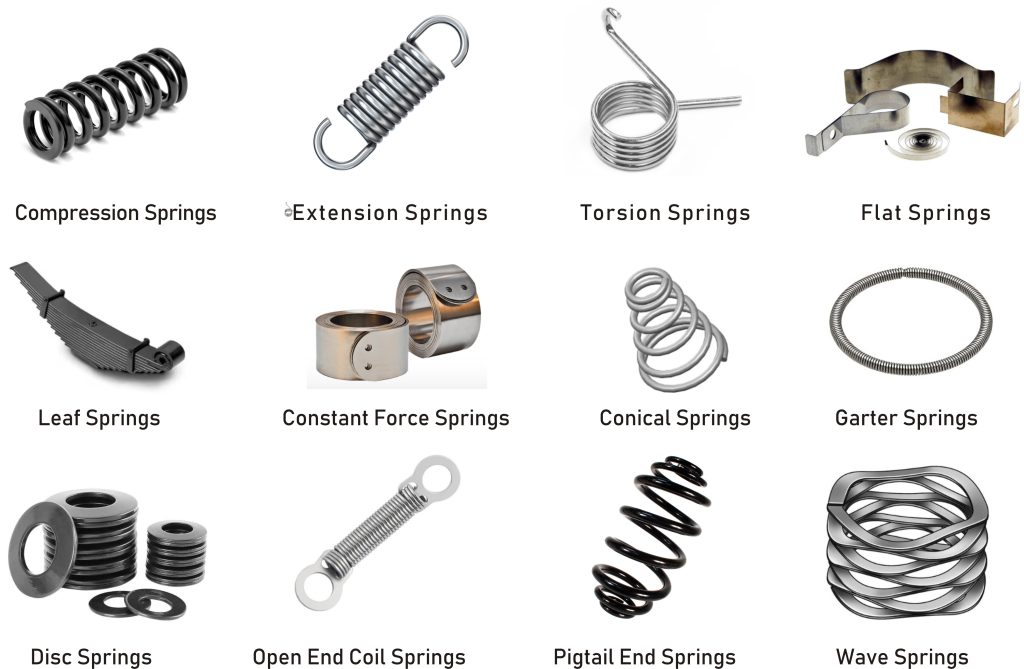
Types of springs — overview of compression, torsion, extension, leaf, and coil spring varieties

Share:

Table of Content

Table of Content

Basic Principles of Springs

Operating as flexible devices capable of storing and releasing mechanical energy, springs primarily absorb external forces through deformation and return to the original shape once the load is removed. Core functions involve absorbing shock and vibration, maintaining tension or pressure between components, controlling motion, and storing energy.

Typically manufactured from coiled metal wire, construction can also utilize machined solid steel, forming cylindrical shapes, stamped designs, or assembled configurations. Manufacturing often relies on specialized coiling machines to wind wire over a specific length and number of turns to achieve a required force constant. When subjected to pushing, pulling, or twisting—technically referred to as “loading”—the generated force increases linearly. Hooke’s Law dictates that the deformation force or load of an elastic object equals its displacement, dimension, or micro-deformation.

types of springs

Types of Springs

Springs can be classified according to their geometry, loading direction, deformation method, and force–deflection characteristics. The following 18 types of springs cover helical springs, leaf springs, disc springs, constant-force and clock springs, and other specialized spring structures.

Helical Springs

Compression Spring

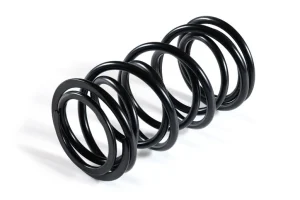
Compression spring is an open-coil helical spring designed to resist axial pressure. When compressed, its coils twist and store elastic energy, producing a restoring force that generally follows Hooke’s Law within the elastic range. The spring rate depends on wire diameter, coil diameter, active coil count, and material properties. Compression springs are used in valves, suspension systems, switches, medical devices, industrial machinery, electrical contacts, and household products to absorb shock, maintain pressure, reduce vibration, and return components to their original positions.

Compression spring — cylindrical coil spring for axial load and shock absorption

Extension Spring

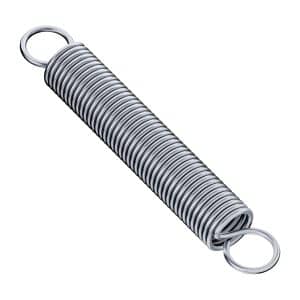
An extension spring is a close-wound helical spring designed to resist tensile force. Hooks or loops at both ends connect it to other components. When stretched, the coils separate and store elastic energy; when the load decreases, the spring contracts and produces a restoring force. Initial tension keeps the coils closed before loading. Extension springs are used in garage doors, agricultural machinery, weighing equipment, trampolines, brake mechanisms, tools, toys, and industrial linkages where pulling force, controlled movement, tension maintenance, or automatic return is required.

Extension spring — close-wound coil spring that stores energy under tension

Torsion Spring

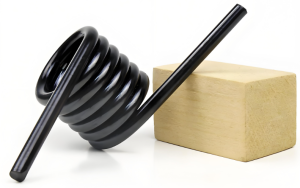
Torsion spring is a helical spring that produces torque when its legs rotate around the coil axis. Angular displacement bends the spring wire, stores elastic energy, and creates a restoring moment that increases with the angle of rotation. Its torque depends on wire diameter, coil diameter, active coil count, material, and winding direction. Torsion springs are used in hinges, clothespins, switches, latches, vehicle lids, garage doors, hand tools, seat mechanisms, and industrial equipment requiring controlled rotation, position holding, or automatic return.

Torsion Springs

Volute Spring

Volute spring is made from a tapered metal strip wound into a conical spiral. Under axial compression, its overlapping coils slide partly inside one another, allowing long deflection and a short compressed height. Bending, twisting, and friction between the coils store and dissipate mechanical energy, producing a nonlinear force response. Volute springs are used in railway buffers, heavy vehicles, industrial presses, vibration isolators, and impact machinery where high load capacity, compact installation, shock absorption, and reduced rebound are required.

Leaf Springs

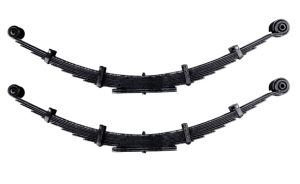
Leaf spring — layered flat steel spring for heavy vehicle suspension systems

Semi-Elliptic Leaf Spring

An elliptic leaf spring consists of two opposing semi-elliptic leaf assemblies joined at their ends to form an oval. Vertical loading flattens the curved leaves and stores energy through bending. When the load decreases, the leaves recover their original curvature and restore the supported structure. Friction between adjacent leaves can also reduce vibration. Elliptic leaf springs were used in horse-drawn carriages, early automobiles, railway vehicles, and suspension systems requiring load support and shock absorption. Current use is mainly found in historical vehicles and specialized mechanisms.

Elliptic Leaf Spring

Semi-elliptic leaf spring is a curved assembly formed from one or more graduated steel strips. Its center is commonly attached to an axle, while both ends connect to the chassis. Vertical loading bends and flattens the spring, storing energy along the leaf pack. When the load decreases, the spring returns toward its original arc. Semi-elliptic leaf springs are used in trucks, buses, vans, trailers, railway vehicles, and off-road equipment because they can support weight, absorb road impacts, locate the axle, and control suspension movement.

Quarter-Elliptic Leaf Spring

Quarter-elliptic leaf spring is a cantilevered leaf assembly fixed rigidly at one end and connected to an axle or moving component at the other. Applied loading bends the leaves around the fixed mounting point and stores elastic energy. When the load is removed, the spring returns the component toward its initial position. Quarter-elliptic springs were used in early automobiles and compact suspension systems. They are now mainly found in restored vehicles, custom suspensions, light trailers, and specialized machinery requiring a narrow spring arrangement with one fixed mounting point.

Three-Quarter Elliptic Leaf Spring

Three-quarter elliptic leaf spring combines a semi-elliptic spring with an additional quarter-elliptic section. Under vertical loading, both sections bend and store energy, providing more suspension travel than a basic semi-elliptic design. When the load decreases, the curved members recover and return the axle or supported body toward its original position. This structure was used in early passenger cars, commercial vehicles, and carriage suspensions. Current applications are mainly limited to vehicle restoration and specialized mechanisms that require extended movement and distributed load support.

Transverse Leaf Spring

Transverse leaf spring is installed across the width of a vehicle rather than along its length. Its center is normally attached to the chassis, while both ends connect to suspension or wheel components. Vertical wheel movement bends the spring and stores elastic energy, creating a restoring force that supports the vehicle and controls wheel travel. Transverse leaf springs are used in passenger cars, sports cars, trailers, and independent suspension systems. One spring can serve both sides, reduce component count, and save longitudinal installation space.

Disc Springs

Belleville Disc Spring

Disc Springs

Belleville spring is a conical disc washer designed to produce high axial force within limited space. Compression reduces its cone height and creates bending and membrane stresses throughout the disc. Individual discs can be stacked in series to increase deflection or in parallel to increase load capacity. Belleville springs are used in bolted joints, valves, clutches, brakes, presses, elevators, pipe supports, and heavy machinery. They maintain preload, compensate for dimensional changes, absorb shock, and provide controlled axial force where conventional coil springs require excessive installation height.

Curved Disc Spring

Curved disc spring is a thin circular washer formed with a shallow curved profile. When compressed, the washer flattens and produces axial force through elastic bending. Its force is generally lower than that of a Belleville spring, but it provides greater movement under light loads. Curved disc springs are used beneath fasteners, bearings, covers, cams, electrical contacts, and mechanical housings. They absorb axial clearance, maintain contact pressure, reduce vibration and noise, compensate for thermal expansion, and prevent looseness caused by wear or dimensional variation.

Slotted Disc Spring

Slotted disc spring is a conical disc containing radial slots that form flexible fingers. During axial compression, both the disc body and slotted sections bend, reducing stiffness and increasing deflection compared with a solid Belleville spring. Slot length, width, number, and position determine the spring’s force response. Slotted disc springs are used in automotive clutches, automatic transmissions, overload couplings, pressure regulators, valves, brakes, bearing preload systems, and precision actuators where controlled engagement, release force, extended movement, or overload protection is required.

Wave Disc Spring

Wave disc spring, or wave washer, is a thin circular washer formed with axial waves around its circumference. Compression flattens the waves and produces a restoring force through elastic bending. Wave height, number, and shape determine its load and deflection. Wave disc springs are used in bearings, seals, motors, valves, gears, electrical contacts, fasteners, and compact housings. They maintain preload, absorb axial play, reduce rattle, compensate for wear and thermal expansion, and provide controlled force where only a short working distance is available.

Wave Disk Springs

Constant-Force and Clock Springs

Constant Force Spring

Constant force spring is a pre-stressed metal strip wound into a tight coil. When the free end is pulled, the strip unrolls and produces an almost uniform resisting force because it continuously attempts to return to its original coil radius. Its output depends mainly on strip thickness, width, material, and coil diameter. Constant force springs are used in cable retractors, counterbalances, window systems, hose reels, medical devices, retail displays, appliances, gym equipment, and industrial mechanisms requiring smooth retraction, continuous tension, controlled extension, or load balancing over long travel.

Constant force spring — flat strip coil that delivers uniform tension throughout extension

Clock Spring

Clock spring is a flat metal strip wound into a planar spiral between a central arbor and an outer attachment point. Rotating either end winds the strip, stores elastic energy, and increases torque. When released, the spring unwinds and converts stored energy into controlled rotary movement. Torque depends on strip thickness, width, length, material, and angular displacement. Clock springs are used in mechanical clocks, timers, cable reels, seat-belt retractors, starters, toys, seat adjusters, and industrial return mechanisms requiring rotational energy storage or automatic return within limited axial space.

Other Specialty Springs

Garter Spring

Garter spring is a helical coil joined at both ends to form a continuous ring. An extension garter spring expands around a component and produces inward radial pressure, while a compression version produces outward force. The circular structure distributes force around the entire circumference and maintains contact despite wear or dimensional changes. Garter springs are used in oil seals, shaft seals, hydraulic equipment, medical pumps, electrical connectors, motors, and fuel systems to maintain sealing pressure, retain circular components, provide electrical contact, or apply uniform radial force.

Garter spring — coiled spring formed into a ring for radial force applications

Wave Spring

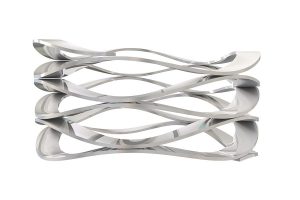
Wave spring is a flat-wire compression spring formed with repeated waves along one or more turns. Axial loading flattens the waves, bends the strip, and stores elastic energy. Compared with many round-wire coil springs, it can provide similar force and deflection with a lower operating height. Wave springs are used in bearings, pumps, valves, clutches, gears, electrical connectors, medical devices, aerospace equipment, and automotive assemblies. They maintain preload, compensate for tolerances and wear, reduce axial movement, control piston travel, and provide force where installation space is restricted.

Wave spring — flat wire coil design for compact axial space savings

Gas Spring

Gas spring is a sealed device containing compressed gas, a piston, a piston rod, seals, and often oil for damping. Gas pressure acts on the piston area and produces extension force. When the rod enters the cylinder, gas volume decreases and pressure rises according to Boyle’s Law, increasing the output force. Gas springs are used in vehicle tailgates, hoods, office chairs, medical beds, furniture, machinery covers, access panels, and marine hatches. They assist lifting, counterbalance weight, hold components in position, and control opening, closing, lowering, or adjustment.

Common Spring Materials

Material selection directly influences spring strength, fatigue life, corrosion resistance, and operating temperature.

  • Spring Steel: Spring steel provides high tensile strength and fatigue resistance.
  • Beryllium Copper: Beryllium copper combines electrical conductivity with corrosion resistance.
  • Ceramic: Ceramic materials resist high temperatures and chemical corrosion.
  • Unidirectional Glass Fiber Composite: Composite springs reduce weight while maintaining structural strength.
  • Rubber: Rubber springs provide vibration isolation and shock absorption.
  • Polyurethane: Polyurethane combines elasticity with abrasion resistance.

These materials are commonly selected according to operating conditions, required load, fatigue performance, corrosion resistance, and manufacturing cost.

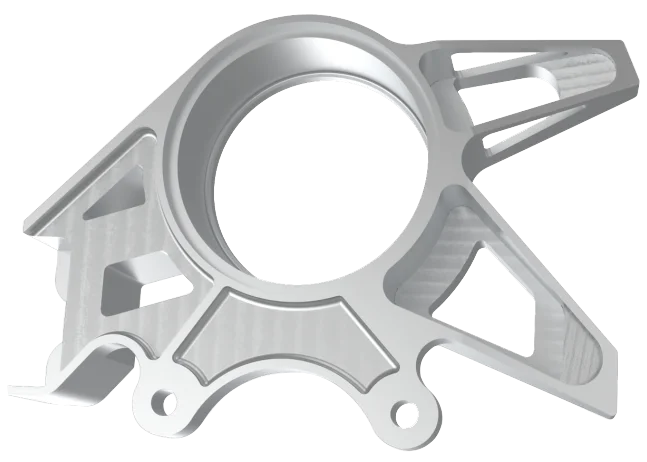
CNC milled aluminum precision part with complex geometry and multiple machining features

Custom Quality Parts By Aria

Send your specs. We’ll get back with a quote in 12 hours.

Scroll to Top