

 EU
Face milling and end milling are easy to confuse. Both run on the same CNC milling machines. Both use a rotating milling cutter with multiple cutting teeth. Both can leave a flat surface on a part. Many shops even use an end mill to face small parts, which blurs the line further.
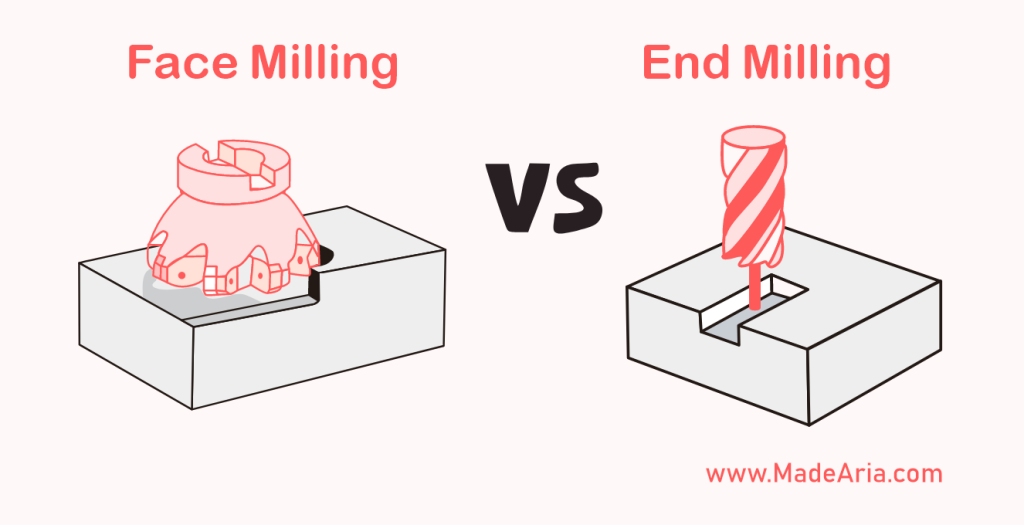
The biggest difference is what each tool is built to cut: a face mill machines large flat surfaces, while an end mill cuts features such as slots, pockets, and contours.
That one difference shapes everything else, from material removal rate and surface finish to precision and cost. This guide compares both processes for engineers, designers, and buyers deciding how a part should be machined.
Core Difference Comparison
Face milling and end milling differ mainly in cutting action, tool geometry, and the features they make.
| Feature | Face Milling | End Milling |
|---|---|---|
| Cutting Edges | Inserts on the bottom face of the cutter | Side flutes and end teeth |
| Tool Design | Large body (Ø50 to 250 mm) with indexable inserts | Small solid carbide or HSS tool (Ø0.5 to 25 mm) |
| Best For | Large flat surfaces, squaring stock, datum faces | Slots, pockets, shoulders, contours, complex 3D shapes |
| Feed Direction | Sideways across the surface | Sideways, plus plunging and ramping into the part |
| Material Removal Rate | High on wide, open faces | Moderate, but flexible for detailed features |
| Surface Finish | Excellent flatness on wide faces | Good on walls and small areas |
The Differences Between Face Milling and End Milling
Machining Process
A face mill cuts with the inserts on its bottom face. The machine spindle holds it perpendicular to the surface being machined. It takes shallow passes across a broad face, often 1 to 4 mm deep. An end mill cuts mainly with its side flutes, so the wall it produces runs parallel to the tool axis. Its end teeth cut the floor and let it plunge into the part, so it can cut much deeper than a face mill.
Material Removal Rate
Face milling can remove material quickly on large surfaces. A wide cutter covers a broad strip in a single pass, and the load is distributed evenly across several inserts. An end mill needs many overlapping passes to clear the same area, but it removes material efficiently on narrow features such as slots, pockets, and side walls.
Tool Design
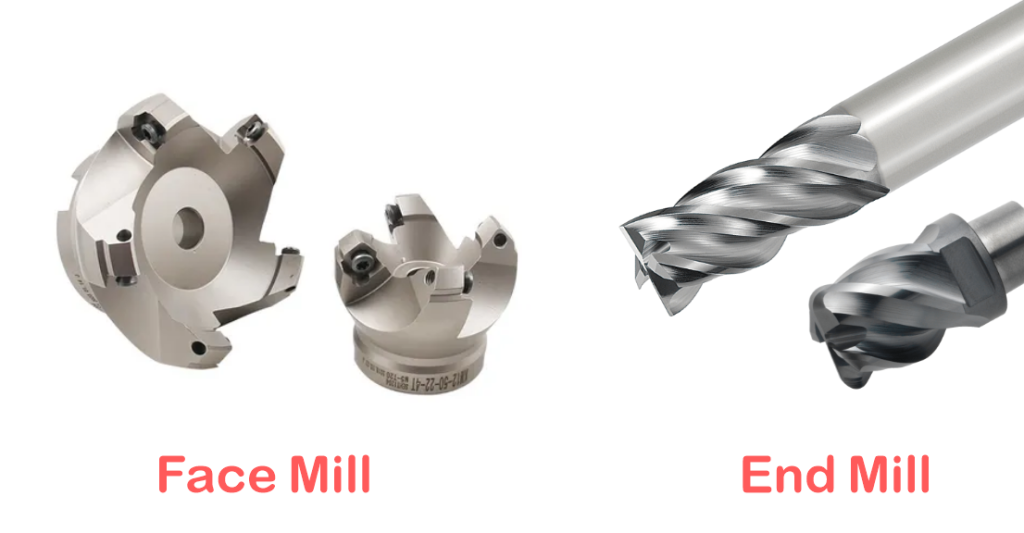
A face mill has a steel body with replaceable carbide inserts. When an edge wears, only the insert is changed. An end mill is usually a single piece of solid carbide or high-speed steel, with a square end, ball nose, or corner radius. Many face mills are shell mills, which mount on an arbor instead of a shank.
Tool Diameter Range
Face mills are large, commonly 50 to 250 mm (2 to 10 in). End mills are small, mostly 0.5 to 25 mm(0.02 to 1 in). The larger diameter lets a face mill cover more surface per pass. The smaller diameter lets an end mill reach pockets and narrow areas a face mill cannot enter.
Helix Angle vs. Entering Angle
End mills have helical flutes, commonly 30° to 45°, which help lift chips out of the cut. Face mills have no helical flutes. Instead, the inserts are set at an entering angle. A 45° cutter allows higher feed rates, while a 90° cutter can cut square shoulders.
Features Produced
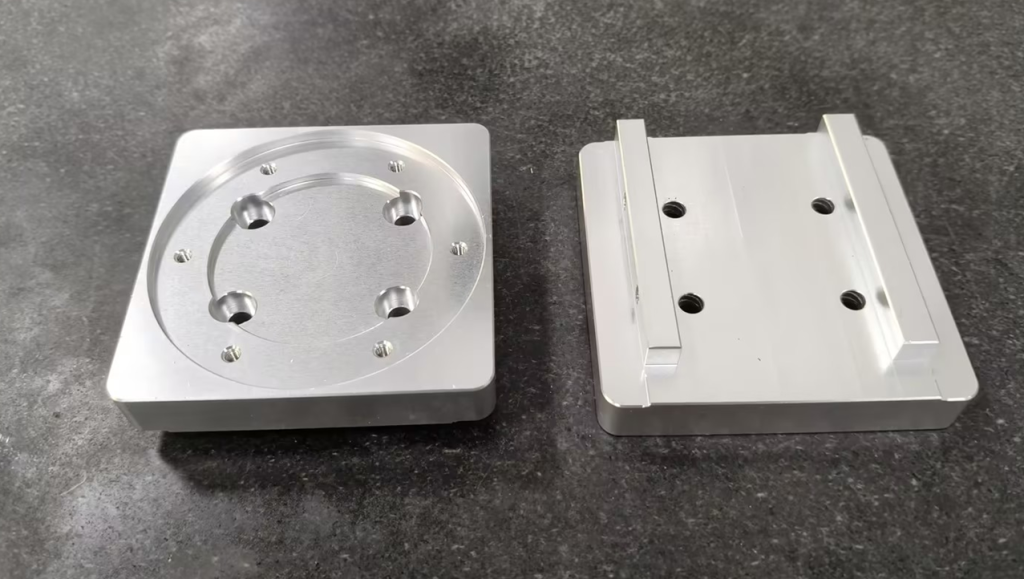
Face milling produces flat surfaces, such as top faces, mounting faces, and datum surfaces. End milling produces slots, pockets, shoulders, and contours. Ball nose end mills also cut the 3D contoured surfaces found in molds and dies. The flat floor of a pocket also needs an end mill, because a face mill is too large to enter it. On many parts, both run in the same setup: the face mill flattens the top first, then end mills cut the features.
Surface Finish and Precision
Face milling gives a smooth finish on wide surfaces because one pass covers the full width. With wiper inserts, it can reach Ra 0.8 µm under good conditions. It is also the better choice for flatness and parallelism, which is why it often creates the datum surface for the precision machining that follows.
End milling gives a good finish on walls and contours, especially in finishing passes. It also controls feature size and position, and precision work can hold around ±0.01 mm. On wide floors, each end mill pass can leave a visible line where it overlaps the next.
Cost
A face mill costs more up front, but its replaceable inserts keep long-term tooling cost low. End mills cost less to buy but are replaced or reground as a whole tool, and small sizes wear faster in hard materials. For most parts, machine time matters more than tooling. Open flat faces and generous internal corner radii let the shop use faster tools and lower the part price.
Material Compatibility
Both processes cut the same materials, including aluminum, steel, stainless steel, cast iron, titanium, and plastics. The material changes the cutting tool, not the process. The main exception is thin parts and softer materials such as plastics, which can distort under a large face mill, so shops often face them with a smaller end mill instead.
How to Choose
Look at the surface on your drawing. If it is flat and open, face mill it. If walls surround it or it has depth, end mill it.
When to Choose Face Milling
Choose face milling when the part has a large, open flat surface, such as a plate, housing, or engine block. Shops also use it first to square raw stock before other machining operations.
When to Choose End Milling
Choose end milling when the part has slots, pockets, shoulders, or complex geometries. A small flat area or one surrounded by walls also calls for an end mill.
Can You Use an End Mill for Face Milling Operations?
Yes. An end mill can machine a flat face, and it is often the better choice for small faces, pocket floors, and surfaces next to walls. On parts that also need pockets or slots, facing with the same end mill saves a tool change.
On a large open surface, a face mill is still faster. An end mill needs many overlapping passes there, and each overlap can leave a visible line.
The reverse does not work. A face mill cannot cut slots, pockets, or contours.
Conclusion
Face milling and end milling work as a team, not as rivals. Face milling gives a part its flat surfaces fast. End milling cuts the slots, pockets, and contours. Choosing the right tool for each surface keeps cycle time and cost down on any CNC machining project.
If you are unsure how a feature on your drawing will be machined, ask before you finalize the design. Aria’s engineers can review your CAD file and point out features that add machining time, such as small internal radii or wide pocket floors.
