

 EU
EUCNC milling and CNC turning are the two core processes of subtractive manufacturing, both using computer numerical control to cut material from a solid workpiece. In milling vs turning, the difference is in the motion: milling spins the tool against a workpiece that stays still, while turning spins the workpiece against a tool that stays still.
This guide covers how it works, the machines, operations, and materials involved, where it fits in production, and how to design parts that mill cleanly.
What is CNC Milling?
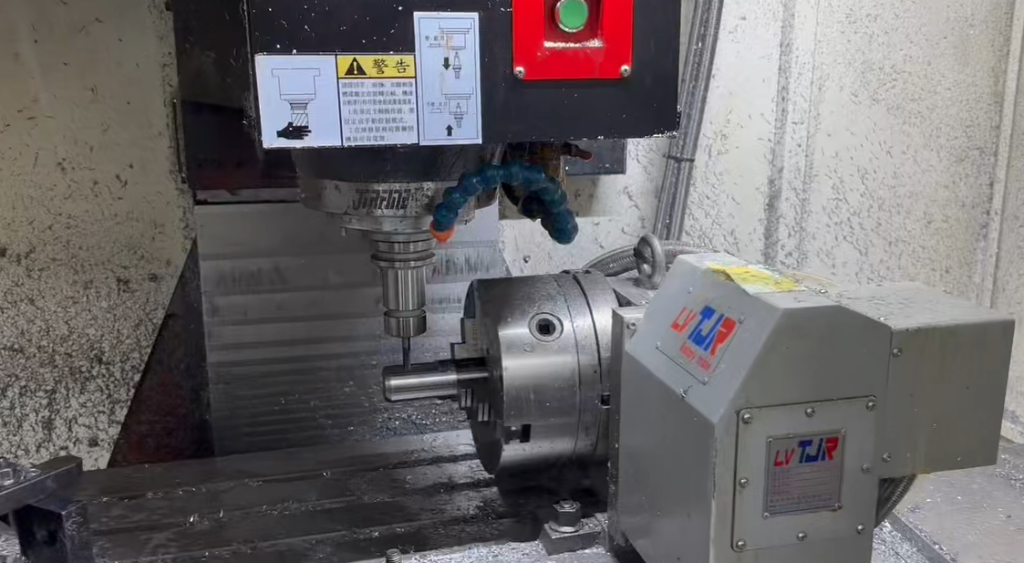
CNC milling is a subtractive process where a rotating cutter removes material from a workpiece clamped on the machine table. The tool moves across the part along multiple axes, cutting flat faces, slots, pockets, and holes. Because the tool moves rather than the part, milling suits prismatic and irregular shapes rather than round ones.
A standard mill works in three linear axes: X, Y, and Z. Advanced 4-axis and 5-axis centres add rotational axes, so the cutter can reach the part from almost any angle, making them ideal for complex components. Fewer setups means less alignment error, which is why tight-tolerance aerospace and medical parts often run on 5-axis machines.
The same machine handles many operations. Face milling flattens surfaces, end milling cuts slots and pockets, and drilling and boring finish holes. Switching between them only takes a tool change and a new program.
Advantages
- High geometric versatility for complex contours and multi-sided components.
- Reaches intricate features such as enclosed pockets, deep slots, angled bores, and freeform surfaces with high accuracy.
- Multi-axis capability cuts the number of fixture setups a complex part needs, which protects accuracy.
- Works across almost every engineering material, from aluminium and steel to titanium, brass, and plastics.
- A wide library of specialised cutters covers almost any feature profile.
Disadvantages
- Higher tooling and setup costs than basic turning operations.
- Longer cycle times for round or axially symmetric parts.
- Heavy continuous roughing across flat surfaces accelerates tool wear.
- Complex 4-axis and 5-axis surface paths demand more involved G-code programming.
- CNC milling requires skilled operators for programming.
What is CNC Turning?
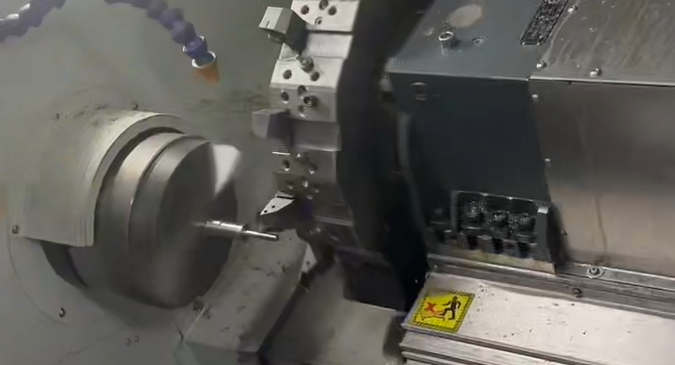
CNC turning is a subtractive process where the workpiece rotates while a stationary single-point tool removes material to create cylindrical parts. The bar stock is clamped in a chuck and driven at high speed, and the tool feeds along the X and Z axes to shape the outer or inner surfaces. Because the workpiece moves rather than the tool, turning suits round and axially symmetrical shapes such as shafts, bushings, and threaded parts.
A lathe machine covers more than basic outer-diameter cutting. Facing squares off the end, boring opens up the inside, and threading, grooving, and parting add features along the surface or cut the finished part free from the bar. Modern lathes often add live tooling: rotating milling and drilling spindles mounted in the turret. Live tools cut off-centre holes, keyways, and flats without moving the part to a separate mill, which cuts a setup out of the process.
Advantages
- High efficiency and rapid cycle times for round, cylindrical, and tube-shaped parts.
- Exceptional concentricity and dimensional accuracy along the rotational axis.
- Excellent surface finish from the continuous cutting contact.
- Lower tooling costs and shorter setup times than milling for symmetric work.
Disadvantages
- Restricted to rotational and axially symmetric shapes without live tooling.
- Flat features, deep pockets, and prismatic geometry need a mill or a mill-turn machine.
- Part size is limited by the bore size and swing capacity of the lathe.
- Asymmetric or irregular stock can create imbalance at high speed.
Key Differences between CNC Milling and Turning
Milling and turning differ across every stage of production, from how the machine moves to what the finished part costs. The sections below break the comparison down by the factors that decide which process fits a given part.
Machining Process
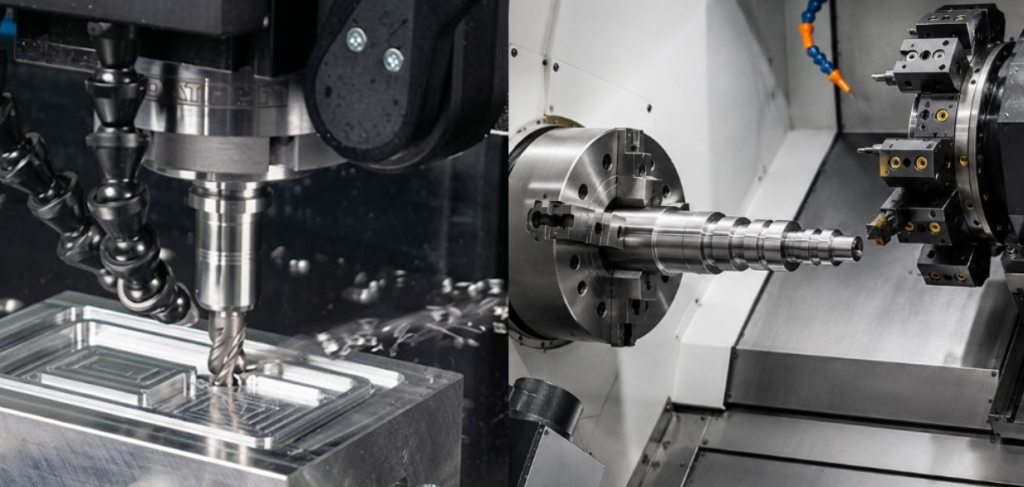
CNC milling process: the stock is clamped to the worktable or held in a vice. The cutter spins at high RPM and moves across the stationary workpiece along programmed paths, a principle central to multi axis machining. Material comes off incrementally as each flute strikes the workpiece, so the cut is interrupted rather than constant.
CNC turning process: the stock is gripped in a spindle-driven chuck and spun at speed. A single-point tool feeds into the material along linear paths. Cutting stays continuous through each pass, which produces smooth diameters, tapers, and faces.
Machines
CNC milling machines: a spindle holds and rotates the cutter while the workpiece stays fixed to a moving table. Vertical machining centres cover most work, with horizontal and 5-axis machines added for multi-sided parts.
CNC turning machines: the stock is gripped in a spindle-driven chuck and spun at speed. A single-point tool feeds into the material along linear paths. Cutting stays continuous through each pass, which produces smooth diameters, tapers, and faces.
Ideal Geometry
CNC milling: flat surfaces, prismatic profiles, square edges, deep pockets, slots, and other complex geometries such as 3D contours. Parts with non-symmetric features or several machined faces belong on a mill.
CNC turning: axially symmetric and cylindrical shape parts, including round bars, shafts, stepped cylinders, bushes, tubes, cones, and fasteners.
Motion
CNC milling: the primary cutting motion is the rotating cutting tool, combined with linear travel of the tool or the machine bed along the programmed axes.
CNC turning: the primary cutting motion is the rotating workpiece. The stationary cutting tool moves linearly, along or across the axis of rotation.
Cutting Tools
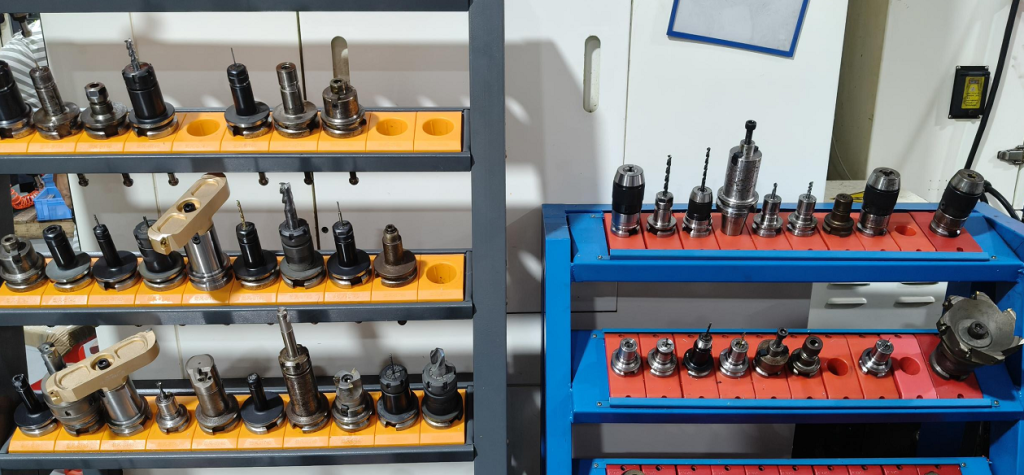
CNC milling: multi-point tools such as end mills, face cutters, ball mills, reamers, and drills. Each clears chips through several flutes or inserts.
CNC turning: single-point tools held in a turret or tool post. The insert shape, such as a parallelogram, triangle, or round, is chosen to match the feed direction, profile angle, and whether the pass is roughing or finishing.
Production Speed
CNC milling: extra step-overs and multiple passes are needed to clear flat layers or profile a cavity, so cycle times run longer on round features.
CNC turning: the insert stays in constant contact with the spinning part, giving a far higher material removal rate than milling on cylindrical profiles.
Material Compatibility
CNC milling: cuts the full range of engineering metals and plastics, and its rigid table clamping suits large, heavy block stock.
CNC turning: cuts the same materials, including aluminium, stainless steel, alloy steels, brass, titanium, ABS, and PEEK. Long, thin cylindrical stock runs better here when supported by a tailstock or steady rest.
Machining Complexity
CNC milling: handles higher geometric complexity. A 5-axis machine moves the tool through five degrees of freedom at once, cutting compound angles and organic surfaces without refixturing.
CNC turning: a standard lathe works in two axes. Reaching off-axis or non-cylindrical features calls for a turn-mill machine with live tooling and a C-axis or Y-axis.
Number of Axes
CNC milling: three axes as standard (X, Y, Z), rising to four (X, Y, Z, A/B) or five (X, Y, Z, A, C) on advanced machines.
CNC turning: two axes as standard (X, Z). A turn-mill lathe extends this to between three and five, adding C, Y, and sometimes a sub-spindle.
Surface Finish
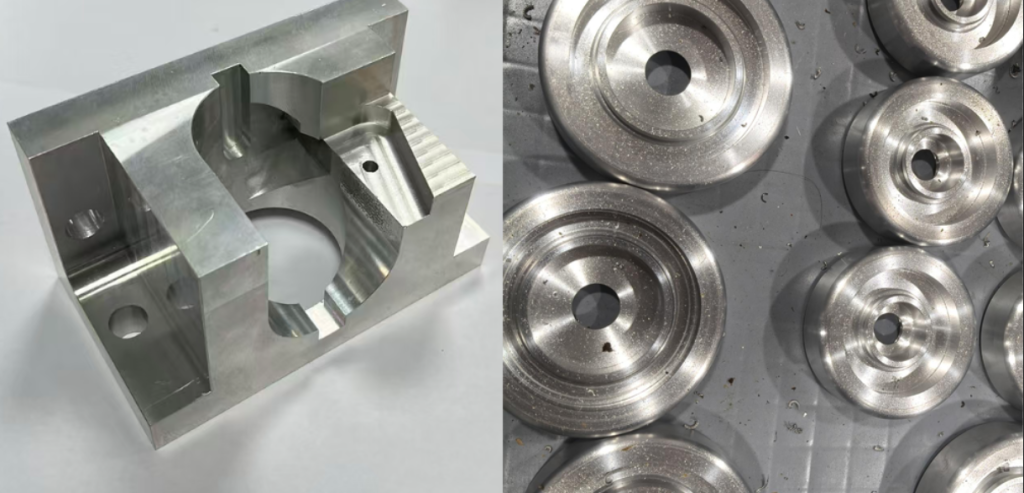
CNC milling: leaves fine ridges known as scallop or cusp marks. Smoothing them out means a finer step-over or a secondary operation such as grinding or polishing.
CNC turning: generally leaves a better finish on round surfaces, because the tool stays in constant contact with the spinning part and avoids the marks left by interrupted flutes.
Cost and Efficiency
CNC milling: higher tooling and fixture costs. For multi-featured non-cylindrical parts, though, multi-axis milling does the whole job in one process and removes the secondary operations a simpler method would need, which lowers the total cost.
CNC turning: lower tooling cost, setup time, and cycle time on round and symmetric parts, which lowers the per-part cost in volume.
Common Operations
CNC milling: face milling uses a rotating multi-tooth cutter to flatten a large top surface, end milling cuts slots and pockets, peripheral milling, and thread milling cuts shapes edges and profiles, and contour milling follows a programmed path for curved surfaces. Drilling uses a rotating tool to drill holes, boring sizes them threads.
CNC turning: facing feeds a single-point tool across the end of the spinning part to square it off and set a reference length. OD/ID turning reduces the outside or opens up the inside, grooving cuts channels, threading cuts screw threads, knurling rolls on a grip pattern, and parting cuts the finished part free from the bar.
Applications:
CNC milling: aerospace structural components, engine housings, injection moulds, and medical implants, all needing multi-axis cutting and tight tolerances on non-round features. For complex one-off parts and prototypes, CNC milling is also the more flexible choice, since a new part is a program change rather than new tooling.
CNC turning: shafts, fasteners, valve bodies, and pipe fittings across automotive, oil and gas, and medical equipment manufacturing, where concentricity and a clean finish on cylindrical surfaces matter most. For simple rotational parts produced in large volumes, CNC turning is also particularly cost-effective.
| Feature | CNC Milling | CNC Turning |
| Workpiece motion | Clamped, stationary | High-speed rotation |
| Tool motion | Rotates on spindle | Feeds linearly along X and Z |
| Tool type | Multi-point (end mills, drills) | Single-point (inserts, boring bars) |
| Primary part shape | Prismatic, flat, complex 3D | Cylindrical, round, tubular |
| Cutting action | Interrupted | Continuous |
| Standard axes | 3, 4, or 5 | 2 to 4 with live tooling |
| Best for | Pockets, slots, complex surfaces | Shafts, bushings, threaded rods |
Similarities Between CNC Milling and CNC Turning
The two processes share more than the differences suggest. Both are subtractive: they start from solid stock and cut material away, rather than building a part up. Both milling and turning run under computer numerical control, driven by the same CAD-to-CAM workflow that turns a 3D model into G-code.
The material range overlaps almost entirely. Aluminium, steel, brass, titanium, and most engineering plastics all machine well on either process. Both generate heat at the cutting edge and rely on coolant to protect the tool and hold tolerances.
The line between them has blurred at the high end. Live tooling gives a lathe milling and drilling functions, while mill-turn centres combine both processes in one machine. For many parts, the practical choice is no longer milling vs turning, but how much of each to run on a single setup.
CNC Milling Vs CNC Turning, How to Choose
Selecting between CNC milling and CNC turning comes down to part geometry, production volume, feature placement, and budget. The choice directly affects unit cost, lead time, and machining quality. Three questions settle most cases: what shape is the part, how many do you need, and what does each option cost to make.
When to Choose CNC Milling Process
Choose milling when the part is not built around a single axis, or when its complexity lives on more than one face. Milling reaches those features without forcing the part into a round profile it was never meant to have. Select milling for:
- Prismatic and flat components: mounting brackets, plates, housings, and engine blocks with square bases and flat faces.
- Complex surface geometry: enclosed cavities, deep pockets, contoured moulds, and complex shapes with 3D sculptured surfaces.
- Off-axis features: holes, counterbores, slots, or threads placed away from any central axis.
- Low-to-medium volumes: prismatic prototypes and small batches, where a new part is a program change rather than new tooling.
When to Choose CNC Turning Process
Choose turning whenever the part is round. A lathe produces axially symmetric parts faster, more concentrically, and at a lower cost than a mill can manage, and it pulls further ahead as volume rises. Select turning for:
- Cylindrical and symmetric geometry: shafts, pins, bushings, fasteners, flanges, and spacers.
- Tight concentricity: round components where inner and outer diameters must hold strict runout tolerances.
- High-volume round production: bar-fed lathes run near-continuously, cutting one part free as the next begins and driving down per-part cycle time.
- Fine surface finish on round surfaces: continuous cutting leaves a clean finish across cylindrical spans, without the step-over marks a mill leaves.
A few small off-axis features, such as a cross hole or a flat, do not rule turning out, since live tooling can add them on the same machine.
Hybrid Solution: Mill-Turn Machining
In the manufacturing industry, many parts are neither purely round nor purely prismatic. A drive shaft with off-centre mounting holes, a cross-drilled oil channel, or a turned body with a milled keyway needs both processes to finish.
The usual route is to turn the part first and move it to a mill for the rest. Every transfer adds setup time, labour, and tolerance stack-up, and a fresh chance to lose alignment. A mill-turn machine removes that step. With live tooling and a motorised C-axis or Y-axis turret, it turns the part, then indexes or stops the spindle to mill slots, drill cross holes, and cut features, all in one setup.
Nothing is unclamped between operations, which protects concentricity and holds tighter tolerances across features that would otherwise span two machines.
CNC Milling vs CNC Turning Services: Why Choose Aria
Knowing which process fits your part is one thing. Having a supplier who runs both, and knows when to combine them, is what gets it made right. Aria Manufacturing operates 3, 4, and 5-axis milling alongside turning centres with live tooling under one roof, so the process is matched to the drawing, not to whichever machine is free.
That range matters most on parts that cross between round and prismatic. A turned body with a milled keyway or a shaft with cross holes can be finished in one mill-turn setup instead of moving between machines, which protects concentricity and holds tolerances across features.
Every drawing is reviewed for manufacturability first, then run on the route that needs the fewest setups. Send a drawing or 3D model, and Aria will advise on the right process, the achievable tolerances, and the cost before any metal is cut.
FAQs:
Q: What is the CNC machining process?
A: CNC machining is an automated, subtractive process where pre-programmed software controls the movement of the cutting tools. A CAD model is converted into G-code, which drives equipment such as mills, lathes, routers, and grinders to cut material away from a solid block or bar. The result is a high-precision metal or plastic part made to the original design.
Q: What is the difference between CNC milling and CNC turning?
A: The core difference is which element rotates. In milling, the cutting tool spins at high speed and moves across a workpiece that stays fixed, which suits prismatic and complex features. In turning, the workpiece spins in a chuck while a stationary tool feeds into it, which suits round and cylindrical profiles.
Q: What is the main difference between a CNC lathe and a CNC mill?
A: A lathe holds the workpiece in a spinning chuck and keeps the tool still, which makes it ideal for round parts such as shafts and bushings. A mill clamps the workpiece to a bed while rotating tools cut from above, which suits flat faces, pockets, slots, and complex 3D contours. That single difference in what moves decides which geometries each machine makes well.
Q: How much does a CNC turn-mill machine cost?
A: Price scales with spindle count, live tooling, and axis configuration. Entry-level mill-turn centres start around $85,000, mid-range industrial machines run $150,000 to $350,000, and high-end multitasking centres exceed $1 million. For most buyers, though, the list price is beside the point. What matters is the cost per part from a supplier who already runs one.
Q: How much does CNC machining cost per hour?
A: Rates depend on the machine, region, and setup. In China, milling runs about $25 to $50 per hour, turning $20 to $40, and 5-axis or Swiss-type work $50 to $90. The same work costs two to three times more in the US or Europe. Hourly rate alone can mislead, though. A faster machine at a higher rate often makes the part for less overall, so cost per finished part is the number worth comparing.
Q: Is milling harder than turning?
A: Milling is generally the more complex process. It needs multi-axis tool path planning, more involved workholding, and management of interrupted cuts across several flutes. Turning is simpler for round parts, since it is mostly continuous single-point cutting along two axes. Neither is harder in an absolute sense; each is straightforward for the geometry it suits.
Q: Can milling be done on a lathe?
A: A standard 2-axis lathe cannot mill. A turning centre fitted with live tooling and C-axis or Y-axis control can, performing light milling, cross-drilling, keyway slotting, and off-centre tapping before the finished part is cut free. Complex milled features still call for a dedicated mill or a mill-turn machine.
