Aerospace CNC Machining: Precision, Applications, and Materials

cnc machining for Aerospace

Share:

Table of Content

Table of Content

A modern aircraft contains thousands of machined parts, each expected to perform under extreme temperature, vibration, and aerodynamic load. Turning those digital designs into certifiable flight hardware is the job of aerospace CNC machining — a discipline held to standards far stricter than general manufacturing.

What Is Aerospace CNC Machining?

Aerospace CNC machining is computer-controlled subtractive manufacturing, where pre-programmed tools cut metal billets or cast preforms into finished parts. Toolpaths are generated from CAD/CAM models as G-code, then executed on mills, lathes, and turn-mill centers that position the cutter to within a few microns. It spans milling, turning, drilling, grinding, and EDM, and is set apart from general machining by micron-level tolerances, full material traceability, and certifications such as AS9100 and NADCAP. Because most aerospace runs are low-to-medium volume but high-value, repeatability and documentation matter as much as raw cutting capability.

Aerospace CNC Machining

Why Precision Matters in Aerospace

Many aerospace parts belong to life-sustaining systems where a single defect can cause catastrophic failure. Precision is what keeps these components safe, reliable, and interchangeable across a global fleet, and it influences everything from assembly fit to long-term fatigue life.

Safety and structural integrity

Tight dimensional control prevents weak points in load-bearing parts, ensuring they withstand operational stress, pressure cycling, and vibration without deformation or premature failure.

Extreme tolerances

Standard aerospace work reaches ±0.0005 in (±12.7 μm) or tighter, with the most critical engine features held to single-digit microns where even a few micrometers of deviation can compromise function.

Repeatability across lots

Programmed toolpaths reproduce identical, interchangeable parts not just within a batch but between production lots — essential for assembly and fast fleet maintenance.

Performance and efficiency

Precise fits and smooth surface finishes minimize friction, turbulence, and wear, directly improving aerodynamics, fuel efficiency, and engine performance.

Compliance and traceability

AS9100 and NADCAP certification, first article inspection (FAI), and statistical process control (SPC) validate every part; falling short risks part rejection, program disqualification, or regulatory penalty.

Key Aspects of Aerospace CNC Machining

Holding flight-critical tolerances depends on far more than a capable machine. The following aspects consistently separate qualified aerospace work from general machining, and most quality failures trace back to one of them being overlooked.

Tolerance and GD&T control

Critical features commonly fall in the ±0.0001–±0.0005 range (±2.5–12.7 μm), and geometric dimensioning and tolerancing (GD&T) define form, orientation, profile, and location more precisely than coordinate dimensions — controlling mating surfaces, bore alignment, and tolerance stack-up across multi-part assemblies.

Material certification and traceability

Every part must originate from verified, approved material with documented supply records, so each batch can be traced from raw mill stock through heat treatment to final inspection — a non-negotiable requirement in regulated supply chains.

Thermal and distortion management

Cutting heat, clamping force, vibration, and tool wear all shift dimensions during machining; thin walls and specialized alloys such as titanium and Inconel amplify the effect and demand controlled feeds and speeds, rigid fixturing, and high-pressure coolant to hold size.

Process control and inspection

SPC monitors variation in real time to catch drift before parts go out of tolerance, while final verification at a 68°F (20°C) reference temperature ensures measurements are not corrupted by thermal expansion — with measuring equipment resolving at least ten times finer than the tolerance checked.

Design for manufacturability

Early review of complex geometries, sharp internal corners, deep pockets, and thin features reduces unnecessary secondary operations and scrap, lowering cost without compromising part function or performance.

CNC Machining Processes Used in Aerospace

Aerospace relies on multiple complementary processes rather than one method, each selected by material type, tolerance, geometry, and part complexity. Most flight parts pass through more than one operation before they are complete.

CNC milling

Rotating cutters remove material from a fixed workpiece to produce complex 3D contours, pockets, and profiles; it is the most widely used aerospace process and the backbone of structural part production.

Multi-axis machining

3-axis and 5-axis centers cut multiple faces in a single setup, reaching undercuts and compound angles while reducing repositioning and the alignment errors it introduces — critical for turbine blades and other free-form surfaces.

CNC turning and turn-mill

Produce cylindrical and rotational components such as shafts, bushings, and housings; turn-mill centers combine turning and milling in one machine to finish complex parts without re-fixturing.

Drilling, grinding, and EDM

Support precise hole-making, fine surface finishing, and hard-material or intricate features — EDM in particular cuts hardened alloys and sharp internal geometries that conventional cutters cannot reach.

Applications of CNC Machining in Aerospace

Across nearly every aircraft and spacecraft system, CNC machining is the process that shapes high-value parts to flight-critical tolerances while balancing strength against weight. It serves commercial aviation, defense, and space alike.

Structural components

CNC milling cuts ribs, spars, bulkheads, and frames from solid billets — often removing more than 90% of the stock to create lightweight monolithic parts with the rigidity and tight fit airframe assemblies demand.

Engine and propulsion parts

5-axis machining carves turbine blades, discs, combustion chambers, and casings whose curved surfaces and tight tolerances are essential to aerodynamic efficiency and thermal performance at extreme temperatures.

Landing gear

CNC turning and milling produce struts, axles, and beams from high-strength steel and titanium to exact specifications, so they survive repeated impact loading and concentrated stress on every landing.

Flight control and actuation

Ailerons, elevators, rudders, valves, and actuators rely on machined parts whose precise internal geometries give pilots responsive, predictable control inputs.

Brackets, housings, and connectors

CNC machining holds the dimensional accuracy needed to fit electrical, fluid, fuel, and avionics systems within tight weight budgets while sealing against pressure and moisture.

Space hardware

Machined components for satellites, spacecraft, and rockets meet the micron-level precision and reliability that survival in the launch and orbital environment demands.

Materials Used in Aerospace CNC Machining

Material selection balances strength, weight, temperature resistance, and machinability while preserving structural integrity. Each class brings trade-offs between performance and the cost and difficulty of cutting it.

Aluminum alloys

Lightweight, corrosion-resistant, and cost-effective with excellent machinability; 6061 and 7075 are workhorses for airframe and structural components where strength-to-weight is paramount.

Titanium alloys

An outstanding strength-to-weight ratio and heat resistance make them ideal for engine parts and high-load structures, though low thermal conductivity and high strength accelerate tool wear and extend cycle times.

Nickel superalloys

Withstand extreme temperatures and oxidation in engine and combustion sections where aluminum and titanium would fail, at the cost of being among the hardest materials to machine.

Engineering plastics

PEEK, Ultem, and acetal serve high-temperature and demanding mechanical applications — insulators, bushings, and interior parts — at a fraction of the weight of metal.

Future Trends in Aerospace CNC Machining

As aircraft programs push for lighter structures, shorter lead times, and lower cost per part, several technologies are reshaping how aerospace components are machined.

Additive and CNC integration

Pairing 3D printing with finish machining produces lightweight parts with complex internal geometries while cutting material waste — printed near-net shapes are then machined to final tolerance on critical surfaces.

High-speed machining

Higher spindle speeds and optimized toolpaths shorten cycle times and improve surface finish and tool life, especially on aluminum and composites, raising throughput on high-volume structural work.

Automation and Industry 4.0

IIoT-enabled smart factories link machines, sensors, and inspection data to support lights-out production, real-time process monitoring, and tighter, data-driven quality control.

Predictive maintenance

sensor data and analytics anticipate spindle, tool, and equipment failures before they occur, minimizing unplanned downtime and protecting the consistency aerospace tolerances require.

Need aerospace parts machined to spec?

Aria Manufacturing delivers precision CNC machining with full material traceability and certification.

Written By
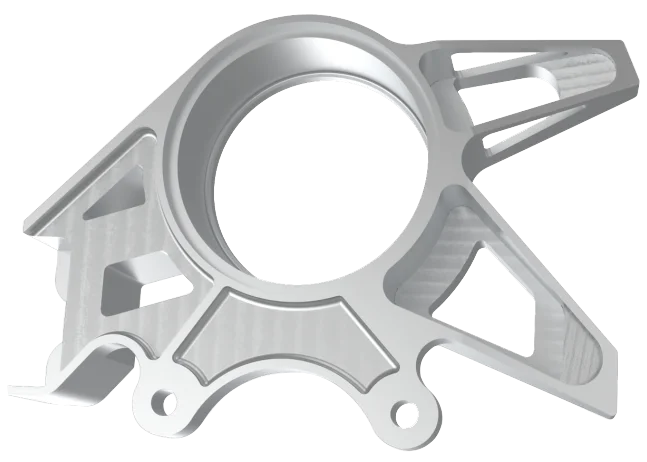
CNC milled aluminum precision part with complex geometry and multiple machining features

Custom Quality Parts By Aria

Send your specs. We’ll get back with a quote in 12 hours.

Scroll to Top