

 EU
Blind holes and through holes are both machined features that accommodate fasteners, locate parts, or carry fluids and wires. What separates them is the bottom: a through hole opens on both faces of the part, while a blind hole stops at a set depth and leaves a closed bottom inside. That one difference affects how each hole is drawn, machined, tapped, assembled, inspected, and priced, which the sections below explain in turn.
What Is a Blind Hole?

A blind hole is a hole with one open end and a closed bottom that ends inside the part. It is drilled, milled, or bored to a set depth, and the opposite side stays intact. A twist drill leaves a cone-shaped bottom, while an end mill or flat-bottom drill leaves a flat one.
Blind holes are used when the far surface must stay unbroken or the part needs material below the hole for structural integrity. Because chips cannot exit at the bottom of the hole, they need careful planning to machine and tap. For machining methods, applications, and design tips, see our full guide to blind holes.
What Is a Through Hole?

A through hole is a hole with no bottom that connects two opposite faces of a part. The tool cuts from one side until it exits the other, and that exit edge usually leaves a burr. Removing it keeps good surface quality, which matters most on thin walls and finished surfaces.
Through holes are used when a bolt, shaft, wire, or fluid needs to cross the part. A common example is a bolt that joins two plates and is held by a nut on the back side. Because chips and coolant drop out of the open end, through holes are easier to machine and tap than blind holes.
Difference Between Blind Holes and Through Holes
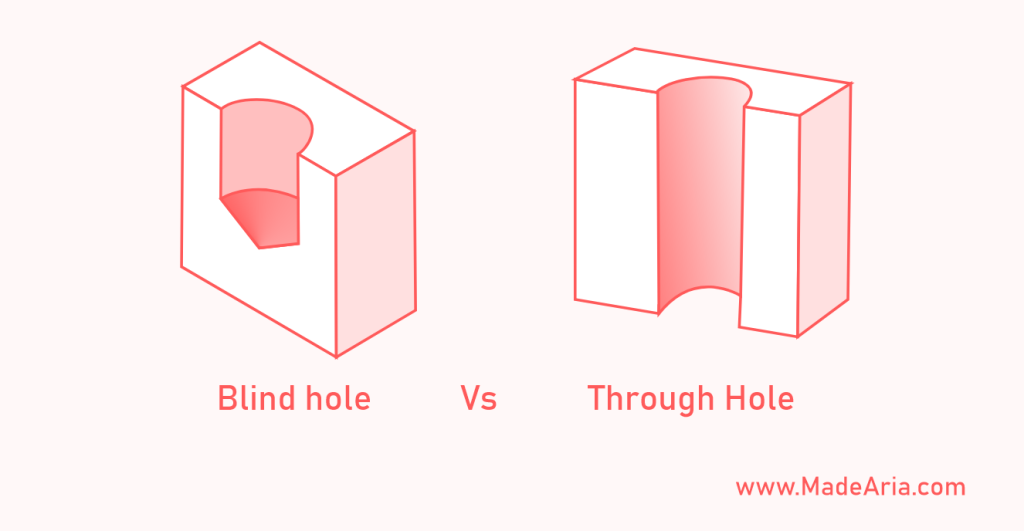
Blind holes and through holes differ in how they are drawn, machined, tapped, assembled, inspected, and priced. Each difference is explained below.
Drawing Symbol
A blind hole is called out with a diameter and a depth, while a through hole is called out with a diameter and THRU. Under ASME Y14.5, ⌀10 ↧15 means a hole with a 10 mm nominal diameter and a 15 mm hole depth at full diameter.
Blind threaded holes list both depths, for example M8×1.25-6H ↧12 MIN FULL THD with a ⌀6.8 ↧16 pilot hole for the tap. A through hole reads ⌀10 THRU. Drawings with no depth and no THRU note often lead to quote delays.
Structure and Design Parameters
A blind hole has a closed bottom and a set depth, while a through hole is open at both ends. A drilled blind hole has a cone-shaped bottom, usually 118° or 135°, unless a flat bottom is specified. A drilled hole also leaves a rough hole wall, so pin and press-fit holes need reaming or boring to lower surface roughness.
Small and deep holes are harder to drill because of chip removal and tool deflection. Standard drilling works best up to about 3 to 5 times the diameter.
Machining Challenges and Tapping
Through holes machine faster and give longer tool life because chips and coolant exit the far end. Deep blind holes need peck drilling (G83) and often coolant through the tool to control chips and heat buildup. Reaching the proper depth depends on an accurate tool length offset, since a small error can leave the hole too shallow or break through.
Through holes use spiral point taps that push chips out the exit. Blind holes use spiral flute taps that pull chips upward, or form taps that make no chips. When material hardness or part value makes tap breakage too costly, thread milling is the safer choice.
Function and Assembly
Blind holes anchor screws that hold mating components from one side, keeping the back face closed and screw tips hidden. Screw length must suit the thread depth so the screw does not bottom out.
Through holes let bolts pass to a nut on the far side, so the joint clamps without relying on the part’s internal threads. This suits soft materials but needs access from both sides. In aluminum or plastic parts with one-side access, threaded inserts strengthen blind tapped holes.
Cost and Inspection
Blind holes cost more to make and inspect than through holes. They take longer to drill, cause more tool wear, carry a higher risk of broken taps, and can trap chips or coolant that spoil the surface finish after anodizing or plating.
Through holes can be checked with a pin or thread gauge from either side. Blind holes also need depth checks with a depth gauge, a full-depth thread gauge, or a CMM to confirm dimensional accuracy.
Practical Applications
Blind holes suit parts where the far side must stay closed, while through holes suit parts where something must pass across.
Blind holes are common in enclosures, hydraulic manifolds, mold bases, and fixtures with dowel pins. Through holes are common in flanges, frames, brackets, shaft bores, hinges, and cable or coolant passages.
How to Choose
Use a through hole whenever the design allows it, because it is more cost effective and easier to machine. Use a blind hole when the far side must stay closed, cannot be reached, or needs the material behind the hole.
When to Choose Blind Holes
- Cosmetic or visible surfaces: A blind hole keeps the back face clean, with no exit holes or screw tips on housings, panels, and consumer products.
- Sealing and pressure containment: A blind hole leaves a solid wall behind each port, which keeps fluids, dust, and moisture inside hydraulic manifolds and sealed enclosures.
- Limited back-side access: A blind hole lets a screw anchor from one side when a nut or tool cannot reach the back of thick blocks, mold bases, or mounted parts.
- Fixed depth for pins and sensors: A blind hole gives dowel pins, springs, and sensors a set depth to seat against.
- Blind hole design tips: Leave enough wall behind the drill point, keep depth no greater than the thread needs, and specify a flat bottom only when required.
When to Choose Through Holes
- Bolt and nut connections: A through hole lets a bolt clamp parts with a nut, which holds up well under vibration and heavy loads, especially in aluminum and plastic.
- Frequent disassembly: A through-bolted joint comes apart quickly for maintenance, inspection, or part replacement.
- Fluid, air, and cable passages: A through hole gives shafts, pins, cables, hoses, coolant, and air an open path across the part.
- Lower machining cost: A through hole needs faster cycles, simpler tapping, and less inspection, which reduces per-part cost on high-volume orders.
- Through hole design tips: Size clearance holes to allow for position tolerance, and plan for deburring on the exit side.
Other Common Hole Types in CNC Machining
Blind and through describe how deep a hole goes. Most other hole types, such as clearance, tapped, counterbored, and countersunk holes, describe its shape or purpose, and each one can be made as either a blind hole or a through hole. For callouts, drawings, and machining methods for each one, see our guide to types of holes in engineering.
When a drawing could use either a blind hole or a through hole, a DFM review before quoting helps settle the choice. Aria’s engineering team checks hole types, depths, and thread callouts as part of every CNC machining quote.
