
12 Different Types of Pins

type of pin

Have you ever stared at a drawer full of small metal pins and wondered which one actually belongs in your machine? You are not alone. This guide walks you through all 12 types of pin fasteners, explains exactly how each one works, and helps you pick the right pin with total confidence — every time.

What Are Pin Fasteners?

Pin fasteners are small but mighty cylindrical hardware components. They connect, align, or lock two or more parts together in an assembly. Unlike bolts, they do not clamp or compress parts — instead, they resist shear force, the opposing push that tries to slide parts sideways against each other.

Think about the last time you serviced a tractor, assembled industrial machinery, or built a precision jig. Somewhere in that process, a pin was doing the quiet, critical work of keeping everything exactly in the right place.

Pin fasteners fall into two broad categories. Semi-permanent pins require tools or pressure to install and remove. Quick-release pins use springs or snap rings for fast, tool-free assembly and disassembly. Knowing which category you need is the first step toward choosing correctly.

Need precision pins machined to spec?

Aria machines custom pin fasteners to ±0.001″ tolerance, in any alloy, at any volume — from a single prototype to full production runs.

Request a free quote

12 Different Types of Pin

Each pin type gets its own breakdown: what it is, how it works, where you will find it, and when to choose it.

Cotter Pins

Cotter pins — also called split pins in the UK — are made from a wire rod bent into a half-circle, with two legs that splay apart after insertion to lock the pin in place.

You will see cotter pins everywhere: automobile suspensions, castle nuts, marine propeller shafts, and agricultural hitches. They provide a reliable, low-cost safeguard against vibration-induced loosening.

Cotter pins are single-use fasteners — the legs are permanently bent during installation. Always replace rather than reuse. Made from soft metals like low-carbon steel or brass, use them as a secondary locking device alongside a clevis pin or threaded fastener.

Cotter Pin

Dowel Pins

Dowel pins are the gold standard for precision alignment. These solid, cylindrical pins are machined to extremely tight tolerances and inserted into pre-drilled holes to lock components in exact positions — with zero lateral movement allowed.

A dowel pin can be a slip fit (slightly smaller than the hole) or a press fit (slightly larger, driven in permanently). Common in CNC molds, injection dies, robotic tooling, automotive jigs, and flat-pack furniture.

Stainless steel dowels resist corrosion; hardened alloy steel dowels handle high shear loads. If you need precision and reusability, dowel pins are the clear choice.

Dowel Pin

Lynch Pins

Lynch pins are quick-release locking pins built around a spring-loaded ring. The pin slides through an axle or shaft hole, and the ring snaps closed automatically to prevent the pin from backing out. No tools required.

Most common in agriculture and construction — tractor implements, hay balers, and equipment hitches all rely on lynch pins. They offer significantly more grip strength than a standard cotter pin.

Wire Lock Pins

Wire lock pins combine the best features of cotter pins and clevis pins into one smart fastener. A spring-steel wire loop wraps around and locks automatically on insertion — and unlike cotter pins, wire lock pins are reusable.

Especially valued in aviation, marine rigging, and military equipment, where vibration is constant and accidental release would be catastrophic.

Spring Pins (Tension Pins)

Spring pins are hollow cylindrical fasteners with a slot running down their length. When driven into a hole slightly smaller than the pin’s outer diameter, the pin compresses and springs outward. That radial tension holds it in place.

Slotted spring pins have a single lengthwise gap. Coiled spring pins are rolled in a spiral of 2.25 coils and provide higher shock absorption. Both types are self-retaining — no secondary locking pin needed.

Taper Pins

Taper pins are precision steel rods wider at one end and narrower at the other. Standard taper ratio: 1:48 for inch, 1:50 for metric.

Driven into a reamed tapered hole, the pin creates a self-locking interference fit — no threads, no clips, just physics. Ideal for securing hubs, collars, and gear shafts in high-vibration environments.

Clevis Pins

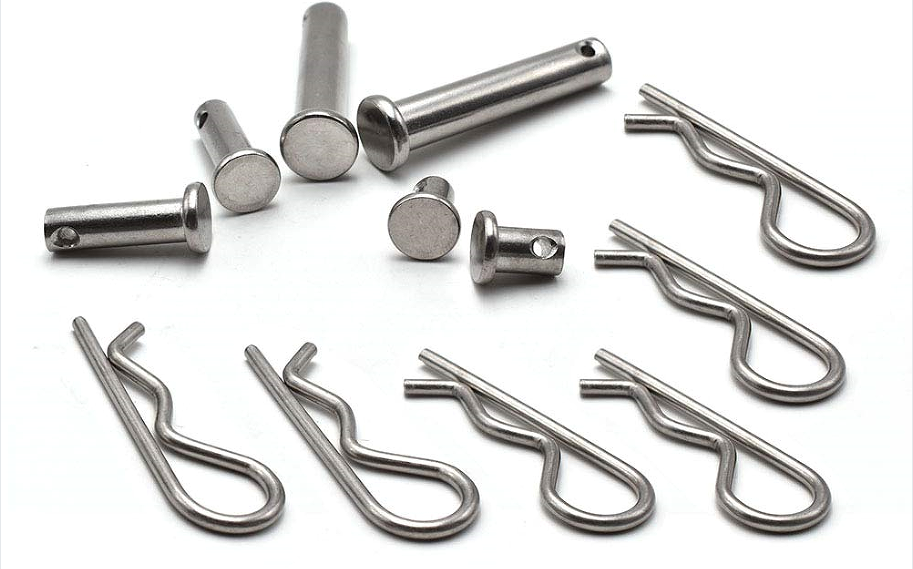
Clevis pins are the hinge pins of the fastener world — a smooth cylindrical shank, a flat head at one end, and a cross-hole at the other. The assembly pivots freely around the pin’s axis.

Critical rule: never use a clevis pin without a secondary fastener through that cross-hole. A cotter pin, hair pin clip, or wire lock pin must secure it. Found in sailboat rigging, agricultural linkages, construction equipment, and automotive steering.

Handle Pins

Handle pins have an ergonomic L-shaped, T-shaped, or ring-pull handle built in — install or remove by hand, no tools needed.

Many include a ball-lock or spring-loaded tip. Popular on panel-mounted equipment, removable safety guards, and tooling fixtures where technicians swap components frequently.

Spring Plungers

Spring plungers are threaded housings with a spring-loaded ball or nose protruding from one end. They screw into a tapped hole and press gently against an adjacent surface, providing controlled, repeatable positioning resistance.

Common in jigs, fixtures, indexing mechanisms, and consumer product housings. The adjustable spring force makes them ideal for soft detents rather than hard locks.

Detent Pins

Detent pins embed a spring-loaded ball bearing in the pin shank. Push the pin through a hole — the ball compresses, then snaps into a groove on the far side, creating an audible, tactile lock.

Tool-free, instant, reliable locking. Pull back against the spring to release. Widely used in quick-change tooling, military equipment, scaffolding, and agricultural machinery.

Retractable Spring Latch Pins

A spring keeps the pin extended in the locked position by default. Pull a ring or lever to retract it, align the parts, release — and the spring drives the pin home automatically.

Ideal for one-handed operation in awkward positions. Found on machine access panels, hinged covers, electrical enclosures, and industrial tooling.

Clip Pins (R-Pins / Hair Pin Cotters)

A single piece of spring steel wire bent into an R or U shape. One leg passes through the cross-hole of a clevis or axle pin; the other wraps around the outside and springs back.

Unlike cotter pins, clip pins are reusable — not permanently deformed. Squeeze the legs together, insert, release. Common on agricultural equipment and light-duty trailers.

How Pin Fasteners Are Made

Understanding manufacturing helps you specify the right pin for demanding environments. Most industrial pins are produced by one of three core methods.

CNC Machiningpreferred for high-precision pins with complex features. Computer-controlled lathes or mills carve pins from solid bar stock to tolerances as tight as ±0.001 inch. Used for dowel pins, detent pins, and custom spring plungers.

Stamping and Cold-Heading — dominant for high-volume, lower-precision production. Metal is pressed through a hardened die in a single stroke. Cotter pins, clip pins, and wire-form products are almost always made this way.

Surface Treatments — critical for pin longevity. Zinc plating for general corrosion resistance; hot-dip galvanizing for outdoor or marine use; case-hardening for dowel and taper pins needing surface hardness without brittleness.

How to Choose the Right Type of Pin

The key question: what does the joint need to do? Answer that and the right choice becomes clear.

Document
YOUR NEED BEST PIN TYPE KEY REASON
Precise part alignment Dowel Pin Tight tolerance, zero lateral play
Prevent nut/bolt loosening Cotter Pin Low cost, locks via bent legs
Rotating / pivoting joint Clevis Pin + secondary lock Allows axial rotation under load
Quick tool-free connection Lynch Pin or Detent Pin Spring-loaded self-locking
High vibration environment Coiled Spring Pin / Taper Pin Interference fit / shock absorption
Frequent manual adjustment Handle Pin or Wire Lock Pin Ergonomic, reusable, fast
Soft positioning detent Spring Plunger Controlled, adjustable resistance
Auto-locking panel fastening Retractable Spring Latch Pin Spring returns to locked automatically

Beyond function, always consider material compatibility. A stainless steel pin in a carbon steel housing can cause galvanic corrosion over time. When in doubt about shear load, oversize the pin rather than undersizing.

If your pin needs to survive repeated removal and reinstallation, choose a reusable pin — wire lock, clip, lynch, or detent. Single-use cotter pins should never be rebent and reinstalled.

Conclusion

Pin fasteners are small components with an outsized impact on how safely and reliably an assembly performs. The wrong pin creates wear, loosening, or outright failure — often at the worst possible moment.

Now that you know all 12 types — from the humble cotter pin to the sophisticated retractable spring latch — you have the vocabulary and criteria to make a confident, informed decision on your next project.

Still unsure which pin is right for your specific application? Reach out to the Aria team. We help engineers specify and machine custom pins every day.

Frequently Asked Questions

What is the difference between a cotter pin and a clevis pin?
A clevis pin is a structural connector that allows two parts to rotate freely around it. A cotter pin is a secondary locking device inserted through the hole at the tip of a clevis pin to prevent it from sliding out. They work together — a clevis pin without a cotter pin (or equivalent lock) is unsafe.
What is a dowel pin used for?
Dowel pins are used to precisely align and locate two components relative to each other. They are machined to very tight tolerances and inserted into matching reamed holes. Common applications include mold alignment, robotic tooling, automotive assembly fixtures, and flat-pack furniture joints.
What is a spring pin / roll pin?
A spring pin (also called a roll pin or tension pin) is a hollow cylindrical fastener with a longitudinal slot. When driven into a hole slightly smaller than its outer diameter, the pin compresses and exerts radial force against the hole wall, holding itself in place without any secondary locking device.
What is a quick-release pin?
Quick-release pins (including detent pins and handle pins with ball locks) use a spring-loaded mechanism to lock and unlock without tools. Push the pin in — it clicks into place. Squeeze the release mechanism — it slides out freely. They are ideal for applications requiring frequent assembly and disassembly.
How do I choose the right type of pin?
Start with function: does the joint need to align, pivot, lock, or release quickly? Then consider load (shear strength needed), environment (corrosion, vibration, temperature), and maintenance frequency (reusable vs single-use). Use the selection table in this guide or contact a fastener specialist for complex applications.
What materials are pin fasteners made from?
The most common materials are hardened carbon steel (high shear strength), stainless steel (corrosion resistance), and aluminum alloy (lightweight applications). Brass pins are used in electrical and marine environments. Surface treatments like zinc plating, galvanizing, or case hardening extend service life significantly.
Scroll to Top