Bead Blasting is one of the most commonly used surface finish processes in modern manufacturing. It can be applied to both metal and plastic surfaces and is often used as a post-processing for CNC Machining, Injection Molding, Die Casting, 3D Printing, and Sheet Metal Fabrication.
What is Bead Blasting?
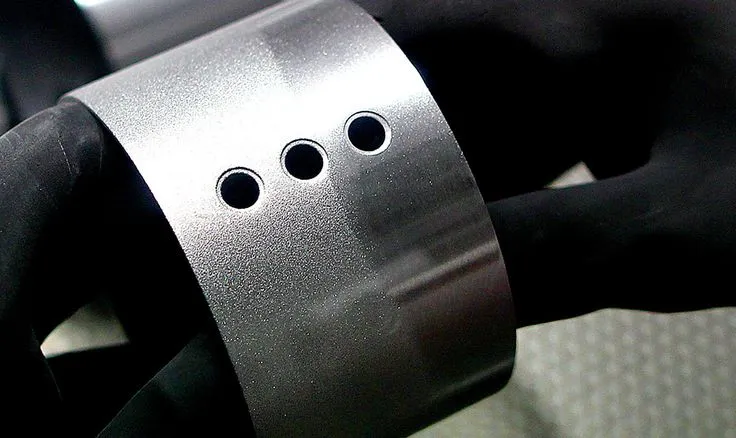
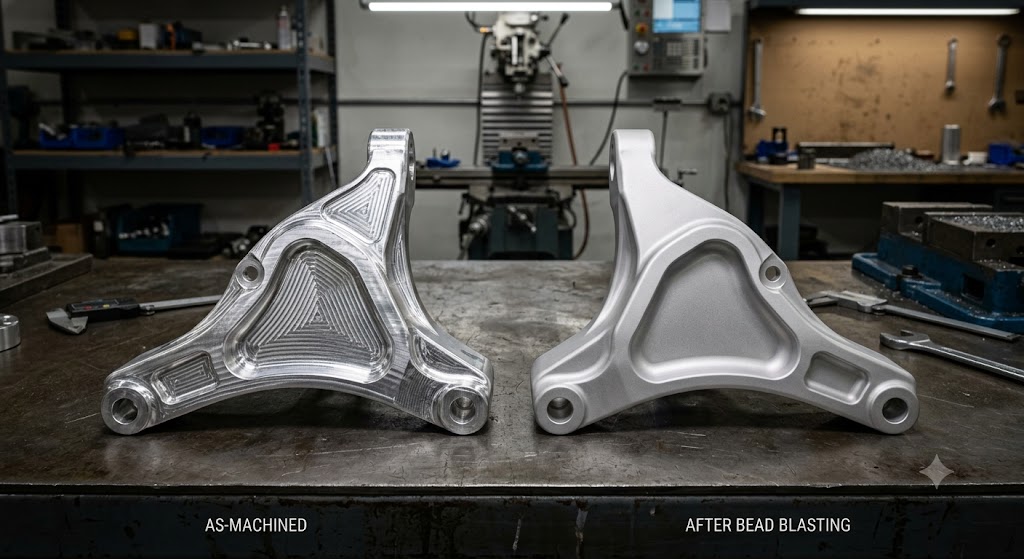
Bead Blasting is a surface treatment process that uses compressed air to shoot high-density spherical particles (typically glass beads) at high speed onto the surface of a material. It can remove the knife marks, burrs and contaminants left on the parts during the processing. It can also form a smooth and uniform surface composed of particles on the part’s surface, presenting a satin or matte finish.
The true engineering value of bead blasting lies in its precision: its impact on part dimensions is negligible (typically at the micron level), meaning you can dramatically elevate the aesthetic appeal and lifespan of your components without risking tight tolerances or original mechanical functions.
How Does Bead Blasting Works?
The bead blasting process is highly controlled and typically takes place inside a specialized containment cabinet. Here is the step-by-step breakdown of how it works:
Step 1: Pre-cleaning and degreasing
Before starting the sandblasting process, it is essential to thoroughly remove any stubborn grease, cutting fluids, or oil stains from the surface of the parts. If oil gets into the sandblasting chamber, it will contaminate the glass beads, causing them to clump together and lose their effectiveness.
Step 2: Loading and Sealing
The workpiece is placed in a sealed sandblasting box. The operator inserts their hands into the heavy-duty protective gloves attached to the box wall, observing the workpiece through the protective window while manually controlling the sandblasting gun.
Step 3: High-speed sandblasting
Using compressed air, glass beads are ejected from the nozzle at a pressure typically ranging from 30 to 80 PSI. The operator must move the nozzle at a uniform distance (generally 4 to 8 inches) and angle (usually 45° to 60°) smoothly to ensure a completely uniform surface treatment.
Step 4: Cleaning and Inspection after Sandblasting
After the surface treatment is completed uniformly, remove the workpiece and clean it to remove any remaining glass dust or fine particles. The final result should be a clean and shiny satin finish.
Types of Blasting Media & Selection Guide
While the term “bead blasting” natively implies the use of perfect, spherical glass beads, modern surface finishing utilizes a wide array of abrasives.
1. Glass Beads (The Industry Standard for Bead Blasting)
Manufactured from high-quality, lead-free soda-lime glass, these perfectly spherical particles deliver a gentle, non-destructive impact. Because the media is entirely round, it lacks sharp edges to cut into the workpiece. Instead of material removal, it relies on micro-displacement, causing the metal surface to compress rather than erode. This makes it an incredibly safe option for delicate or precision-machined parts.
2. Ceramic Beads (The High-Durability Alternative)
Formulated from an engineered blend of zirconium oxide and silica, ceramic beads are significantly harder and tougher than traditional glass. Under higher operational pressures, glass beads break down rapidly into fine dust. Ceramic beads, however, resist fracturing and maintain their structural integrity for up to 30 times longer, making them highly efficient in closed-loop recycling systems and automated finishing environments.
3. Steel Shot (The Surface Hardening Heavyweight)
Steel shot consists of heavy, spherical carbon steel particles that carry massive mass and high kinetic energy upon impact. Unlike lighter glass or ceramic options, steel shot delivers heavy mechanical hammering to the metal substrate. This intense physical pounding induces cold working on the surface layer, which introduces beneficial compressive residual stresses that help prevent future structural fatigue and cracking.
4. Aluminum Oxide (The Aggressive Cutting Standard)
Moving completely away from spherical media, Aluminum Oxide is a classic angular (jagged) abrasive. The sharp, multi-edged grains act like millions of microscopic cutting tools hitting the workpiece at high speeds. Rather than dimpling or compressing the surface, it violently cuts, gouges, and shears away surface contaminants, scales, and base material, leaving a distinct raw profile.
5. Plastic Media (The Soft & Delicate Stripper)
Formulated from soft thermoplastic materials like urea, melamine, or acrylic, plastic media offers an ultra-gentle, non-abrasive solution. Unlike hard minerals or metals, plastic grains possess a very low Mohs hardness. This allows the media to safely strip coatings, deflash injection-molded edges, or clean surfaces without generating any heat or causing the slightest dimensional wear to sensitive underlying substrates.
Bead Blasting Media Selection Guide
Media Type
Mohs Hardness
Material Removal Risk
Media Cost
Best Project Fit
Glass Beads
5.5 – 6.0
Very Low (Micron-level)
Low
Cosmetic satin/matte finish on aluminum, CNC tool mark removal, anodizing prep.
Ceramic Beads
7.0 – 7.5
Very Low
Moderate
High-volume automated production, finishing hard stainless steel/titanium.
Heavy rust stripping, thick paint removal, creating rough anchor profile for coating.
Plastic Media
3.0 – 4.0
None
Moderate
Ultra-delicate cleaning, stripping paint from composite materials, electronics deflashing.
Advantages and Disadvantages of Bead Blasting
Like any manufacturing process, bead blasting comes with its own set of trade-offs.
Advantages
Perfect Aesthetic Finish: It removes machining lines, scratches, and minor defects, replacing them with a gorgeous, high-end satin/matte texture.
Preserves Part Tolerances: Because the media is round, it does not remove critical base material. This is crucial for tight-tolerance aerospace, medical, and CNC components.
Enhanced Corrosion Resistance: By compressing the metal surface, bead blasting closes micro-fissures, reducing the localized stresses that lead to stress corrosion cracking.
Excellent Post-Processing Prep: It creates the perfect, microscopically uniform “tooth” required for high-quality anodizing or plating.
Disadvantages
Limited Scale & Rust Removal: Because it lacks aggressive cutting action, bead blasting is incredibly slow and inefficient at removing heavy rust, thick industrial paint, or hard mill scale.
Media Fragility: Glass beads shatter upon high-impact strikes. Over time, shattered glass beads turn into sharp angular dust, meaning the media pool must be monitored and replaced regularly to maintain a consistent finish.
Manual Labor Intensive: Most precision bead blasting requires manual operation inside a cabinet, making it less ideal for high-throughput, massive structural steel structures.
Common Uses of Bead Blasting
Bead blasting is highly valued across several industries due to its gentle yet transformative nature:
CNC Machined Aluminum Parts
Most anodized aluminum products (such as high-end laptop chassis, mechanical keyboards, or camera rigs) undergo bead blasting right after CNC machining to wash away tooling paths.
Medical Equipment
Surgical instruments and implants are bead-blasted to achieve a non-glare satin surface, ensuring surgeons aren’t blinded by overhead operating lights.
Automotive Restoration
Restoring delicate vintage parts like aluminum cylinder heads, intake manifolds, and carburetors without altering critical mating surfaces.
Welding Cleanup
Seamlessly cleaning and smoothing out weld seams on stainless steel food-grade or pharmaceutical piping.
Sandblasting Vs. Bead Blasting: Which is Better for Your Project?
While the terms are often used interchangeably, Sandblasting (using angular abrasives like sand, coal slag, or aluminum oxide) and Bead Blasting (using spherical glass/ceramic beads) serve entirely different purposes.
The choice between the two processes comes down to your project’s primary objective:
When to Choose Sandblasting:
You are preparing a surface for paint or powder coating: The rough, angular profile created by sandblasting acts as mechanical “anchors” for paint to grip onto.
You need heavy material removal: You are stripping thick layers of rust, old paint, or heavy industrial scale from structural steel.
Dimensional tolerances do not matter: The parts are raw cast iron, structural steel beams, or heavy automotive frames.
When to Choose Bead Blasting:
Aesthetics are your main priority: You want a clean, professional, premium satin-matte texture.
You are preparing parts for anodizing: Bead blasting hides tool marks perfectly and provides the uniform surface needed for uniform chemical dye uptake during anodization.
Dimensions must remain precise: You cannot afford to lose even $0.01\text{ mm}$ off a critical bearing seat or thread.
You are working with softer metals: Your workpiece is made of aluminum, brass, copper, or thin-gauge stainless steel.
Gavin Leo is a content editor at Aria Manufacturing with hands-on experience in CNC machining, Injection molding, materials selection, and part design. Outside of work, he enjoys hiking and collecting mechanical watches.
Custom Quality Parts By Aria
Send your specs. We’ll get back with a quote in 12 hours.


 EU
EU