Anodizing is one of the most common surface finishing processes for metal parts. But it only works on a limited range of materials, such as aluminum, titanium, and magnesium. In practice, over 90% of Anodizing applications are for aluminum.
What is Anodizing?
Anodizing(also spelled as Anodising in British English) is an electrochemical process that converts a metal surface into a durable, corrosion-resistant, and anodic oxide finish. Unlike powder coating or electroplating, which applies a coating on top of the metal, Anodizing is fully integrated with the underlying aluminum substrate. It alters the molecular structure of the surface, meaning it cannot chip, flake, or peel off.
How Does Aluminum Anodizing Work?
To understand how Anodizing works, it helps to visualize a controlled, accelerated version of natural oxidation. When raw aluminum is exposed to oxygen, it naturally forms a thin, protective oxide film.
Here is the step-by-step breakdown of the anodising process:
1. Pre-Treatment & Etching
The aluminum parts are thoroughly degreased to remove cutting fluids. They then undergo a light chemical etch (usually in sodium hydroxide) to strip away natural oxides and micro-imperfections, creating a clean, uniform satin surface.
2. Desmutting (The Secret to Color Purity)
After etching, a dark, powdery alloy residue (called “smut”) naturally remains on the surface. The parts are dipped in an acid neutralizing bath (desmutting) to fully strip this smut, ensuring the subsequent oxide layer is chemically pure and perfectly receptive to bright dyes.
3. Racking & Fixturing
Before entering the acid tank, parts must be securely mounted onto specialized aluminum or titanium racks to guarantee consistent electrical contact.
Note: The contact points will leave tiny, un-anodized “rack marks,” which should always be designed on non-visual, internal surfaces.
4. The Electrochemical Acid Bath
The racked parts are submerged into an temperature-controlled acid electrolyte bath (typically sulfuric acid). The aluminum parts are connected to the positive terminal (making them the anode), while lead or aluminum plates act as negative cathodes.
5. Controlled Oxide Growth
When direct current (DC) is applied, it splits water molecules in the electrolyte to release oxygen ions. These ions migrate to the aluminum surface, reacting at a molecular level to grow a highly porous, ultra-hard aluminum oxide (Al₂O₃)barrier layer.
6. Coloring and Sealing
Once the desired thickness is reached, the porous, honeycomb-like structure of the oxide layer is ideal for absorbing organic dyes. Finally, the parts undergo a hot-water or chemical sealing bath to close the pores, permanently locking in the color and maximizing wear and corrosion resistance.
What Are the Types of Anodizing?
There are mainly three types of anodizing, each using different chemical concentrations, temperatures, and currents to achieve different performance characteristics.
Type I: Chromic Acid Anodizing (CAA)
Type I anodizing is the oldest form, using chromic acid to produce the thinnest oxide layer, typically ranging from 0.5 to 2.5 microns(0.0002 to 0.0001 in.).
It offers excellent corrosion resistance with virtually zero impact on part dimensions, making it the premier choice for aerospace components and critical structural parts that cannot compromise on tight engineering tolerances.
Type II: Sulfuric Acid Anodizing
Type II is the most widely used anodizing method in global manufacturing, utilizing a sulfuric acid bath to produce a medium-thickness coating. The standard(MIL-A-8625) thickness typically ranges from 2.5 to 25 microns, though standard commercial applications often focus on a practical range of 5.1 to 30.5 microns (0.0002 to 0.0012 in.).
Its highly porous structure absorbs organic dyes exceptionally well, striking the perfect balance between cost, corrosion resistance, and vibrant decorative aesthetics.
Type III: Hardcoat anodizing (Hard anodizing)
Type III hardcoating operates at near-freezing temperatures with significantly higher voltages to produce a much thicker, denser oxide layer. Depending on the application, the thickness can range from 12.7 to 50.8 microns (0.0005 to 0.002 in.) for standard hardware, up to 80 microns for extreme heavy-duty components.
The resulting surface offers structural wear resistance rivaling tool steel, making it the premier choice for industrial machinery, valves, and gears.
What Are the anodizing Colors?
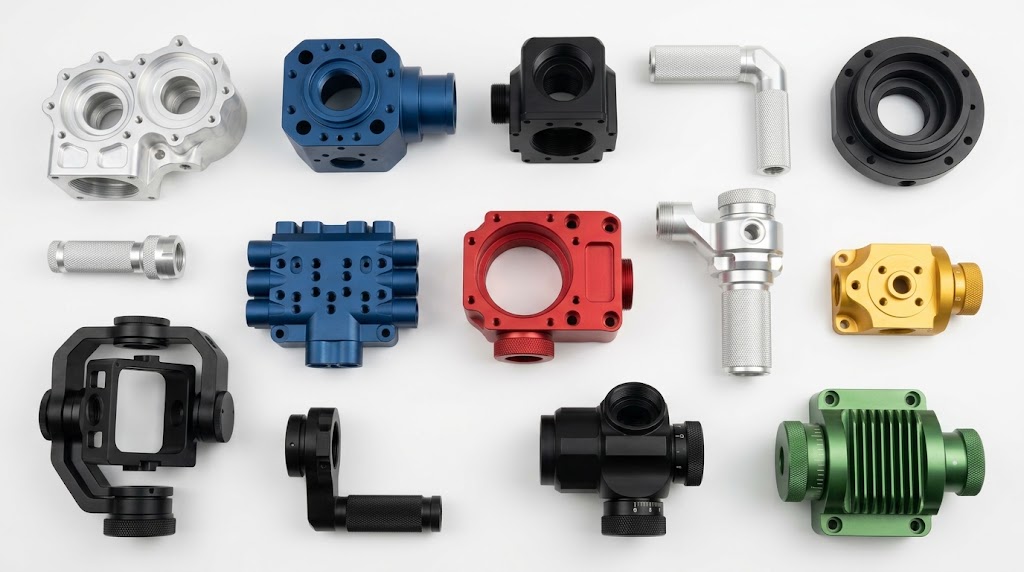
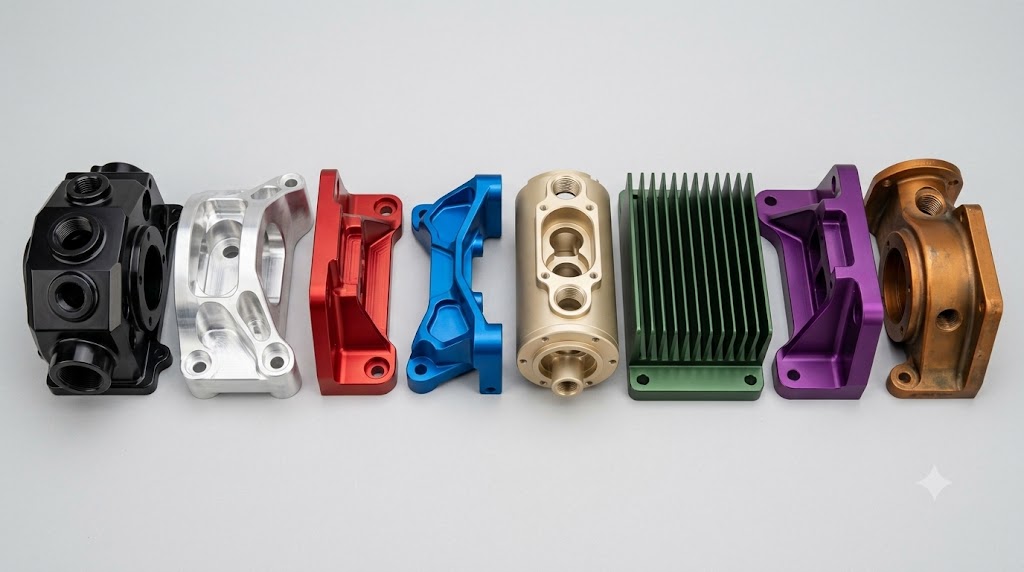
Anodizing changes the color of the aluminum surface by absorbing dyes directly into the porous oxide layer. Common color options include sleek black, clear (natural silver), and vibrant metallic hues like red, blue, gold, and green.
You can reference our component color chart below to see the actual visual effects of different anodizing finishes on aluminum machined parts:
Benefits
Superior Corrosion Resistance
The anodic oxide layer is highly stable. It bonds to the base metal at a molecular level. This makes it far more resistant to corrosion than paint or plating in harsh environments.
Excellent Wear Resistance
Anodized surfaces are extremely hard. Type III hard anodizing can reach up to 70 HRC on the Rockwell scale. This makes anodized parts ideal for high-friction and high-wear applications.
Aesthetic Versatility
Anodizing supports a wide range of colors through dyeing. The finish looks clean and consistent. Unlike paint, the color won’t chip or peel because the dye sits inside the porous oxide layer.
Electrical Insulation
The oxide layer is non-conductive. This makes anodized aluminum useful in electronic housings and insulating components.
Environmentally Friendly
Anodizing produces no harmful heavy metals. The process is safer and more eco-friendly than electroplating methods like chrome plating.
Improved Adhesion
The porous surface left by anodizing improves adhesion for paints, primers, and adhesives. This is useful when parts need secondary coatings or bonding in assembly.
Long-Term Cost Efficiency
Anodized parts require little to no maintenance. The finish lasts for decades without fading, peeling, or flaking. This reduces replacement and refinishing costs over time.
Limitations
Limited Material Compatibility
Anodizing only works on a few metals. Aluminum, titanium, and magnesium are the most common. It cannot be applied to steel, stainless steel, or most other metals. Even among aluminum alloys, those with high copper or silicon content (such as 2000-series and 4000-series) do not anodize well. They tend to produce uneven or discolored oxide layers.
Brittle Oxide Layer
The oxide layer is hard but not flexible. If an anodized part is bent, impacted, or exposed to repeated thermal cycling, the coating can develop micro-cracks. This is a concern for parts designed to flex or operate under high mechanical stress.
Difficult to Repair
A deep scratch on an anodized surface cannot be touched up locally. The only option is to remove the existing oxide layer entirely and run the part through the anodizing process again.
Dimensional Changes
The oxide layer grows both outward and inward from the original surface. This changes the part’s dimensions slightly. For tight-tolerance parts, this must be accounted for during design. Type III hard anodizing, with its thicker coating, has a bigger impact on dimensions than Type II.
Color Consistency Challenges
Achieving uniform color across a batch is not always easy. The final color depends on many factors, including the aluminum alloy grade, how the surface was prepared before anodizing, the electrolyte concentration, and the dyeing time.
Industrial Applications of Anodizing
Because of its unique balance of durability, aesthetics, and corrosion resistance, aluminum anodizing is an essential surface finish across dozens of sectors. Here are the primary industries that rely heavily on anodized components:
Aerospace & Defense: Used for critical structural frames, landing gears, and aircraft skins that require extreme corrosion protection with zero added weight.
Consumer Electronics: Found on smartphones, laptops, high-end audio equipment, and camera bodies for a premium metallic feel and high scratch resistance.
Automotive & Marine: Applied to engine brackets, custom wheels, hydraulic valves, and marine hardware exposed to harsh saltwater environments.
Medical Devices: Ideal for orthopedic tools, surgical trays, and diagnostic equipment enclosures that must undergo frequent, rigorous sterilization without degrading.
Industrial Manufacturing: Used for automated robotics, custom tooling, pneumatics, and sensor housings that operate under high friction and heavy-duty wear.
Architecture & Construction: Applied to window frames, building facades, roofing panels, and outdoor structures for long-term weather and UV resistance.
Anodizing vs. Electroplating
While both are electrochemical bath processes, they treat the metal surface differently. Electroplating deposits an external layer of a foreign metal (like nickel or chrome) on top of the substrate, whereas anodizing chemically grows a protective oxide layer directly out of the aluminum itself.
Choosing the right finish depends entirely on your project’s mechanical requirements, budget, and base material. For a deep dive into the costs, aesthetics, and durability of these two methods, read our comprehensive guide: Anodizing vs. Electroplating.
Bring Your Project to Life with Aria
From custom CNC machining to professional Type II and Type III anodizing, Aria is your all-in-one manufacturing partner. Our team ensures your parts are machined precisely and finished to the highest industrial standards.
Ready to optimize your next project? Contact the Aria team today for a fast engineering review and professional quote!
Gavin Leo is a content editor at Aria Manufacturing with hands-on experience in CNC machining, Injection molding, materials selection, and part design. Outside of work, he enjoys hiking and collecting mechanical watches.
Custom Quality Parts By Aria
Send your specs. We’ll get back with a quote in 12 hours.


 EU
EU