

 EU
EUSurface roughness controls how a part seals, wears, accepts coatings, and resists fatigue. Getting it wrong costs money on both ends: under-specifying causes leaks, premature wear, and assembly failures, while over-specifying adds machining time, secondary operations, and scrap.
During my nearly six years at Aria Manufacturing, I found that many customers either left surface roughness unspecified or set requirements far tighter than the part needed. Both mistakes cost money.
This guide covers what surface roughness is, how it is measured, how to read drawing symbols, and how to choose the right roughness for your part.
What is Surface Roughness?
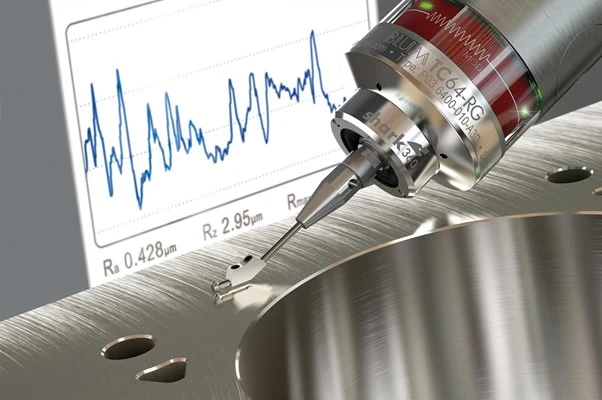
Surface finish is the overall description of a surface including texture, imperfections, material add-ons, and coatings. Although surface finish is often used informally as another name for surface roughness, the two terms are not identical. Surface roughness describes fine, short-wavelength irregularities, while surface finish also considers waviness, lay, and the direction of the surface pattern.
Surface roughness measures the fine, closely spaced deviations in a surface profile. It is commonly expressed in micrometres (µm) or micro-inches (µin) using parameters such as Ra, Rz, and Rq. A higher value means a rougher surface, while a lower value indicates a smoother one.
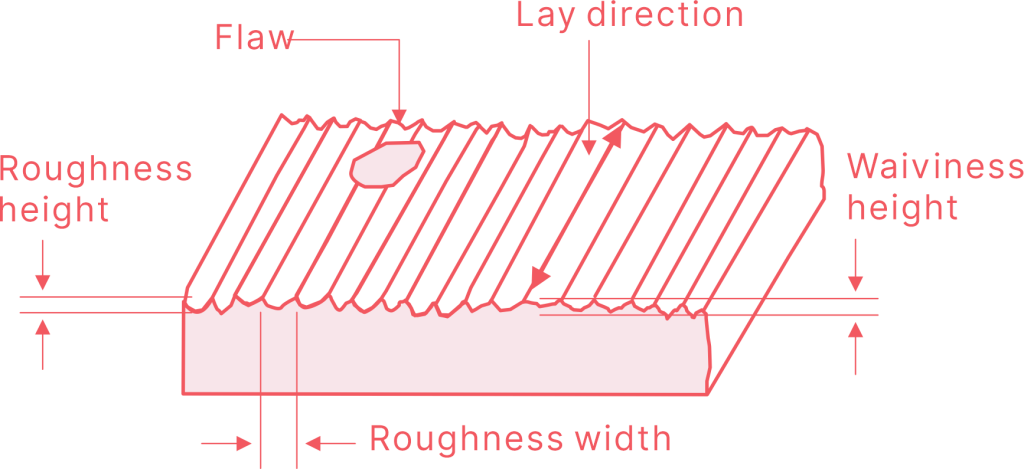
Surface texture is not one thing. It is three things layered on top of each other.
1. Roughness
Roughness is the fine-scale component. Think of it as the texture left behind by the cutting tool: small, closely spaced peaks and valleys that are typically invisible to the naked eye but measurable with a profilometer.
This is what engineers most often specify on drawings. It is quantified with parameters like Ra, Rz, and RMS.
2. Waviness
Waviness is the broader, more gradual undulation of the surface. While roughness comes from the cutting tool, waviness comes from larger-scale machine behaviour: spindle runout, machine chatter, thermal distortion during machining, or workpiece deflection under cutting forces.
In surface texture analysis, roughness and waviness are separated by spatial frequency. Roughness captures the short-wavelength deviations. Waviness captures the longer-wavelength undulations. A profile filter (typically a Gaussian filter with a defined cutoff wavelength) separates the two during measurement.
Waviness matters for bearing races, sealing surfaces, and any application where a gradually uneven surface would compromise fit or function.
The main waviness parameters are:
| Parameter | What It Describes |
| Wa | Average waviness height |
| Wt | Total waviness height |
| Wsm | Average waviness spacing (peak-to-peak) |
3. Lay
Lay is the direction of the dominant surface pattern. On a turned shaft, the lay runs circumferentially. On a milled flat, it runs along the feed direction. After grinding, you often see a multidirectional or random lay.
Lay affects friction, fluid flow, and how two surfaces interact under load. In fluid power and hydraulic systems, the lay direction relative to the sealing element can determine whether a seal holds or leaks.
Why is Surface Roughness Important in Manufacturing?
Surface roughness affects whether your part works. Not just how it looks. Here is what I have seen go wrong when surface roughness is ignored or mis-specified:
Premature wear
Rough mating surfaces wear out faster. The asperities (those microscopic peaks) rub against each other, generating friction and heat. While a controlled level of roughness helps retain lubricant in the valleys, excessive roughness accelerates material loss. On a shaft in a bearing housing, this failure mode shows up fast.
Sealing failures
A gasket surface that is too rough leaks. A smooth surface can also cause problems because the seal has nothing to “bite” into. There is an optimal range for every sealing application.
Fatigue cracking
Surface irregularities act as stress risers. Under cyclic loading, cracks initiate at the base of valleys, often starting from the lowest valleys in the profile. This is especially critical for aerospace and medical components. In biomedical implants, surface roughness also influences cell adhesion, which is one reason controlled roughness specifications matter in medical applications.
Coating delamination
Paints and platings need a specific surface profile to adhere properly. Too smooth and the coating peels. Too rough and the coating thickness becomes uneven. For example, automotive body panels require a controlled roughness range before painting to ensure consistent adhesion and appearance.
Assembly headaches
If mating surfaces are rougher than specified, press fits can seize up or interference fits will not assemble within tolerance. On the flip side, over-specifying surface roughness has its own cost: longer machining time, secondary grinding operations, higher scrap rates.
At Aria, we use the same principle every time a job comes through: specify the roughest surface that still meets the functional requirement. Nothing smoother than necessary. That keeps costs down without compromising quality.
Surface Roughness Parameters
The types of roughness parameters are far more numerous than what people are aware of, and each parameter reflects different information about the surface.
The most common ones are five: Ra, Rz, Rp, Rv, and Rmax.
Ra: Arithmetic Average Roughness
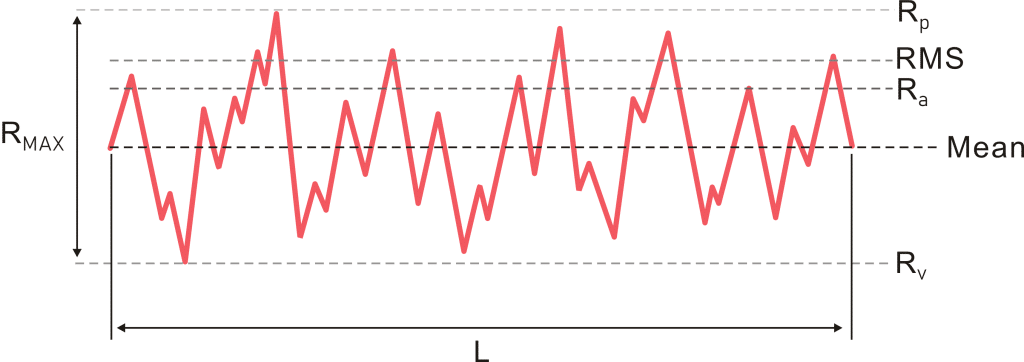
Ra is the arithmetic mean of the absolute vertical deviations of the surface profile from the mean line, measured over the evaluation length. It is the parameter defined on most engineering drawings, usually shown as the Ra value.
Imagine drawing a centreline through your surface profile. Ra is the average distance between that line and all the peaks and valleys combined.
It is expressed in micrometres (µm) internationally, or micro-inches (µin) in the United States.
Ra Surface Finish Grade Numbers:
| Ra (µm) | What it feels like | Typical process |
| 12.5 | Visibly rough | Sand casting, rough forging |
| 6.3 | Rough machined | Heavy roughing cuts |
| 3.2 | Standard machined | General CNC turning/milling |
| 1.6 | Smooth machined | Precision CNC with sharp tooling |
| 0.8 | Fine ground | Cylindrical or surface grinding |
| 0.4 | Very smooth | Fine grinding, honing |
| 0.1 | Near-polished | Precision lapping |
| 0.025 | Mirror | Superfinishing, optical polishing |
Limitation of Ra: Because Ra averages all deviations, it can mask individual defects. A surface with one deep scratch and otherwise smooth texture may produce the same Ra value as a surface with many small, evenly distributed peaks. This is why Ra alone is sometimes not enough for critical applications.
Rz: Mean Roughness Depth
Rz is the average of the five largest peak-to-valley height differences across the evaluation length.
The evaluation length is divided into five equal sampling lengths. In each sampling length, the vertical distance from the highest peak to the deepest valley is measured. Rz is the mean of those five values.
Why does this matter? Because Rz is more sensitive to isolated surface defects like deep scratches, sharp burrs, or tool marks. A surface with one bad spike might have an acceptable Ra but a failing Rz.
Rv: Maximum Valley Depth
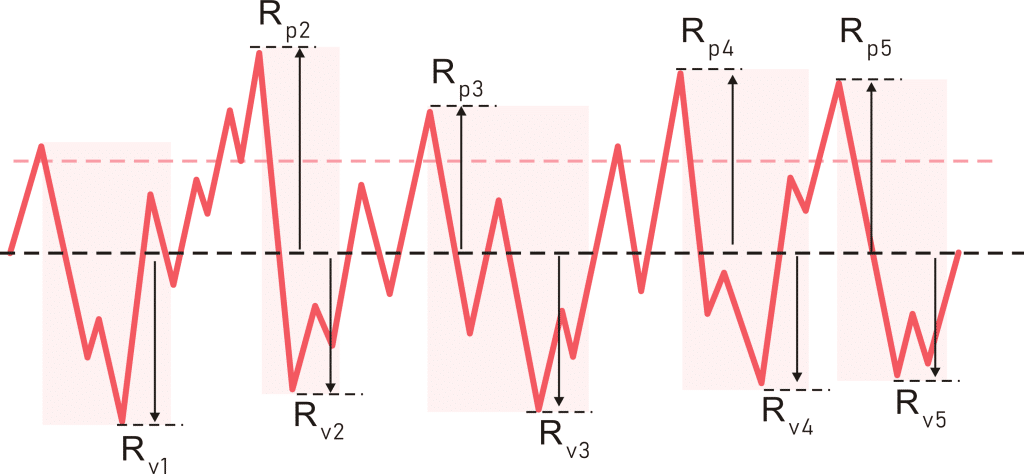
Rv is the depth of the deepest single valley below the mean line within the evaluation length.
Deep valleys can trap contaminants, hold lubricant (which is sometimes desirable), or initiate corrosion. In food-grade and pharmaceutical equipment, Rv is a critical hygiene parameter because deep valleys are difficult to clean and can harbour bacteria.
Rp: Maximum Peak Height
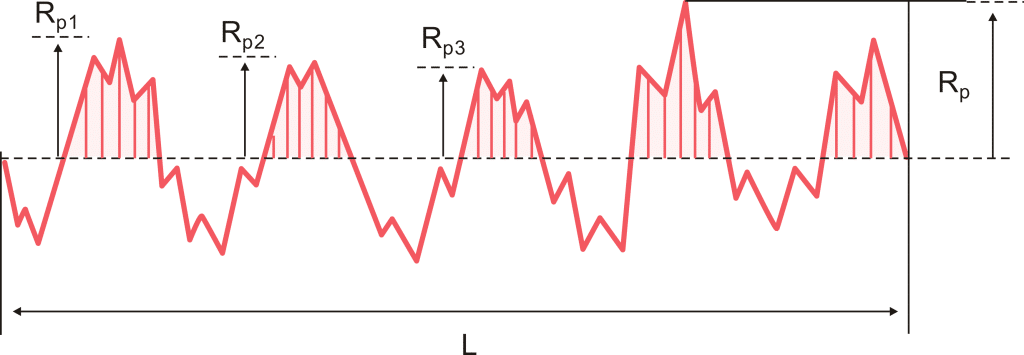
Rp is the height of the tallest single peak above the mean line within the evaluation length. This matters when a single high asperity could cause interference, contact stress concentration, or damage in a mating assembly.
Rmax: Maximum Roughness Height
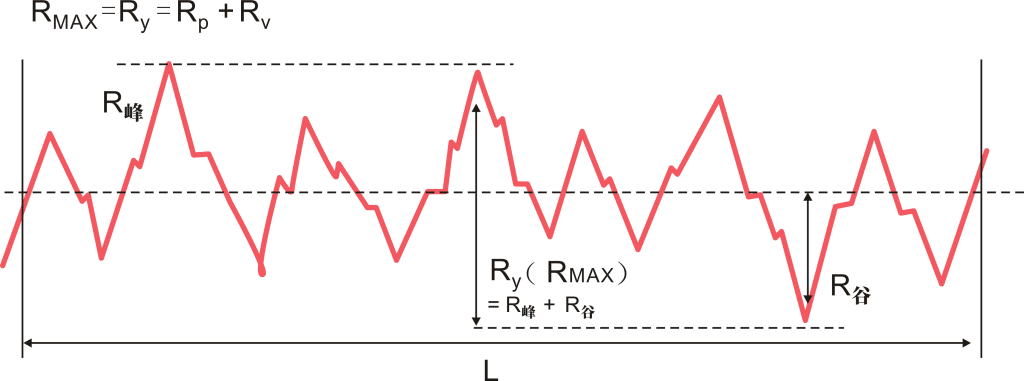
Rmax (sometimes written as Rz1max) is the height difference in the single worst sampling length across the entire evaluation length, capturing the maximum height from the highest peak to the deepest valley within that worst sampling length. It is the most sensitive of all the amplitude parameters to isolated defects.
I use Rmax routinely in quality control at Aria when we are inspecting sealing surfaces and precision fits where a single bad spot can cause a rejection. For example, if Ra looks fine but something still seems off on a critical bore or sealing face, Rmax usually tells the story.
Surface Roughness Symbols on Drawings
Surface roughness requirements are communicated on engineering drawings through standardised symbols defined in ISO 1302 (internationally) and ASME Y14.36M (in North America).
Basic surface texture symbol

Any manufacturing method is permitted unless the circle or bar is specified.
Material removal by machining is required symbol

This symbol means that material must be removed by machining to achieve the required surface finish.
Material removal prohibited (check mark with circle)

The surface must be produced by processes such as casting, forging, hot finishing, cold finishing, die casting, powder metallurgy, or injection moulding without subsequent removal of material.
Surface texture symbol

This applies to surfaces produced by any method, unless a bar, circle, or specific process is indicated.
Parallel to plane of projection symbol

A blade-shaped tool is required to create creases that are parallel to the surface indicated by the symbol in the diagram.
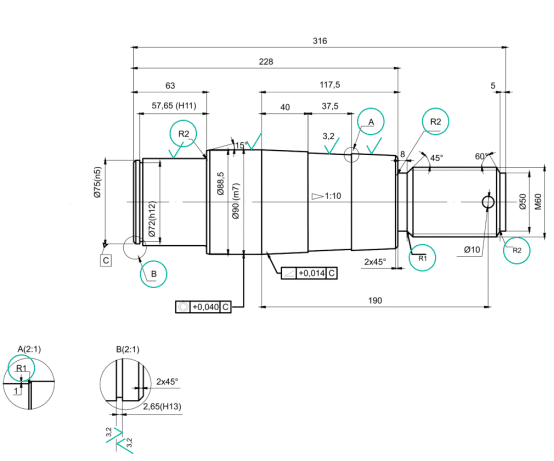
Practical examples
How to Measure Surface Roughness
There are four common surface roughness measurement methods: direct measurement, non-contact, comparison, and in-process methods, each suited to different levels of precision and production requirements. The choice depends on the component, required accuracy, and production process, since the right method improves the reliability of measurement results.
Direct Measurement (Stylus Profilometry)
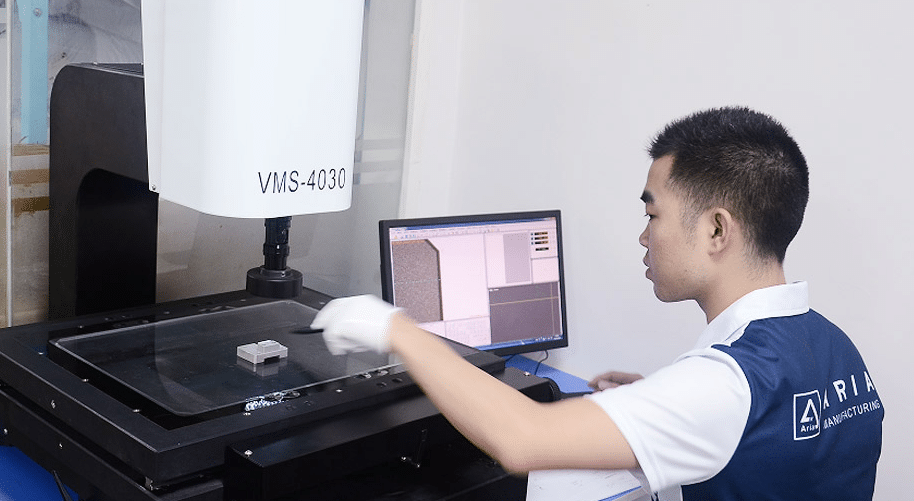
The industry standard: stylus profilometry is the most common contact method for measuring roughness. A diamond-tipped stylus drags across the machined surface as the measuring instrument moves it at a constant speed, tracing every peak and valley. The instrument calculates Ra, Rz, RMS, and other parameters automatically. Accurate, traceable, and accepted by all major standards.
Non-Contact Methods
For surfaces where physical contact is not acceptable. White Light Interferometry (WLI) and Confocal Microscopy use light to map surface height without touching the part, producing full 3D surface data. For nanometre-scale work, Atomic Force Microscopy (AFM) is another high-resolution non-contact option, and these systems can also report root mean square height as an areal metric. The go-to choice for optical components, precision moulds, and delicate surfaces.
Comparison Methods
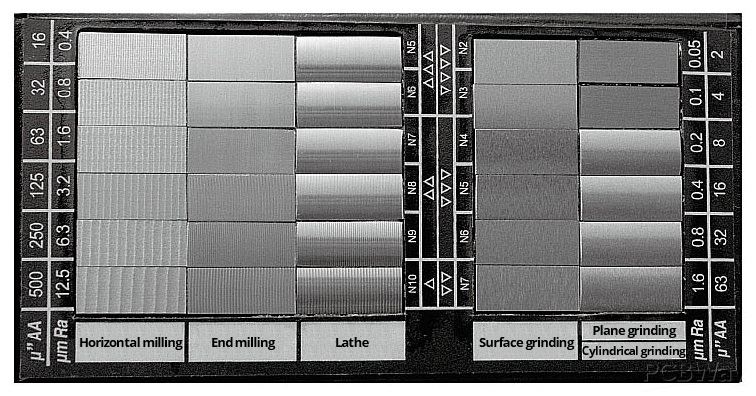
Physical reference plates with known Ra values. The inspector compares the part surface by eye and touch. Fast and cheap, but subjective. Good for quick shop floor checks, not formal quality records.
In-Process Measurement
Sensors embedded directly into the machining process monitor surface finish parameters in real time, supporting the manufacturing process with feedback before out-of-tolerance parts are produced. This allows immediate correction before defects compound. At Aria, we use in-process monitoring on high-volume runs because it plays a key role in catching drift early and reducing scrap.
Surface Roughness by Manufacturing Process
Different manufacturing processes produce different levels of surface roughness. This table shows the typical achievable roughness range for common processes. Use it as a starting point when specifying roughness requirements.

Cost implication: Moving from Ra 3.2 to Ra 1.6 adds modest cost. Moving from Ra 1.6 to Ra 0.8 often requires grinding, a separate operation that adds significant time and cost. Below Ra 0.4, expect lapping, honing, or superfinishing, which can multiply part cost by 2 to 5 times compared to standard machining.
Surface Roughness Chart
Surface Roughness Conversion Chart
Use this table when you need to convert between Ra, RMS, and Rt values, or between µm and µin. The following table is given in ISO 1302:1992.
| Roughness N ISO Grade Numbers | Roughness values Ra micrometres (µm) | Roughness values Ra microinches (µin.) | RMS | CLA (µin.) Centre Line Avg. | Rt Roughness, microns |
| N12 | 50 | 2000 | 2200 | 2000 | 200 |
| N11 | 25 | 1000 | 1100 | 1000 | 100 |
| N10 | 12.5 | 500 | 550 | 500 | 50 |
| N9 | 6.3 | 250 | 275 | 250 | 25 |
| N8 | 3.2 | 125 | 137.5 | 125 | 13 |
| N7 | 1.6 | 63 | 64.3 | 63 | 8.0 |
| N6 | 0.8 | 32 | 32.5 | 32 | 4.0 |
| N5 | 0.4 | 16 | 17.6 | 16 | 2.0 |
| N4 | 0.2 | 8 | 8.8 | 8 | 1.2 |
| N3 | 0.1 | 4 | 4.4 | 4 | 0.8 |
| N2 | 0.05 | 2 | 2.2 | 2 | 0.5 |
| N1 | 0.025 | 1 | 1.1 | 1 | 0.3 |
Surface Roughness Comparison Chart
Here is a quick reference table I use as a starting point when discussing finish requirements with customers:
| Application | Recommended Ra (µm) | Why |
| Non-functional surfaces | 3.2 to 6.3 | Cost-effective, no performance requirement |
| General mating surfaces | 1.6 to 3.2 | Standard fit and function |
| Bearing seats and shafts | 0.4 to 0.8 | Reduce wear, control friction |
| Sealing/gasket surfaces | 0.4 to 1.6 | Balance leak prevention and seal grip |
| Hydraulic cylinder bores | 0.1 to 0.4 | Lubricant retention, seal life |
| Optical and mirror surfaces | 0.012 to 0.05 | Reflectivity, light transmission |
| Medical implant surfaces | 0.05 to 0.8 | Biocompatibility, cell adhesion, corrosion resistance |
| Surfaces for painting/coating | 1.6 to 3.2 | Coating adhesion without excessive thickness variation |
| Semiconductor surfaces | 0.012 to 0.05 | Minimise electrical resistance and surface defects |
Different industries read the same chart differently: in semiconductors, high surface roughness can increase electrical resistance, while in consumer products, surface roughness affects reflectivity and tactile feel.
Ra vs Rz vs RMS: How to Choose the Right Parameter
Ra vs Rz
Ra and Rz are not interchangeable. They measure different things and suit different applications.
| Ra | Rz | |
| What it measures | Average of all deviations from the mean line | Average of the five worst peak-to-valley heights |
| Sensitivity to defects | Low (averages out spikes) | High (captures isolated problems) |
| Best for | General machined surfaces, overall texture control | Sealing surfaces, bearing fits, surfaces where one bad spot causes failure |
| Standard drawing default | Yes, most common globally | Common in German/European standards (DIN) |
| Rough conversion | – | Rz is roughly 4 to 7 times Ra, depending on the process |
Rule of thumb: If the surface only needs to look and feel consistent, Ra is sufficient. If a single defect could cause a functional failure, specify Rz alongside Ra, or use Rz as the primary control parameter.
In practice, many European automotive and hydraulic specifications call out Rz rather than Ra because sealing and bearing performance depend more on worst-case peaks and valleys than on averages.
Ra vs RMS (Rq)
Ra and RMS (also called Rq) are two different ways of calculating a roughness value from the same surface profile data. The difference lies in the calculation method, not the measurement itself.
Ra calculation: Takes the absolute value of each height deviation from the mean line, then averages them all. Every deviation gets equal weight, whether it is a tiny ripple or a deep scratch. Ra is the default for general machined components. It is specified on the vast majority of engineering drawings globally and works well for surfaces where overall texture is what matters.
RMS (Rq) calculation: Squares each deviation before averaging, then takes the square root. That squaring step amplifies larger deviations disproportionately. A single deep valley or sharp spike will push RMS noticeably higher than Ra on the same surface.
For a mathematically perfect sine-wave profile, Rq equals approximately 1.11 times Ra. On real machined surfaces with occasional defects, the ratio is typically higher.
RMS is preferred for optical surfaces, precision electronics, semiconductor wafers, and applications governed by standards such as ISO 10110-8. If your application is sensitive to individual surface anomalies rather than average texture, RMS gives you a more honest picture. For areal (3D) roughness measurement, the ISO 25178 series defines parameters such as Sa (the areal equivalent of Ra) and Sq (the areal equivalent of Rq).
Standards note: The primary international standards for 2D profile roughness parameters are ISO 21920 (which replaced the older ISO 4287) and ASME B46.1.
Factors That Affect Surface Roughness
Surface roughness is not random. It is the direct result of how the part was machined. Understanding these factors helps engineers specify achievable roughness values and avoid costly over-specification.
Cutting Parameters
Feed rate has the largest single effect on roughness. A higher feed rate leaves wider, deeper tool marks. Halving the feed rate can reduce Ra by roughly 75% in single-point turning (the relationship is approximately Ra proportional to feed rate squared divided by tool nose radius).
Cutting speed also matters. Higher cutting speeds generally produce smoother surfaces because they reduce built-up edge formation on the cutting tool.
Depth of cut has a smaller direct effect on roughness but influences cutting forces and vibration, which indirectly affect surface quality.
Tool Geometry and Condition
A larger tool nose radius spreads the feed marks over a wider area, producing lower roughness. A worn or chipped cutting edge leaves irregular marks and increases Ra.
Tool material and coating also play a role. Polished carbide or PCD inserts produce finer finishes than uncoated tools on the same material.
Workpiece Material
Softer, more ductile materials (such as low-carbon steel or aluminium) tend to produce built-up edge and tearing, which roughens the surface. Harder, more brittle materials (such as cast iron or hardened steel) often machine with a cleaner shear and produce lower roughness values.
Machine Rigidity and Condition
Vibration is the enemy of surface finish. A rigid machine with well-maintained spindle bearings, tight gibs, and proper workholding produces smoother surfaces than a worn machine running the same parameters. Chatter vibration is one of the most common causes of unexpectedly rough surfaces.
Coolant and Lubrication
Proper cutting fluid reduces friction at the tool-chip interface, washes away chips, and controls heat. All three improve surface finish. Dry machining or inadequate coolant flow typically produce rougher surfaces.
FAQs
Q:What is the difference between surface finish and surface roughness?
Surface finish is the broad term covering the overall condition of a surface, including roughness, waviness, lay, coatings, and visible defects. Surface roughness is one specific, measurable component of surface finish: the fine-scale peaks and valleys quantified by parameters like Ra and Rz.
Q:What Ra value is considered smooth?
A: Ra 0.8 µm or below is generally considered smooth in machining. Ra 0.4 µm feels very smooth to the touch. Ra 0.1 µm and below approaches a polished or mirror finish. However, “smooth” is relative to the application. A surface at Ra 3.2 µm is perfectly acceptable for most general mechanical components.
Q:Can you convert Ra to Rz directly?
A:There is no exact conversion because the relationship depends on the surface profile shape, which varies by process. As a rough guideline, Rz is typically 4 to 7 times Ra for machined surfaces. For ground surfaces, the ratio tends to be lower (around 4 to 5 times Ra). Always specify the parameter you actually need rather than converting from one to the other.
Q:What is the standard surface roughness for CNC machined parts?
A: Most CNC machined parts come off the machine at Ra 1.6 to 3.2 µm without any secondary finishing. This is commonly called the “as-machined” finish and is suitable for the majority of functional surfaces. Finer finishes require adjusted cutting parameters or secondary operations like grinding.
Q:Which roughness parameter should I put on my drawing?
A: For most applications, Ra is sufficient and universally understood. Add Rz when the surface serves a sealing or bearing function where worst-case peaks and valleys matter more than the average. Specify Rq (RMS) for optical or semiconductor applications. When in doubt, talk to your machining supplier. They can advise on what is achievable and cost-effective for your part geometry and material.
