

Different Types of Screw Threads

Not sure which screw thread type to use? You’re in the right place. This guide walks you through every major screw thread — what it is, how it works, and when to use it.

What Is a Screw Thread?

A screw thread is a helical ridge on the outside of a cylinder — or inside a bore. The outside version is a male thread, like a bolt. The inside version is a female thread, like a nut.

When you turn a bolt into a nut, the spiral converts rotation into clamping force. Think of it as a ramp coiled around a shaft. The tighter you turn, the more force it generates.

Understanding screw threads matters because the wrong type can fail — sometimes dangerously. Fortunately, once you know the key differences, the right choice becomes clear.

In practice, screw threads serve three roles:

  • Fastening: holding parts together — bolts, screws, nuts
  • Power transmission: converting rotation into linear movement — lead screws, jacks, presses
  • Sealing: creating leak-proof pipe joints — plumbing, gas lines, hydraulics

Key Thread Parameters

Every screw thread is defined by a set of measurements. Here’s what each one means:

Document
Parameter What it Means Why It Matters
Major Diameter The widest point of the screw thread — the outermost crests The first number in any designation: M10 = 10 mm
Minor Diameter The narrowest point — the root (valley) of the thread Determines tensile strength — more material = stronger
Pitch Distance from one crest to the next — mm or threads per inch Controls advance per turn and grip strength
Lead Total axial advance per one full 360° rotation Equal to pitch on single-start threads; larger on multi-start
Thread Angle The V-angle between the two flanks — 60° (ISO/UTS), 55° (Whitworth), 29° (Acme) Affects friction, efficiency, and strength
Helix Angle How steeply the thread spirals around the shaft Steep = self-locking; shallow = faster travel

Different Types of Screw Threads

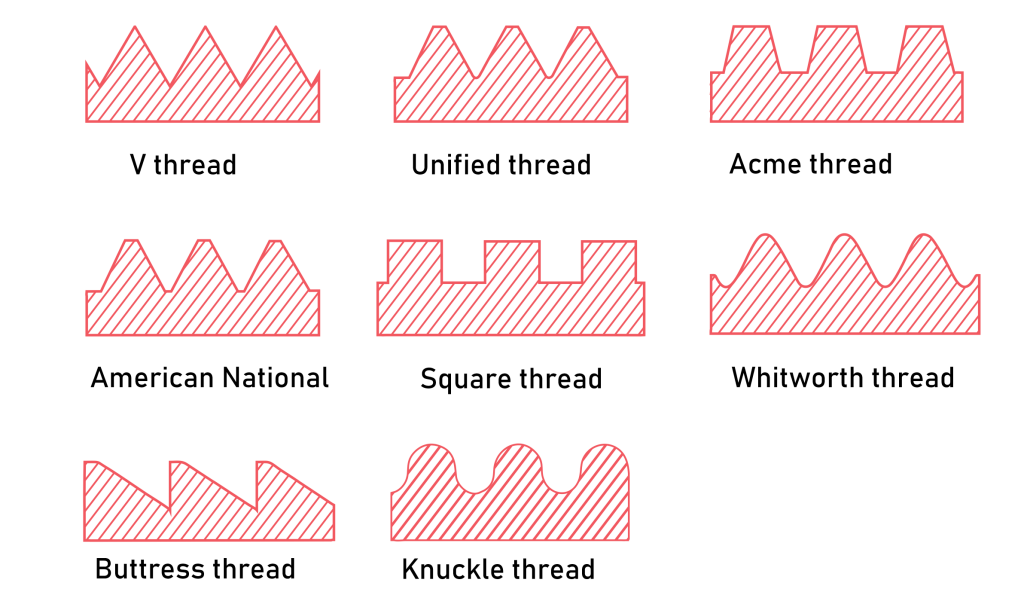
Now that you understand the geometry, let’s look at each screw thread type. Every profile is an engineering trade-off between strength, friction, efficiency, and ease of manufacture. No single screw thread wins on every dimension — that’s why so many types exist.

types of thread

Unified Thread Standard — UNC & UNF

Document
Standard ANSI/ASME B1.1 — primary inch-based screw thread standard (USA, Canada)
How to Read 1/4"-20 UNC = 1/4 inch diameter, 20 threads per inch, coarse
Thread Angle 60° — same as ISO Metric, but in inches. NOT interchangeable.

If you’re working in North America, UTS is your baseline screw thread system. It uses the same 60° angle as ISO Metric. However, it measures everything in inches and threads-per-inch (TPI).

That difference makes them incompatible. Don’t mix metric and inch threads — even if they seem to engage at first.

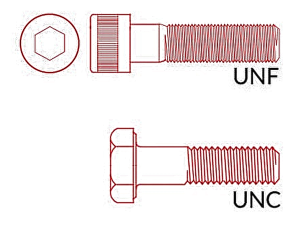
Two variants matter most. UNC (Unified National Coarse) is the American workhorse — general bolts, machine screws, and structural fasteners. UNF (Unified National Fine) provides higher strength and better vibration resistance. As a result, aerospace fasteners (AN, NAS, MS bolts) use UNF as standard.

Three tolerance classes define the fit: Class 1 (loose), Class 2 (standard — used in ~90% of applications), Class 3 (precision).

ISO Metric and UTS are NOT interchangeable. A metric bolt may engage a UNC nut for a few turns — then seize or strip. Always verify the designation before assembly.

ISO Metric Thread (M / MF)

Document
Standard ISO 68-1 / ISO 261 — the world's most widely used screw thread system
How to Read M10×1.5 = 10 mm outer diameter, 1.5 mm pitch
Global Share ≈ 70% of all manufactured fasteners worldwide

When someone says ‘metric bolt’, they mean an ISO Metric screw thread. It’s the global default for fastening.

The ‘M’ prefix tells you the diameter in millimetres. The number after the ‘×’ is the pitch. For example, M10×1.5 has a 10 mm diameter with 1.5 mm between thread peaks.

You’ll encounter two variants. Coarse threads (M) are faster to install and more tolerant of contamination. They suit general assembly. Fine threads (MF) have peaks spaced closer together. They offer better vibration resistance — so you’ll find them in engine components and instruments.

Use Coarse (M) for general assembly. Switch to Fine (MF) only when your application needs better vibration resistance.

V-Shaped Thread

Document
Thread Angle 60° (ISO/UTS) · 55° (Whitworth)
Best For General fastening — bolts, nuts, screws in every industry

If you’ve looked at a bolt, you’ve already seen a V-shaped screw thread. It’s the most common thread profile in the world.

The V-shape creates a wedging action when tightened. Picture a door wedge: the harder you push, the tighter it seats. That’s exactly how a V-thread grips under load.

As a result, V-threads resist vibration-induced loosening without any extra hardware. They’re easy to cut using a lathe, tap, or die. Consequently, they dominate everything from car engines to flat-pack furniture.

British Standard Whitworth (BSW) Thread

Document
Invented 1841 by Sir Joseph Whitworth — the world's first standardised screw thread
Key Feature 55° thread angle (ISO and UTS use 60°) — this is how you identify it
Where Used Legacy British machinery, classic vehicles, BSP pipe fittings (EU/Asia)

BSW was the world’s first standardised screw thread. Before 1841, every manufacturer used their own dimensions. Bolts from one factory wouldn’t fit nuts from another. Whitworth changed that.

Today, you’ll mostly find BSW in older British machinery and vehicles made before the 1970s. However, the related BSP (British Standard Pipe) thread remains widely used. It’s still the standard for pipe fittings across Europe, the Middle East, Australia, and Asia.

The key identifier is the 55° thread angle. If a thread won’t accept a 60° pitch-gauge blade cleanly, you’re likely looking at a Whitworth-family screw thread.

Acme Thread

Document
Profile Trapezoidal (flat-topped) with a 29° included angle
Efficiency 80–90% — the practical optimum for power transmission screw threads
Best For CNC lead screws, bench vises, lathe carriages, screw jacks

Whenever a screw thread needs to move something — not just hold it — the Acme thread is usually the right choice.

Its flat-topped trapezoidal profile is a practical compromise. It’s significantly more efficient than V-threads, which waste energy pushing sideways on the nut flanks. Moreover, it’s far easier to manufacture than square threads.

The wider, flat flanks also serve a critical function: they allow a split-nut to snap open and closed. In CNC lathes, this means the carriage can rapidly engage and disengage from the lead screw. That’s something V-threads or square threads can’t do.

Three tolerance classes cover most applications: 2G (general), 3G (closer fit), 4G (precision, minimal backlash).

Square Thread

Document
Profile Perfect square cross-section — flanks perpendicular to the thread axis (0° flank angle)
Efficiency > 95% — the highest mechanical efficiency of any screw thread profile
Limitation Very expensive to machine; cannot use split nuts; cannot be ground after hardening

The square screw thread is the theoretical ideal for power transmission. Its flanks run perfectly perpendicular to the shaft axis. As a result, all load travels directly along the axis — with zero lateral component.

In theory, no other screw thread profile beats it. In practice, however, the 90° flank angle is extremely difficult to machine accurately. It’s also impossible to grind after hardening and incompatible with split-nut wear compensation.

For those reasons, Acme threads have largely replaced square threads in modern machinery. Nevertheless, square threads remain in use where maximum efficiency justifies the extra cost — heavy industrial jacks, hydraulic press columns, and large valve stems.

Buttress Thread

Document
Profile Asymmetric: load flank ~3° from vertical · back flank ~45°
Unique Strength Handles very large axial loads in one direction — analogous to a ratchet
Applications Aircraft propeller hubs, artillery breech mechanisms, heavy bench vise spindles

Buttress screw threads are built for one job: resisting a massive force in a single direction. The near-vertical load flank acts like a wall against thrust. Meanwhile, the angled back flank makes the thread much easier to manufacture than a square thread.

A useful analogy is a door wedge. It stops a door moving in one direction perfectly. However, you can kick it out from the other side easily. Buttress threads work on the same principle.

Consequently, you’ll find them wherever a large force always acts in one direction: aircraft propeller hubs absorbing engine thrust, artillery breech mechanisms withstanding firing loads, and heavy bench vise spindles transmitting clamping force.

Knuckle Thread

Document
Profile Fully rounded crests and roots — semicircular cross-section, ~30° angle
Key Advantage Highly resistant to damage and contamination — can be cast, rolled, or stamped
You See It On Glass bottle caps, garden hose fittings, railway couplings, hydrant nozzles

Here’s a screw thread type you use every day without realising it. When you screw the lid onto a glass jar, connect a garden hose, or close a shampoo bottle — you’re engaging a knuckle thread.

Its rounded crest and root profile makes it extremely resistant to damage. Unlike a precision V-thread, it survives dirt, rough handling, and even minor damage without losing function. Furthermore, knuckle threads can be produced by casting, stamping, or rolling — no precision machining required.

As a result, they’re cheap to manufacture at scale. The trade-off is lower precision and reduced load capacity. In applications where durability matters far more than precision, however, the knuckle screw thread is the optimal choice.

Tapered Thread — NPT and BSPT (Pipe Threads)

Document
Purpose Sealing, not fastening — the screw thread form itself creates the leak-proof joint
How It Seals Diameter narrows (tapers) so the thread wedges tighter as you turn it in
NPT vs BSPT NPT = 60° (North America) · BSPT = 55° (UK/Europe/Asia) — NOT interchangeable

Tapered pipe threads are fundamentally different from every other screw thread on this list. Their purpose is not fastening or power transmission — it’s creating a pressure-tight seal.

The thread is cut on a cone rather than a cylinder. As you tighten a male thread into a female socket, the threads wedge progressively tighter. They deform slightly to close every leakage path — without needing a separate gasket.

Two standards dominate. NPT (National Pipe Thread) governs North American pipe connections, using a 60° angle. BSPT (British Standard Pipe Taper) is the equivalent for the UK, Europe, and Asia, using 55°. These two screw thread standards are not interchangeable. Mixing them causes leaks — with serious consequences on pressurised gas or hydraulic systems.

NPT (60°) and BSPT (55°) look nearly identical but will leak when mixed. On any pressurised system, always verify the screw thread standard before assembly.

Worm Thread

Document
Based On Sealing, not fastening — the screw thread form itself creates the leak-proof joint
Function Transmits power between perpendicular shafts with a high reduction ratio
Self-Locking Typically cannot be back-driven — the output cannot turn the input

A worm screw thread is the threaded shaft in a worm gear system. Imagine a large screw meshing with a spur gear at 90°. Turn the worm shaft, and the gear wheel rotates. Try to turn the gear wheel, and the worm stays put.

That self-locking property is what makes worm drives invaluable for lifting and positioning. The load cannot back-drive the mechanism and cause unwanted movement.

You encounter worm thread drives more often than you might expect. Guitar tuning pegs use tiny worm gears — that’s why the string stays in pitch when you release the key. Beyond that, worm screw thread systems appear in automotive steering boxes, conveyor drives, electric gate openers, and packaging machinery.

Left-Hand vs. Right-Hand Threads

Document
Right-Hand (RH) Tightens clockwise — the universal default for every standard screw thread fastener
Left-Hand (LH) Tightens counterclockwise — used only where a RH thread would loosen in service
How to Identify Left-hand fasteners are marked 'LH' or have notches cut on the hex flats

Right-hand screw threads tighten when you turn clockwise — ‘righty-tighty, lefty-loosey.’ They account for more than 99% of all fasteners you’ll encounter.

Left-hand screw threads tighten counterclockwise. They exist to prevent a fastener from loosening when normal operating rotation would undo a right-hand thread.

The most widely known example is the left-side bicycle pedal. As you pedal forward, the crank’s rotation would progressively loosen a right-hand pedal. So engineers use a left-hand screw thread on that side. Other applications include turnbuckle ends, certain gas cylinder valves (left-hand signals a flammable gas), and some counter-rotating shaft assemblies.

Single-Start vs. Multi-Start Threads

Document
Single-Start One spiral groove — advances one pitch per turn. Self-locking, high clamping force.
Double-Start Two grooves — advances 2 × pitch per turn. Twice the axial travel per rotation.
Triple-Start Three grooves — advances 3 × pitch per turn. Very fast assembly, less self-locking.

Every standard bolt you’ve used is a single-start screw thread — one continuous spiral advancing one pitch per full turn. That gives you maximum mechanical advantage and reliable self-locking.

Multi-start screw threads introduce two or more helical grooves, each starting at an evenly spaced position around the circumference. Every full turn advances the thread by the pitch multiplied by the number of starts. Consequently, a double-start thread advances twice as far per turn.

The trade-off is reduced self-locking tendency. For applications where speed of assembly matters more than locking security — twist-off bottle caps, pen caps, medical syringe connectors — multi-start screw threads are the right choice.

How to Identify Any Screw Thread?

At some point you’ll encounter an unmarked screw thread — an imported fitting, a legacy fastener, or a pipe connection with no label. Good news: you only need two tools. A thread pitch gauge and a digital caliper will identify any screw thread in under five minutes.

Step 1: Male or Female Thread?

An external (male) screw thread wraps around the outside of a cylinder — like a bolt. An internal (female) thread is cut inside a bore — like a nut. For external threads, measure across the outermost crests. For internal threads, use the internal caliper jaws to measure the bore.

Step 2: Tapered or Parallel?

Hold a straight edge alongside the thread. Parallel screw threads maintain a constant diameter — used for fastening. Tapered threads get narrower toward one end — used for sealing (NPT, BSPT). If the diameter visibly decreases over 4–5 crests, it’s tapered.

Step 3: Measure the Pitch

Use a thread pitch gauge — a fan of leaf blades. Press each blade against the screw thread until one seats cleanly with no visible gap. The blade shows the pitch: millimetres for metric (e.g. 1.25 mm) or threads-per-inch for imperial (e.g. 20 TPI). No gauge? Measure across 10 crests and divide by 9.

Step 4: Measure the Diameter

Place caliper jaws across the thread crests (major diameter) for an external screw thread. For internal threads, measure the bore. Record in both millimetres and inches — a 12 mm metric thread and a 1/2″ UNC (12.7 mm) look similar but belong to different systems.

Step 5: Match to a Thread Standard

With pitch and diameter in hand, consult a standard chart — ISO 261 for metric, ASME B1.1 for UTS. To confirm the family, check the flank angle. A 60° blade fits ISO and UTS cleanly. If there’s a gap, try a 55° blade — that confirms Whitworth or BSP. You now have a complete screw thread designation: e.g. M12×1.75, 1/2″-13 UNC, or 3/4″ NPT.

Common Screw Thread Standards

Different regions use different screw thread systems. Using the wrong standard causes incompatible assemblies — and on pressurised systems, dangerous leaks. If you work across international supply chains, knowing which standard applies where is essential.

Document
Standard Units Angle Tapered Where Used Typical Application
ISO Metric (M / MF) mm 60° No Global General fastening, automotive, electronics
Unified UNC / UNF inch (TPI) 60° No USA, Canada Industrial fasteners, aerospace (UNF)
BSW / BSF / BSP inch (TPI) 55° BSP: No / BSPT: Yes UK, EU, Asia Legacy machinery, pipe fittings
NPT / NPTF inch (TPI) 60° Yes (1:16) North America Pipe sealing, gas, hydraulics
API Thread inch (TPI) 60° Yes Oil & Gas Drill pipe, casing, wellheads
MJ / UNJ mm / inch 60° No Aerospace Fatigue-critical fasteners (+30% life)

Three Rules That Prevent Screw Thread Mistakes

  • ISO Metric and UTS both use 60° — but they’re NOT interchangeable. Different pitch and diameter values mean even a close-fitting combination will strip under load.
  • BSW/BSP uses 55° — never connect a BSP fitting to an NPT fitting. That 5° angle difference creates leakage paths on any pressurised system.
  • NPT screw threads are tapered and seal by wedging. ISO and UTS threads are parallel — they need a face seal, o-ring, or sealant to form a pressure-tight joint.

The Application of Threads

Choosing the right screw thread means matching three factors: what the thread must do (fasten, move, or seal), which regional standard applies, and how the part will be manufactured. Use the table below as your starting point.

Document
Industry Application Thread Type Why This Choice
Automotive Engine bolts, chassis ISO Metric Coarse (M) Global standard; easy worldwide sourcing
Aerospace Structural fasteners UNF / MJ Thread Fine pitch resists vibration; MJ root adds ~30% fatigue life
Oil & Gas Drill pipe, casing API Thread (tapered) Pressure-tight; globally standardised for rig interoperability
Piping / HVAC Pipe joints, fittings NPT (USA) / BSP (EU/Asia) Tapered screw thread seals without a separate gasket
CNC Machine Tools Lead screws, axes Acme / Ball Screw Acme: low friction + split-nut engagement. Ball screw: servo precision
Heavy Industry Jacks, presses, clamps Square / Buttress Square: max efficiency. Buttress: max unidirectional load
Medical Devices Implants, instruments ISO Metric Fine (MF) Fine-pitch screw thread: precise adjustment + fatigue resistance
Consumer Products Bottle caps, closures Knuckle Thread Survives rough handling; no precision machining required

How to Remove a Threaded Screw?

This is always your first step. Penetrating oils (WD-40 Specialist, PB Blaster, Kroil) are thin, low-viscosity fluids. They wick into the gaps between screw thread flanks and chemically break the rust bond.

Method 1: Penetrating Oil — For Corroded or Seized Screws

Even when you’ve chosen the right screw thread, maintenance brings corroded, overtorqued, or damaged fasteners. The key is diagnosing the failure mode first. Using the wrong removal technique can make extraction impossible.

  • Apply the oil generously
  • Wait — then heat cycle
  • Use the correct driver
  • Shock the thread

Method 2: Rubber Band Grip — For a Partially Stripped Drive Head

When the screw turns freely but the driver slips out, the drive recess has been partially stripped. Before reaching for a drill, try this zero-tool trick.

  • Lay a wide rubber band flat over the screw head, covering the entire drive recess.
  • Press your driver firmly through the rubber and into the recess. The rubber fills the worn gaps and restores friction.
  • Apply firm downward pressure while turning slowly counterclockwise. Any bounce breaks the grip.

Method 3: Screw Extractor / Easy-Out — For a Broken Screw

When a screw head snaps off flush, a screw extractor (Easy-Out) is the professional solution. Extractors are hardened, left-hand tapered spirals. They bite into a pilot hole drilled into the stub and drive it out counterclockwise.

  • Centre-punch and choose drill size
  • Drill the pilot hole
  • Insert and engage the extractor
  • Drive the stub out

Screw extractors are extremely brittle. Never use an impact driver — they snap inside the pilot hole. If the extractor binds, back off and re-soak with penetrating oil first.

Method 4: Cut a New Slot — For a Destroyed Drive Head

When the drive recess is too damaged for any bit to grip, cut a new flat slot across the screw head with a rotary tool.

  • Protect the surrounding material with masking tape.
  • Use a thin cut-off wheel on a Dremel to cut a straight slot across the full diameter — approximately 1–2 mm deep, perpendicular to the screw axis.
  • Insert the largest flathead screwdriver that spans the slot and remove counterclockwise with firm pressure.

Method 5: Weld a Nut — Last Resort

When every other method fails and the broken screw is accessible by a welder, weld a nut directly onto the stub. The heat does two things: it bonds the nut to the stub and breaks the corroded screw thread bond.

  • Select a nut whose inner diameter is slightly larger than the stub.
  • Weld solidly across the gap between nut and stub. The weld transmits torque to the stub.
  • Allow 2–3 minutes to cool. Then use a wrench on the nut and unscrew counterclockwise.

Conclusion

Screw threads are precisely engineered geometries — not interchangeable commodities. The wrong choice directly affects safety, efficiency, and service life.

The practical framework is straightforward. For general metal-to-metal fastening, use ISO Metric Coarse (M) globally or UNC/UNF in North America. For power transmission, Acme threads offer the best balance of efficiency and manufacturability. For pipe and fluid connections, use NPT in North America and BSP in Europe and Asia — and never mix these two.

For fatigue-critical aerospace fasteners, MJ or UNJ screw threads provide ~30% better fatigue life. For stuck fasteners, start with penetrating oil — then work through the five removal methods in sequence.

With a pitch gauge and caliper, you can identify any screw thread in under five minutes. With the selection guide and removal methods in this article, you’re equipped to specify, identify, and service any screw thread type you encounter.

FAQs

1.What are the most common types of screw threads?

ISO Metric Coarse (M) is the global default — covering ~70% of all manufactured fasteners. In North America, UNC is most common for fastening. For pipe connections, NPT dominates in North America while BSP covers Europe and Asia. For power transmission in machine tools, Acme screw threads are the industry standard. In everyday consumer products, you’ll encounter knuckle threads most often.

2.How are screw threads classified?

Screw threads are classified across five dimensions: (1) Profile shape — V-shaped, square, Acme, buttress, knuckle, or worm; (2) Geometry — parallel or tapered; (3) Direction — right-hand or left-hand; (4) Number of starts — single or multi; (5) Standard — ISO, UTS, BSW, NPT, API, etc. Within each standard, tolerance classes define the tightness of fit. For example, Class 2A/2B in UTS covers ~90% of commercial applications.

3.What screw thread type is used for CNC lead screws?

CNC machines use two screw thread types. Acme threads (29° trapezoidal) are used in cost-effective machines — they offer 80–90% efficiency and convenient split-nut engagement. Ball screws replace sliding contact with recirculating ball bearings. They achieve >90% efficiency and near-zero friction. Consequently, they deliver the sub-millimetre positioning accuracy that modern CNC machining centres require. Ball screws cost more but are standard in all current-generation CNC equipment.

Scroll to Top