Stainless Steel Passivation: The Complete Guide to Process, Standards & Methods

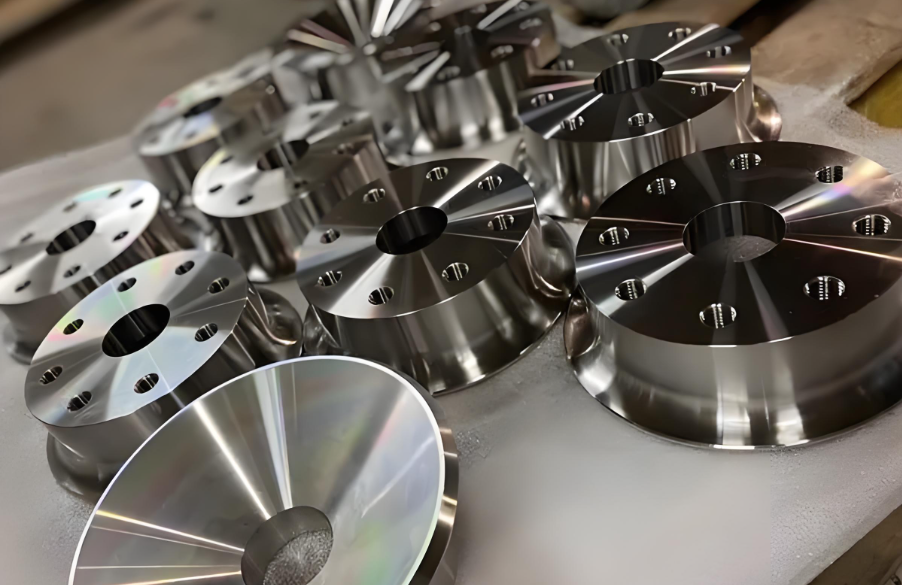
Stainless Steel Machining

Have you ever shipped a batch of machined 316 stainless steel parts, only to hear days later — “Your stainless parts are rusting”? I’ve seen it happen too many times, and the root cause almost always traces back to one missed step: stainless steel passivation.

In this guide, I’ll walk you through what it is, why it matters, the exact process, the standards, and how to choose the right method. Let’s dive in.

What Is Stainless Steel Passivation?

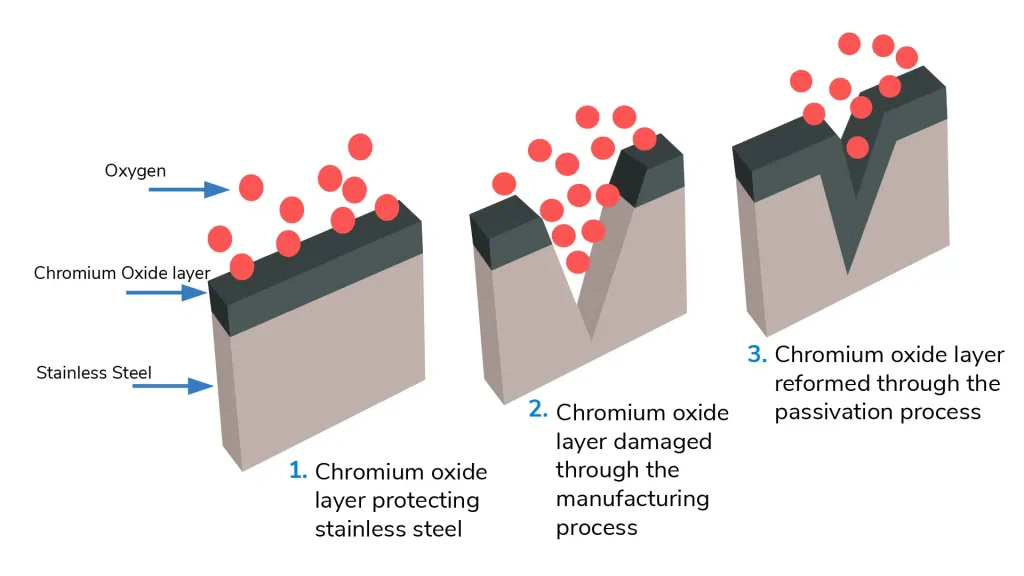
Stainless steel passivation is a chemical treatment that uses a mild oxidizing acid — typically nitric or citric acid — to remove free iron and surface contaminants from stainless steel, while promoting the formation of a thin, protective chromium oxide layer.

During machining, grinding, or welding, tools embed microscopic iron particles into the surface. These free iron particles oxidize and break down the natural passive film, causing rust spots even on “stainless” steel. Passivation dissolves that contamination and lets the chromium-rich passive layer reform uniformly — typically reaching a Cr:Fe ratio of 1.5:1 or higher. The result is a surface that resists corrosion, heals itself when scratched, and lasts dramatically longer in service.

Passivation of Stainless Steel

Why Stainless Steel Passivation Matters: 5 Core Benefits

You might be tempted to skip passivation. I get it — it’s an extra step, an extra cost, and an extra lead time. But once you understand what passivation actually delivers, you’ll see why I treat it as non-negotiable for any stainless steel part I produce. Here are the five core benefits that make it worth every cent.

A massive corrosion resistance boost.

 Properly passivated stainless steel can last 5–10× longer in corrosive environments compared to untreated parts. The chromium-enriched surface dramatically slows down the electrochemical reactions that cause rust, which is the single biggest reason I never let a stainless part leave the shop without it.

Complete elimination of free iron.

Every embedded iron particle from your machining process gets dissolved away. No more “rust bloom” appearing weeks after delivery, no more customer complaints about brown spots on supposedly “stainless” parts. The surface becomes truly clean at a microscopic level.

Pitting corrosion prevention.

 Pitting is the silent killer of stainless steel — small holes that grow inward until the part fails structurally. By the time you can see a pit, the damage is already deep. Passivation closes the door on pit initiation before it can ever start.

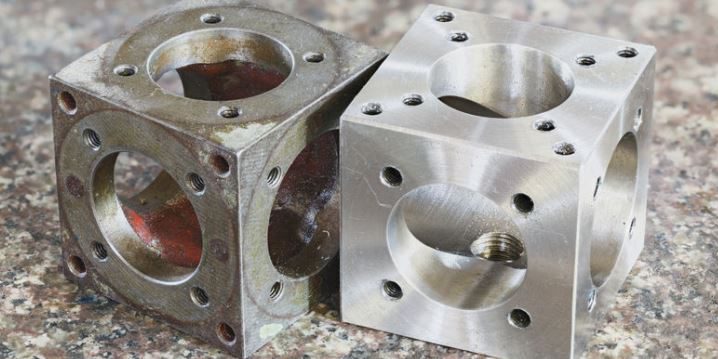
Stainless Steel Passivation

A self-healing passive layer.

Once formed, the chromium oxide film regenerates automatically when scratched or damaged. Your parts essentially heal themselves throughout their service life — a built-in insurance policy you only get when the surface is properly prepared.

Compliance with industry standards.

Medical, aerospace, food, and pharmaceutical industries don’t accept un-passivated stainless steel. Period. If your parts are destined for FDA, AMS, 3-A SSI, or cGMP environments, passivation isn’t a value-add — it’s a baseline requirement to even get through the door.

The Stainless Steel Passivation Process: A 5-Step Guide

Here’s how I run a passivation job from start to finish. Each step matters — skip one, and the whole batch can be ruined.

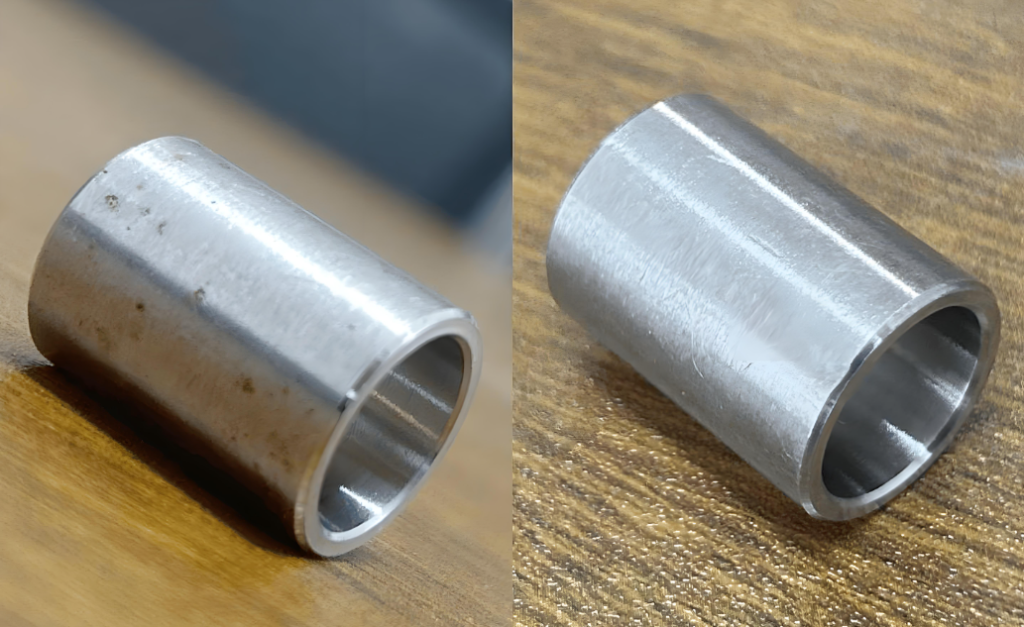
Passivation of Stainless Steel process

Step 1 — Pre-clean and degrease.

First, I get the parts surgically clean. Any oil, cutting fluid, or fingerprint on the surface will block the acid from doing its job. Depending on contamination level, I use an alkaline bath, solvent degreasing, or ultrasonic cleaning. Skipping this step is the #1 cause of passivation failure.

Step 2 — Rinse with DI water.

I rinse everything with deionized or RO water — never tap water, since chlorides and minerals will recontaminate the surface I just cleaned.

Step 3 — Acid bath.

Now the chemistry kicks in. I immerse the parts in either nitric or citric acid, with concentration, temperature, and time tuned to the alloy and the standard (typically ASTM A967). The acid dissolves the free iron and lets the chromium-rich passive film reform uniformly.

Step 4 — Post-rinse.

Out of the acid, the parts go straight into two or three cascading DI water rinses. Any residual acid that dries on the surface will stain or etch the part, so I don’t cut corners here.

Step 5 — Dry and inspect.

Finally, I dry the parts with clean compressed air or a low-temp oven, then check every one under good lighting. A good passivated surface should be uniform and clean — no etching, no pitting, no rainbow stains, no water spots. If anything looks off, I investigate before the parts move forward.

Industry Standards for Stainless Steel Passivation

If you’re buying or selling passivated stainless steel parts, the standards below are the ones that will show up on purchase orders, drawings, and quality contracts. Each defines what “properly passivated” actually means for a specific industry — and knowing which standard governs your parts is how you avoid getting them rejected at incoming inspection.

Most global manufacturers follow one of three standards bodies. ASTM International publishes the most widely used passivation standards — its Committee A01 on Steel, Stainless Steel and Related Alloys developed both A380 and A967, the two specifications at the heart of the industry. AMS (Aerospace Material Specifications) governs aerospace work, where the highest material and process reliability is expected. And British Standards (BS), developed by the BSI, apply across the UK and Commonwealth supply chains. Here’s how the key standards compare:

Standard What It Defines Typical Industry
ASTM Standards
ASTM A967 / A967M Chemical passivation methods (nitric, citric, electropolishing) plus verification tests. General manufacturing, aerospace, automotive
ASTM A380 / A380M Practice for cleaning, descaling, and passivating parts and systems. Industrial equipment, construction, manufacturing
ASTM F86 Surface preparation of metallic surgical implants. Medical devices, surgical implants
ASTM F983 Permanent marking of orthopedic implants. Medical orthopedics
AMS Standards
AMS 2700 Passivation chemicals, parameters, and testing methods for aerospace parts. Aerospace
AMS-QQ-P-35 Legacy passivation and cleaning spec, now superseded by AMS 2700. Aerospace, medical devices
AMS-STD-753 Sampling and testing methods for surface passivity. Aerospace, general manufacturing
British Standards
BS EN 2516 Chemical passivation of corrosion-resistant steels across all grades. Aerospace, UK & Commonwealth supply chains

Among these, ASTM A967 is the workhorse I reference most often for commercial work — it covers nitric and citric immersion, electropolishing, and the verification tests that prove the job was done right. AMS 2700 is the equivalent for aerospace, and ASTM F86 is the must-cite spec for medical implants. The right choice depends entirely on where your part is going.

The Advantages of Stainless Steel Passivation

So far we’ve covered what passivation is, how it works, and the standards governing it. Now let me step back and talk about what passivation actually buys you in the real world — because the technical details only matter if they translate into business value.

Longer Service Life

Properly passivated stainless steel lasts 5–10× longer than untreated parts in moisture, salt, or chemical environments. That kind of longevity changes the lifetime economics of any product.

Regulatory Compliance

FDA, AMS 2700, 3-A SSI, cGMP — every major framework for medical, aerospace, food, and pharma applications expects passivated stainless steel. Skip it, and you can’t legally sell into these industries.

Fewer Failures & Recalls

A 2% cost adder upfront prevents catastrophic rework, lost contracts, and regulatory fallout downstream. The math always favors doing it right the first time.

Cleaner, Consistent Finish

Passivation gives parts a cleaner, more uniform finish — no discoloration, no oxide spots, no batch-to-batch variation. A consistent finish signals quality before a single function is tested.

Brand & Customer Trust

Your customer never sees the chromium oxide layer — they only see whether your “stainless” parts actually stay stainless. One rust complaint can undo years of reputation-building. Passivation protects the relationship, not just the metal.

Pair with Electropolishing for Top-Tier Performance

For the most demanding applications — semiconductor, pharmaceutical, surgical implants — pairing electropolishing with citric acid passivation delivers the highest level of surface integrity. Electropolishing levels the surface and removes burrs; citric passivation then maximizes the Cr:Fe ratio. The result is a surface so clean that bacteria can’t adhere and corrosion has nowhere to start.

The Bottom Line

In a world where every CNC shop can hit a tolerance, surface integrity is where real differentiation happens. Passivation is the cheapest insurance policy you’ll ever buy — and the ROI is worth taking seriously.

Need Passivated Stainless Steel Parts?

Aria delivers ASTM A967-compliant passivation as part of an integrated, single-source manufacturing service — CNC machining, electropolishing, and full surface finishing under one roof. 12 years of factory experience, 1,000,000+ parts delivered.

Get an Instant Quote →
Scroll to Top