Have you ever poured months into a brilliant design, only to watch it stumble at manufacturing? Costs spiral. Suppliers ask for endless tweaks. Launches slip.
Here’s the hard truth: 70–80% of a product’s manufacturing cost is locked in during the design phase. That’s why DFM matters.
What is Design for Manufacturing (DFM)?
DFM is the practice of designing a product so it can be manufactured easily, reliably, and cost-effectively—right from the first sketch. You’ll also hear it called “design for manufacturability”—same thing.
The core idea: stop treating design and manufacturing as separate worlds. Bake manufacturing realities into your design from day one. DFM asks “Can I make this part easily?” Its close relatives—DFA (assembly), DFMA (both), and DFMEA (failure analysis)—all sit under the broader Design for Excellence (DFX) family.
The 6 Core Principles of DFM
Now let’s get into the principles I actually apply on real projects. There are six I rely on, and I want to walk you through each one with a practical lens.
Principle 1: Process — Choose the Right Manufacturing Method Early
Every design decision starts with one question: how will this be made? Injection molding, CNC machining, sheet metal fabrication, die casting, and 3D printing all have different rules, capabilities, and cost structures.
If you design a part with deep, narrow pockets, CNC machining will eat your budget alive. But the same geometry might be trivial with 3D printing. Pick the process first. Then design for it.
Principle 2: Design Simplification — Less Is Almost Always More
This is the principle I lean on the most. I think Albert Einstein said it best: “The best design is the simplest one that works.”
Boothroyd and Dewhurst gave us a beautifully simple test. For every part in your assembly, ask:
Does it move relative to other parts during operation?
Must it be a different material from the parts it touches?
Does it need to be separate to allow assembly or service?
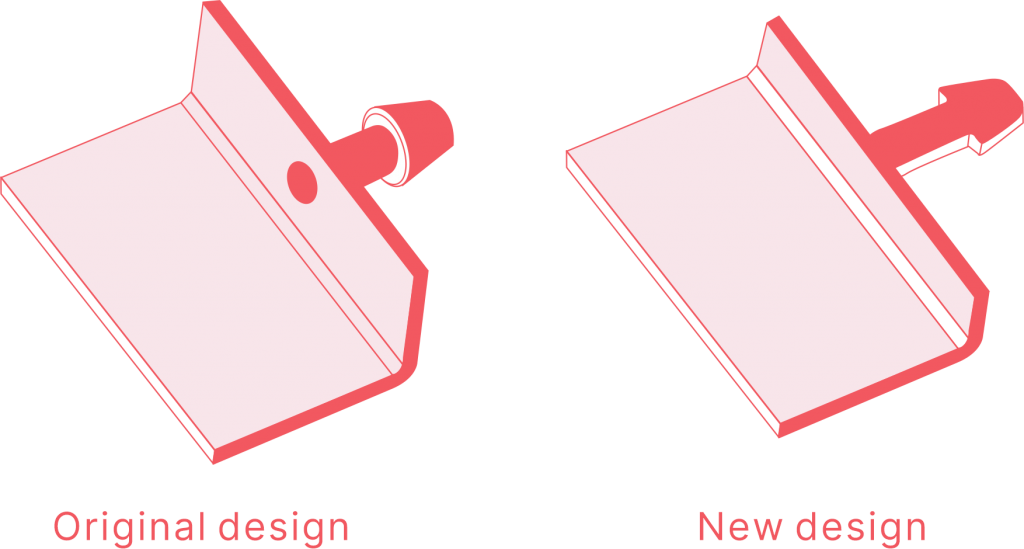
If the answer to all three is “no,” that part is a candidate for elimination or consolidation. I’ve cut part counts by 40% on some projects just by running this check.
Principle 3: Material Selection — Standardize Whenever Possible
Exotic materials look impressive on a spec sheet. But standard, readily available materials almost always win in production. They cost less, ship faster, and don’t disappear from the supply chain when you need them most.
I always ask: can I use an off-the-shelf grade of steel, aluminum, or plastic instead of a custom alloy? Nine times out of ten, the answer is yes—and the savings are massive.
Principle 4: Environment — Design for Where the Product Will Live
Will your product sit in a humid factory? Bake in direct sunlight? Freeze in an outdoor enclosure? These environmental realities shape your material choices, surface finishes, and tolerances. Don’t design for a lab and discover the real world the hard way.
Principle 5: Compliance and Testing — Build It In, Don't Bolt It On
Whether you’re targeting CE marking, FDA approval, UL certification, or ISO standards, compliance is far cheaper to design in than to retrofit. I’ve watched teams burn six-figure budgets redesigning around a compliance issue that a 30-minute conversation could have prevented.
Principle 6: Tolerances and Standardization — Loosen What You Can
Here’s a counterintuitive truth: every time you tighten a tolerance, your cost climbs—often exponentially. A ±0.1 mm tolerance might be cheap. Demand ±0.01 mm and you’ve just doubled or tripled the price.
Ask yourself ruthlessly: does this feature actually need that precision? Or am I just specifying it out of habit? Tighten only where function demands it, and loosen everywhere else.
The Key Benefits of DFM
This is where DFM earns its reputation. When I apply it consistently, the impact shows up in every metric that matters—from cost sheets to launch dates to warranty rates. Here’s what you can expect.
Significant Cost Reduction
This is the headline benefit. Companies applying DFM well typically cut manufacturing costs by 15–30%, and I’ve seen specific projects achieve 49% reductions through targeted design iterations. The savings come from three places: fewer parts, simpler processes, and better material choices. Each one compounds, and over a production run of thousands of units, the impact is enormous.
Faster Time-to-Market
Streamlined designs assemble faster. Modular components fit together without custom tooling. The result? Up to 30% shorter assembly time—which means you ship sooner and start earning revenue faster. In competitive markets, weeks matter. DFM gives them back to you.
Improved Product Quality
Every part you eliminate is a failure point you remove. Simpler designs mean fewer defects, fewer warranty claims, and more satisfied customers. DFM also forces you to specify achievable tolerances—which means parts come out right the first time, instead of getting reworked or scrapped.
Better Scalability
A design that works at 100 units can collapse at 100,000. DFM ensures your product scales without surprise bottlenecks. When demand spikes, you can ramp up confidently—not scramble to redesign under pressure.
Stronger Regulatory Compliance
Building compliance into the design avoids costly recalls and last-minute redesigns. Whether you’re targeting CE, FDA, UL, or ISO, DFM bakes those requirements in from the start—so your launch isn’t held up by a certification you could have planned for.
Greater Sustainability
Less material waste. More recyclable inputs. Lower energy in production. DFM and ESG goals align beautifully—you cut costs and shrink your environmental footprint at the same time. That’s a story your customers, investors, and regulators all want to hear.
Real Competitive Advantage
When you deliver a better product faster and cheaper than competitors, you simply win more deals. DFM gives you all three at once—not a tradeoff, but a stack.
Lower Risk Throughout Development
DFM catches manufacturing problems while they’re still cheap to fix on a CAD model—not after tooling has been cut. A change costs almost nothing in the design phase. The same change after tooling can cost six figures and weeks of delay. DFM moves the conversation upstream, where mistakes are still affordable.
DFM Design Guidelines
Principles are great. You came for actionable rules. Here’s what I follow on every project:
Minimize part count— every removed part cuts assembly time, inventory, and failure points
Use standard, off-the-shelf components— custom fasteners are budget killers
Design for ease of fabrication— don’t require five-axis when three-axis works
Avoid tight tolerances unless required— tighten only where function demands it
Minimize secondary operations— painting, grinding, deburring all add cost
Make parts multifunctional— one bracket beats three
Run through these before any design release. If something doesn’t pass, fix it now—not later.
How to Implement DFM?
Reading about DFM is one thing. Implementing it is another. Here’s the seven-step process I follow.
Step 1: Assemble a Cross-Functional Team
DFM dies in silos. I make sure my team includes design engineers, manufacturing engineers, quality, supply chain, and someone from procurement. Each one catches issues the others miss.
Step 2: Define Requirements and Constraints Clearly
Before sketching anything, I nail down the target cost, annual volume, required materials, regulatory needs, and lead time. These constraints actually unlock creativity—they don’t kill it.
Step 3: Conduct Early DFM Analysis
The earlier I run DFM analysis, the more impact it has. I use CAD-integrated tools and finite element analysis (FEA) to forecast manufacturability and performance during the concept phase—not after tooling is ordered.
Step 4: Run Design Reviews with Manufacturing Engineers
I schedule formal reviews at every major milestone. Manufacturing engineers walk through the design, flag concerns, and propose alternatives. The goal isn’t to defend the design—it’s to improve it.
Step 5: Prototype and Test Aggressively
3D printing makes prototyping faster and cheaper than ever. I build, break, and refine. Then I run a small pilot production run to surface issues that only show up in real manufacturing conditions.
Step 6: Optimize for Full Production
Once the pilot is solid, I work with the manufacturing team to fine-tune fixtures, tooling, cycle times, and inspection plans. Small optimizations here pay back enormous dividends across thousands of units.
Step 7: Build a Continuous Improvement Loop
Launch isn’t the end. I collect production data, warranty returns, and operator feedback—then feed all of it back into the next design revision. DFM is a flywheel, not a one-shot deal.


 EU
EU