Types of Holes in Engineer Drawing

Types of holes

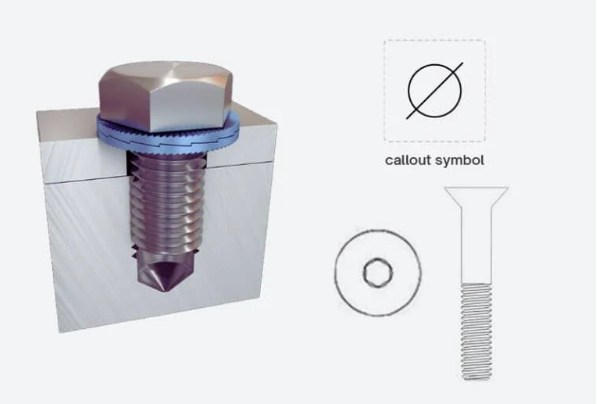
Engineering drawings often include different types of holes for specific reasons, so it is crucial to identify them correctly.

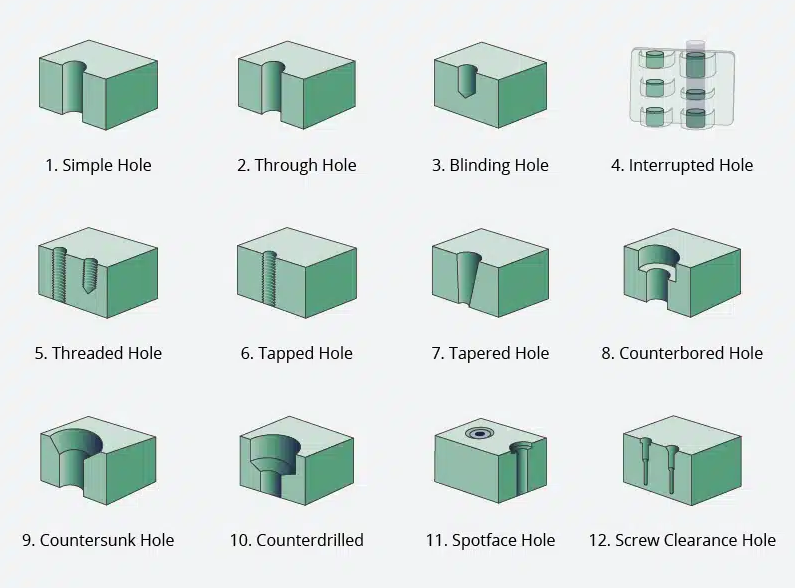
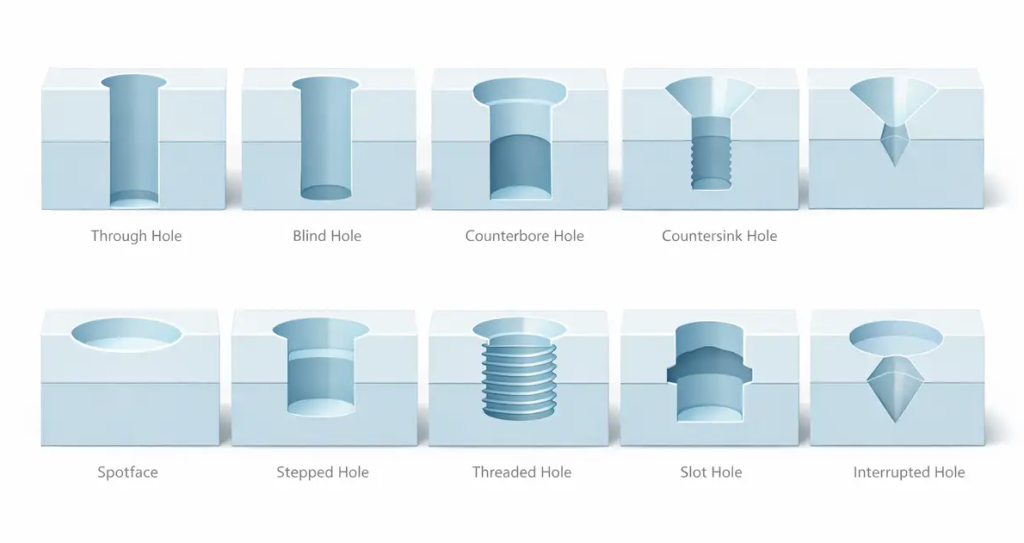
There are 14 common types of engineering holes, including Simple holes, Through Hole, Blind Hole, Interrupted Hole, Threaded Holes, Tapping holes, Counterbore Holes, Spotface Holes,Screw Clearnce Holes etc.

In this complete guide to the various types of engineering holes, we will explore how each one works and what it does. We will also see which common machining processes are used to create them.

types of holes

Overview of Types of Engineering Holes

We have heard that a picture paints a thousand words, so let us take a look at some engineering holes and see what they are used for.

The table below shows some common types of engineering holes.

Document
Hole Type Cross-Section Shape Primary Purpose
Simple Hole Basic circular shape with a uniform diameter. Serving as a general passage or providing a basis for creating complex holes.
Through Hole Tunnel passing through the entire thickness. Allowing bolts to pass completely through them, enabling nuts to be attached.
Blind Hole Circular shape stopping at a specified depth. Creating holes that would otherwise cause one of the adjacent flat surfaces to crack.
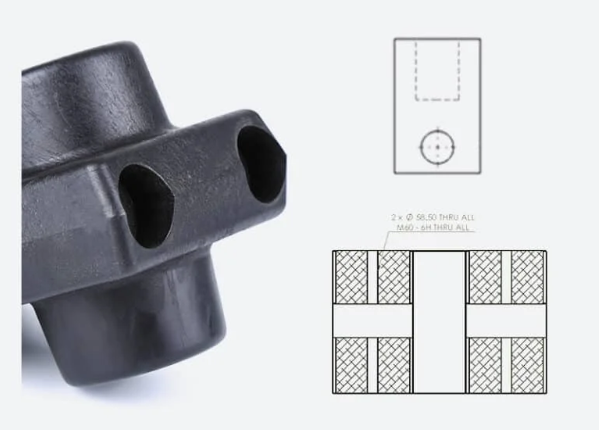
Interrupted Hole A drilled hole that crosses an existing gap or void. Directing fluids or fasteners through hollow mechanical parts.
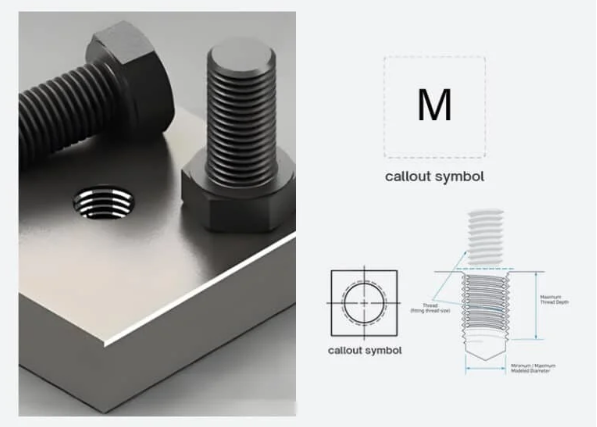
Threaded Holes Walls featuring internal screw thread grooves. Attaching bolts or screws directly to materials without using a nut.
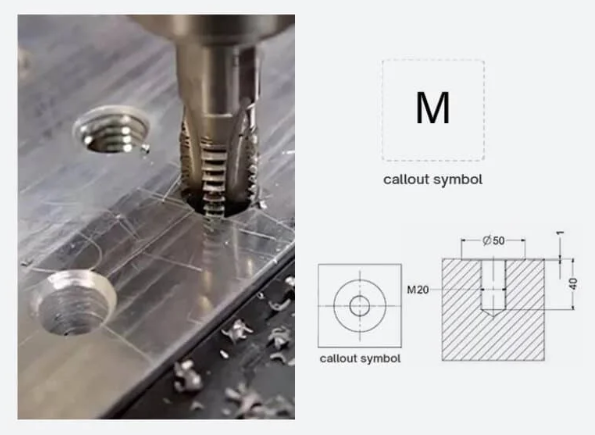
Tapping Holes A hole with a slightly bigger diameter than the screw core. Providing accurate locations to start threading for blind holes.
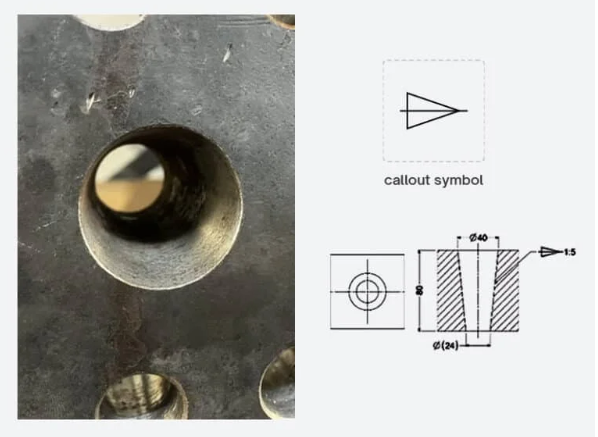
Tapered Holes A conical shape that narrows along the axis. Creating leak-proof seals or self-centering fits for valves and pins.
Counterbore Holes A wide cylindrical step atop a smaller hole. Enabling socket head screws to fit flush with or be recessed below a surface.
Countersink Holes A conical hole at the opening of the bore. Creating nut driver access for flathead screws on flat surfaces.
Counterdrill Holes An angled transition between two diameters. Providing surfaces for tool guide-ways or drilling clearances for drill points.
Spotface Holes A shallow, flat-bottomed recess. Providing smooth, even surfaces for installing washers on rough casting surfaces.
Screw Clearance Holes A hole slightly larger than the screw head or shank. Creating space for a bolt to pass through freely to connect two mechanical components
Reamed Holes Extremely smooth walls with high precision. Ensuring precise holes for high-tolerance press-fit pins and shafts.
Overlapping Holes Multiple intersecting holes in a pattern. Weight reduction or creating specialized paths for fluid flow.

Detailed Explanation of Each Hole Types

In the following paragraphs, we will take a look at some common types of engineering holes, what they are used for and how they are created.

Simple Hole

sample hole

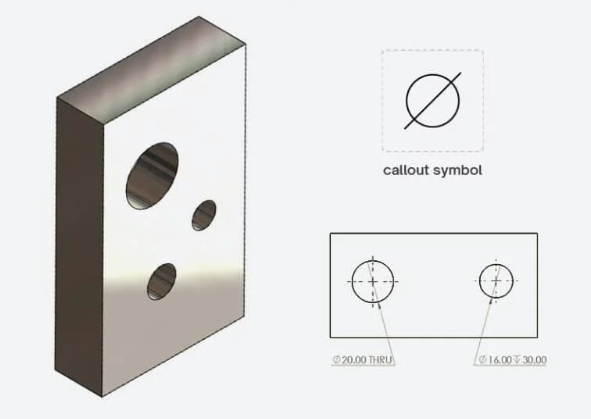
A simple hole is a circular opening cut into a material. The diameter is consistent throughout, with no threads or shoulders. Simple holes are the most commonly drilled type of engineering hole, and are typically drilled using standard carbide drill bits. They are often used as pilot holes or to create a passage for a pin.

Through Hole

through hole

A through hole (also known as a “thru hole”) is one that extends all the way through a part. You can see light coming through the other side when you look into it. Bolt holes are typically drilled as through holes so that a nut can be screwed onto the bolt from the opposite side of the part. Drilling through holes is often easier than drilling blind holes because the chips have an easy escape path.

Blind Hole

Blind Hole

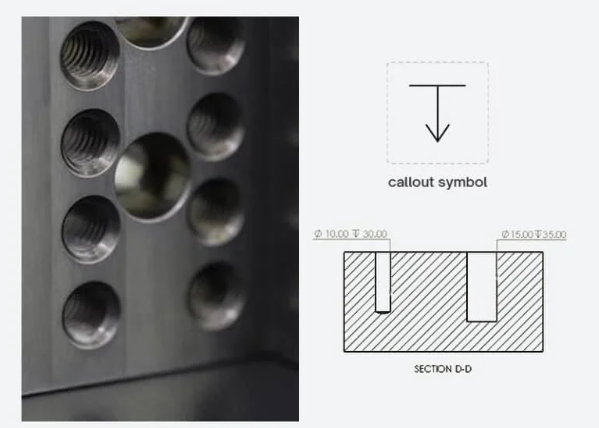
A blind hole does not go all the way through a part. It has a specific depth and is closed at the bottom. This presents some challenges for drilling and threading: the drill bit will have a larger angle at the bottom of the hole, and chips can accumulate in the hole. The hole may need to be evacuated periodically to avoid damaging the drill bit.

Interrupted Hole

Interrupted Hole

An interrupted hole intersects with an existing void or hole within the material being drilled. For example, drilling into a hollow tube might create an interrupted hole. Interrupted holes can be particularly difficult to drill accurately, as the drill bit may bind or break when it transitions from drilling through solid material into a void.

Threaded Hole

Thread Hole

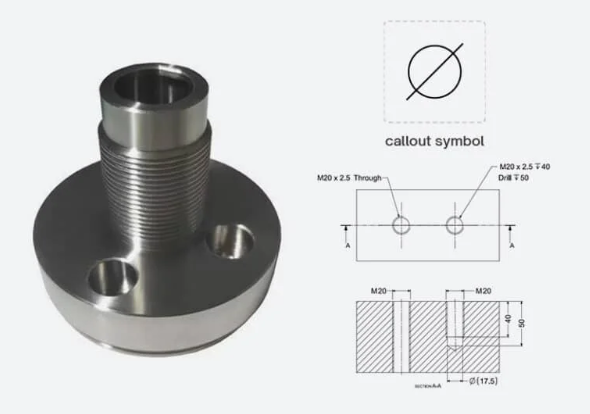
A threaded hole has internal threads that allow a bolt or screw to be screwed directly into the material. Drilling a threaded hole typically involves two steps: drilling a pilot hole and then tapping the hole to create the threads.

Tapping Hole

Tapping Hole

A tapping hole is a hole drilled to a specific diameter that will receive threads. The hole should be drilled to a diameter that matches the core diameter of the bolt or screw that will be screwed into it. If the hole is too small, the tap will break; if it is too large, the threads may strip out under stress.

Tapered Holes

Tapered Hole

A tapered hole differs from a straight hole in that it is not cylindrical but cone-shaped. This means that one end of the hole is wider than the other. Tapered holes are used in plumbing and high-pressure applications where a seal must be created that tightens as parts are pressed together; they are also common on machine tool spindles, where a part must locate (or center) itself exactly within another part.

Counterbore Holes

Counterbore Holes

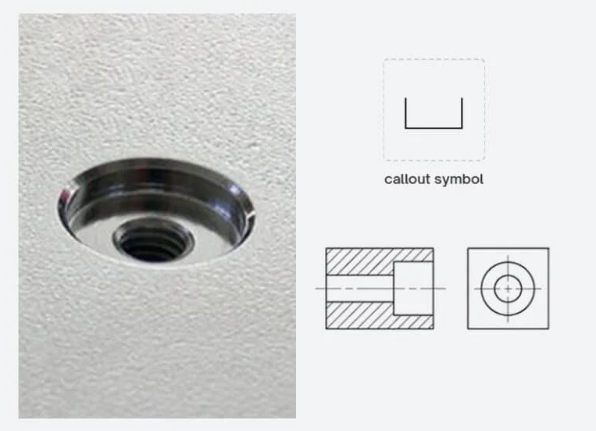
If you look closely, you’ll see that these have an expanded area that forms a cylindrical shape, which then merges into a smaller hole. They’re typically used where a socket head screw is required so that the head sits flush or even below the surface of the material.

Countersink Holes

Countersink Hole

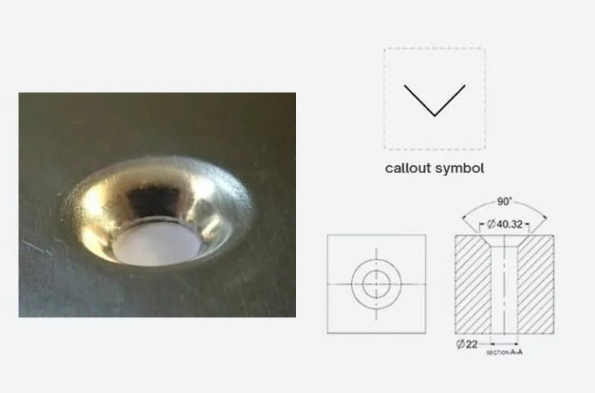
These have a conical section that matches the angle of a countersunk bolt. You’ll see these on lots of everyday products, such as laptops and floorboards – they allow the bolt head to sit flush with the surface so that it doesn’t present a tripping hazard.

Counterdrill Holes

Counterdrill Hole

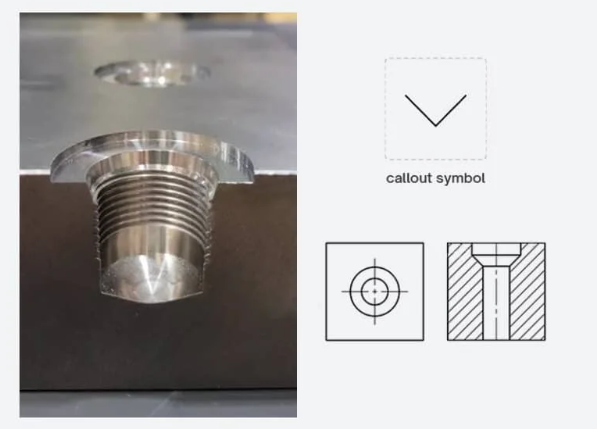
Sometimes you’ll hear these referred to as ‘step drills’. They’re similar to counterbores in that they have two different diameters, but whereas a counterbore has a flat base, a counterdrill is angled. They’re often used for relieving the edge of a drill hole or for providing a lead-in for a secondary part during assembly.

Spotface Holes

Spotface Hole

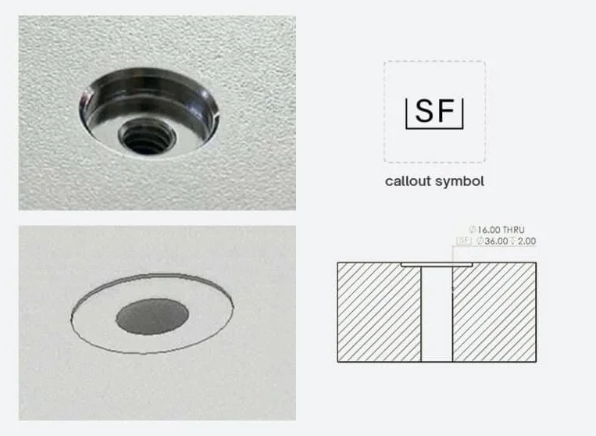
This is effectively a very shallow counterbore. It isn’t intended to allow the head of a bolt to be sunk below the surface, but rather to provide a smooth surface for a washer or bolt to sit on castings. This is especially important because if this isn’t done, the uneven surface can cause bolts to come loose over time.

Screw Clearance Holes

Screw Clearance Hole

As the name suggests, these are holes that are intended to provide clearance for a screw. They’re typically slightly larger than the screw that’s intended to pass through them, and their purpose is to allow two metal parts to be screwed together tightly. Without them, the threads of the screw would catch on the surrounding metal.

Reamed Holes

To produce these, you first need to drill a slightly undersized hole. You can then use a reamer (a type of rotary cutting tool) to remove a small amount of material and create a highly accurate, rounded hole with a smooth surface finish. This is especially important when you’re working with dowel pins that need to fit precisely without any movement.

Overlapping Holes

You’ll also see these referred to as ‘intersecting holes’. They’re exactly what they sound like – two circular holes which overlap each other. Machinists tend to dislike these because they can cause the drill bit to ‘walk’ into the empty space created by the first hole. Special techniques and highly rigid machinery are needed in order to accurately drill overlapping holes, but they’re very useful for reducing the weight of parts and creating complex flow paths in manifold blocks.

Surface Finish Requirements for Holes

In many applications, holes need to be more than just the correct size, they also need to have the correct surface finish.

A rough surface finish can increase friction and lead to the entrapment of debris. The surface roughness of the hole depends on the processing method and thier Applications.

Typically, standard processing will keep the average roughness within 3.2 micrometers.

Document
Process Typical Range (μm) Common Applications
Drilling 3.2 – 6.3 Clearance holes, non-critical features
Boring 1.6 – 3.2 Bearing bores, engine components, hydraulic cylinders
Reaming 0.8 – 1.6 High-precision fits, sealing surfaces
Honing/Grinding 0.1 – 0.4 High-performance bearings, ultra-tight seals

Hole Tolerances Explained

Hole tolerance refers to how much variation is allowable in the diameter of a hole. If the hole is too large for the bolt, the bolt will be loose in the hole. If the hole is too small, the parts will not fit together properly.

Hole tolerance is typically indicated on the part’s blueprint using either the “H” or “G” system of limits and fits for metric holes. The specific tolerance requirements need to be indicated on the blueprint so that the machinist knows how precisely the hole needs to be machined.

Common hole tolerances for manufacturing generally range from ±0.05mm - ±0.1mm for standard machined holes.

How to Choose the Right Hole for Your Project

hole types

When deciding which type of hole to use for your project, consider what you need the hole to do. If you want to create a hidden fastener, you will need a counterbore.

If you want to create a strong, permanent bond, you will need a threaded hole. Keep in mind material thickness, too.

For example, creating a blind hole in steel may be much more difficult (and expensive) than creating a through hole in aluminum. Always opt for the simplest hole type that will get the job done safely.

How to Avoid Design Errors

Designing engineering holes correctly can save time, money, and headaches later on. The majority of design errors in holes occur because the engineer did not take into consideration how the part will be cut. This may seem obvious, but it is a common mistake nonetheless. By anticipating potential errors, engineers can avoid them altogether.

Here are some common design errors to watch out for:

1. Insufficient depth in blind holes

One common error is not allowing enough room in the bottom of a blind hole. Engineers need to remember that the hole must accommodate both the threaded depth as well as the tap lead-in threads. By not accounting for both, engineers may create holes that are too shallow. For example, if a hole needs ½” of threads, it is a good idea to make the hole 9/16” deep. This will provide extra room at the bottom of the hole for chips to accumulate.

2. Over-tight tolerances increase cost

Another common design error is specifying hole tolerances that are tighter than necessary. While it may be tempting to call out tight tolerances on all bolt holes, keep in mind that each additional 0. 001” of precision machining adds time and money to the job. Clearing holes typically does not require tight tolerances unless moving parts will interact with each other in that area. Limiting tight tolerances to mating or sliding surfaces and using looser tolerances elsewhere can save both time and money.

3. Incorrect countersink angles

Countersinks are not all 90 degrees; common angles are 82 degrees, 90 degrees and 100 degrees. If the angle of the countersink in your part doesn’t match the angle on the head of the screw, they won’t mate correctly, and the screw will sit on a single point. This can lead to loose screws and damaged parts, so it’s important to match the screw to the hole. If you haven’t already done so, take a look at the design specifications for your fasteners and compare them to your engineering drawing.

4. Ignoring tool access and chip evacuation

It’s often difficult to clear chips from deep holes. This is particularly true for those that are very narrow in relation to their depth. It’s common for the drill bit to fail because of this — especially if it breaks and you can’t get the remainder of the bit out.

Of course, this assumes the CNC milling machine can even access the hole. A common rookie design mistake involves placing a feature in a location that is inaccessible to the CNC machine. The entire design may need to be reworked in order to accommodate the manufacturing process.

5. Poor alignment in multi-hole patterns

If you have two parts with holes that need to line up perfectly (or almost perfectly) so that they can be bolted together, then you need to think carefully about alignment.

If the tolerances on the two parts are too tight, then even small manufacturing errors can result in a situation where the bolts won’t fit through the holes. In this situation, it often makes sense to make one set of clearance holes slightly larger than the other. This allows for a little “wiggle room” during assembly.

Aria Capabilities for Hole Machining

Creating the perfect hole isn’t always easy — especially when you’re working with complex geometries, tight tolerances, or difficult materials. But it doesn’t have to be.

When you partner with an experienced manufacturing team like Aria, you can be sure that all of your holes will be produced accurately.

As professionals, we’re well equipped with the latest CNC milling machines, and we offer a wide range of services, including reaming, threading (including blind holes) and drilling.

If you’re having trouble figuring out which type of hole you need or how to get started with your project, just contact us. We’re always happy to help!

FAQs

Q: What is the best way to handle hole depth in blind holes?

A: When creating holes that don’t go all the way through a part, you have to take into account the drill point. Drill tip angles are typically tapered so that the deepest part of the hole will be wider than the surface opening. For threading blind holes, ensure the hole size reaches a specified depth so the tap doesn’t bottom out before finishing.

Q: How do you ensure dimensional accuracy in hole making?

A: Creating precise holes for mechanical components often requires a two-step process: drilling and reaming. Drilling creates the initial hole, which is usually a slightly bigger diameter. Then you use reamed holes to bring the hole to size and create a precise circular shape. Reaming is especially important when the hole needs to fit another part closely.

Q: Why are counterbored holes important for flat surfaces?

A: In mechanical engineering, you’ll sometimes encounter counterbored holes – holes with an enlarged portion that allows the head of a bolt or screw to sit flush with the surface of the part. Creating these recessed areas is important if you don’t want the fastener to stick out (for example, to keep other components from coming into contact with it).

Q: How do you manage complex hole geometries on a single part?

A: If you need to drill multiple holes at angles that intersect or are otherwise complex (for example, a cluster of holes that all need to be circular and perfectly aligned), you’ll need to spend extra time thinking about how the drill bit interacts with your material and planning the best approach. Computer-controlled machines are a good bet in these situations.

casibom casibom
Scroll to Top