

12 Different Types of Casting Processes

Choosing the wrong casting process wastes time and money. This guide covers 12 proven methods—how each works, ISO tolerance grades, pros, cons, and real applications—so you can pick the right one with confidence.

What Is the Casting Process?

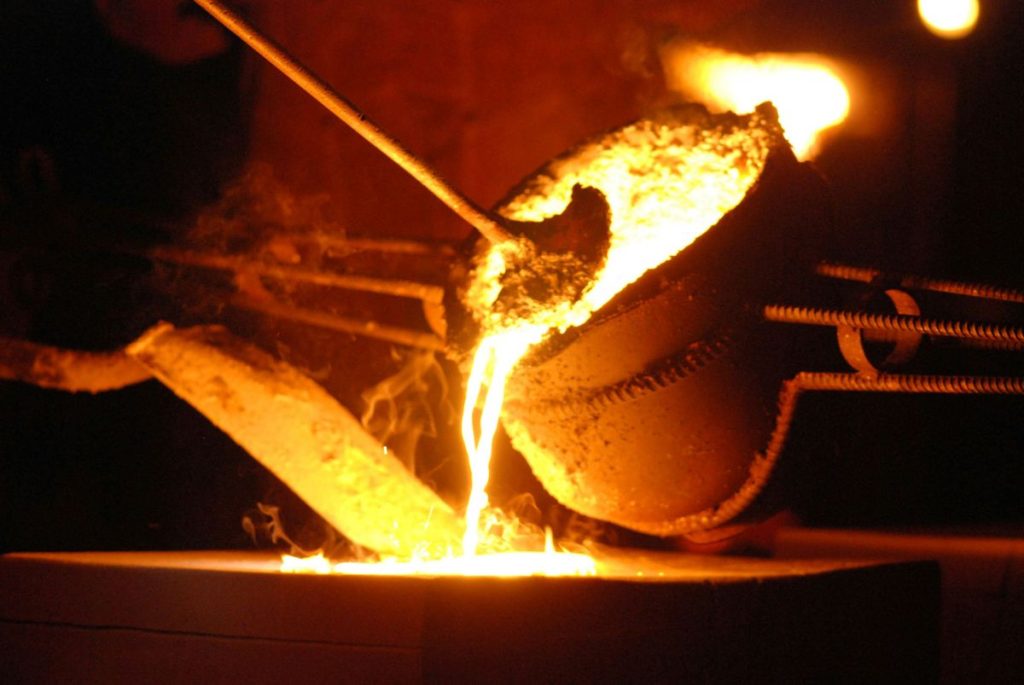
Casting is one of humanity’s oldest manufacturing methods—its origins trace back over 7,000 years. At its core, casting means pouring liquid material into a shaped cavity. The material solidifies, then is removed as a finished or near-finished part.

Today, global casting production exceeds 100 million tonnes per year, according to the World Foundry Organization (WFO). Ferrous metals (iron and steel) dominate, followed by aluminum alloys. Nearly every industry depends on castings.

Types of Casting Processes

Each method suits different materials, volumes, geometries, and budgets. Read through all 12 below to find the right fit for your project.

Sand Casting

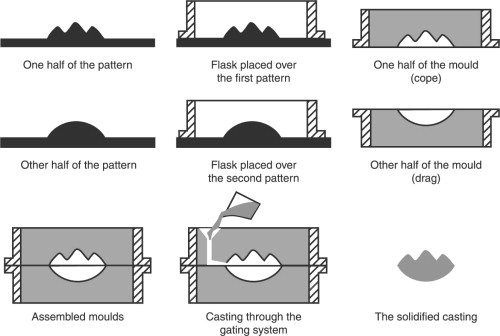
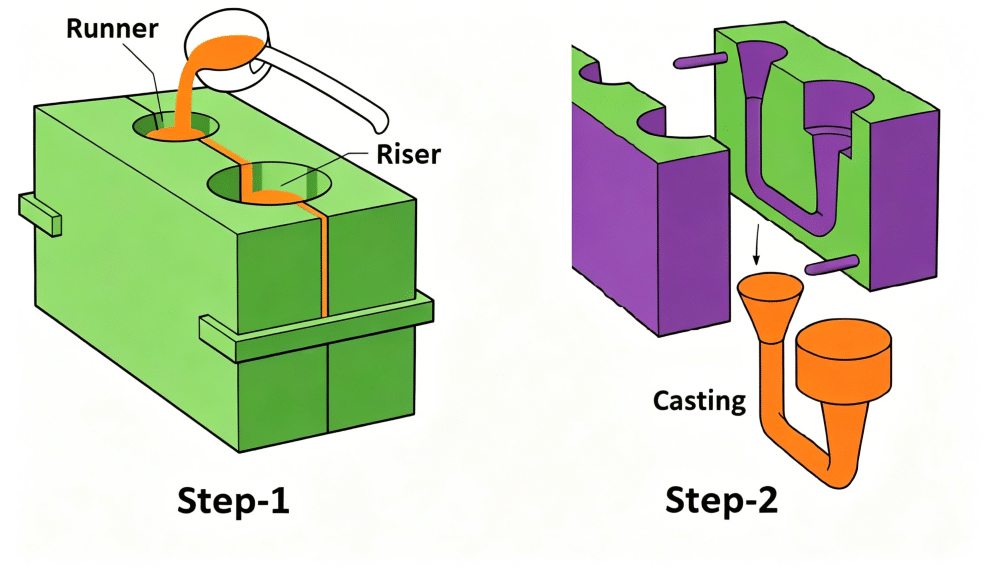
Sand casting uses a two-part mold (cope and drag) packed from silica-based sand. A pattern defines the cavity shape. Molten metal fills the cavity through a sprue and gate system.

This process handles almost any alloy—including high-melting-point metals like steel and titanium. Per ASTM A802, surface quality is graded S1 to S5. Sand casting accounts for roughly 60% of all metal castings worldwide (AFS data).

Typical applications: Engine blocks, cylinder heads, crankshafts, marine components, large industrial housings.

Sand Casting .
Advantages Disadvantages
Lowest tooling cost of all casting methods Roughest surface finish (Ra 12.5–50 µm)
Handles virtually all alloys and very large parts Widest tolerance band (ISO CT 8–12)
Sand is recyclable—low material waste Secondary machining needed for tight features
Ideal for prototypes and low volumes Lower production rate vs. die casting

Die Casting

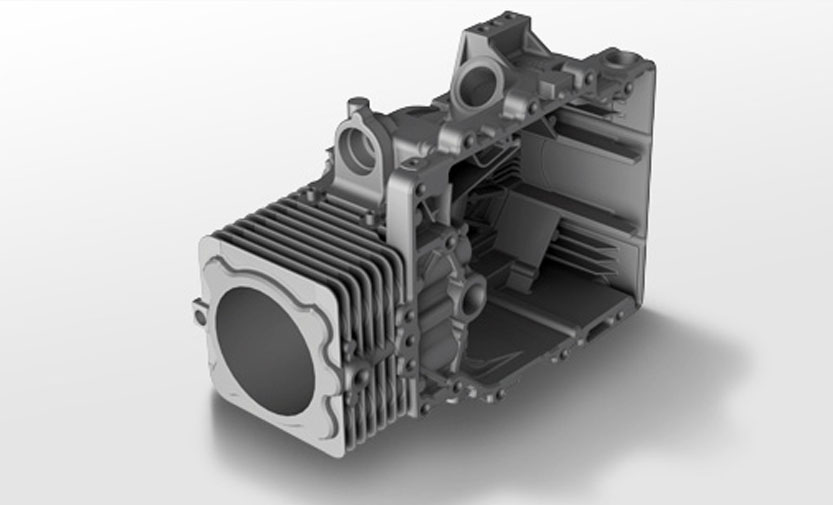
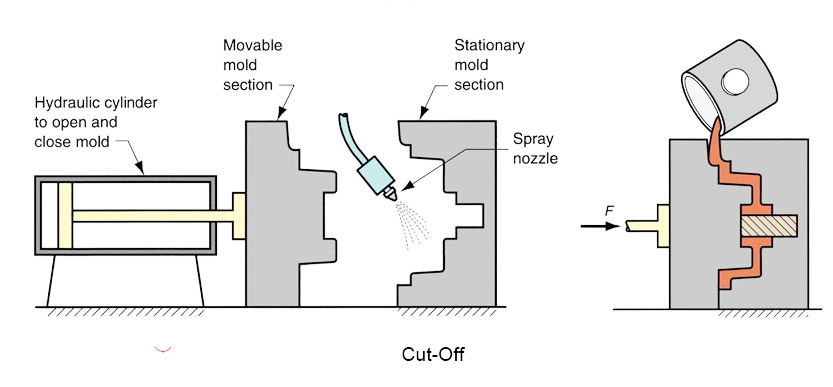
Die casting uses hardened steel molds called dies. Molten metal—limited to lower-melting non-ferrous alloys—is injected under pressure and solidifies rapidly, producing dimensionally precise parts.

Hot-chamber die casting keeps the injection mechanism submerged in the melt—best for zinc and tin. Cold-chamber die casting ladles metal separately before each shot—required for aluminum, magnesium, and copper alloys. ASTM B85 governs aluminum alloy die castings.

Typical applications: Automotive housings, electronic enclosures, appliance components, toys, furniture hardware.

die casting
Advantages Disadvantages
Excellent dimensional accuracy (ISO CT 4–6) High initial tooling investment
Very fast cycle times at high volumes Limited to non-ferrous alloys only
Die life typically exceeds 100,000 shots Porosity limits use in structural parts
Minimal secondary machining required Large capital equipment cost

Pressure Die Casting

Die casting uses hardened steel molds called dies. Molten metal—limited to lower-melting non-ferrous alloys—is injected under pressure and solidifies rapidly, producing dimensionally precise parts.

Hot-chamber die casting keeps the injection mechanism submerged in the melt—best for zinc and tin. Cold-chamber die casting ladles metal separately before each shot—required for aluminum, magnesium, and copper alloys. ASTM B85 governs aluminum alloy die castings.

Typical applications: Automotive housings, electronic enclosures, appliance components, toys, furniture hardware.

pressure Die Casting
Advantages Disadvantages
Rapid cycle times (HPDC) High tooling costs
Dense, low-porosity parts (LPDC) Limited to non-ferrous alloys
Excellent dimensional consistency Complex process control required
Reduced secondary machining Not suitable for very large parts (HPDC)

Investment Casting

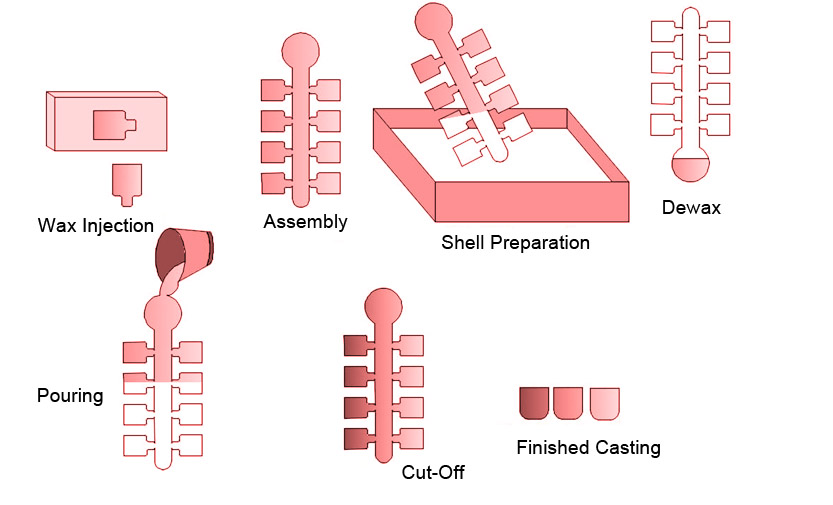
Also called lost-wax casting, this process dates back to the Bronze Age. A wax pattern is coated in multiple layers of ceramic slurry. The wax is melted out, leaving a hollow shell. Molten metal is poured in, the shell is broken away, and a near-net-shape part emerges.

For prototypes, 3D-printed low-ash polymer patterns replace injection-molded wax—cutting tooling lead times dramatically. ASTM A732 governs investment casting tolerances. Accuracy typically falls in ISO CT 4–CT 6.

Typical applications: Turbine blades, surgical instruments, MRI components, aerospace brackets, jewelry.

Investment Casting
Advantages Disadvantages
Excellent accuracy (ISO CT 4–6) and surface finish Labor-intensive; higher per-part cost
Handles superalloys, titanium, cobalt-chrome Longer production lead times
Near-net shape reduces machining cost New pattern needed each cycle (wax)
Complex internal geometries possible Size and weight limitations

Permanent Mold Casting

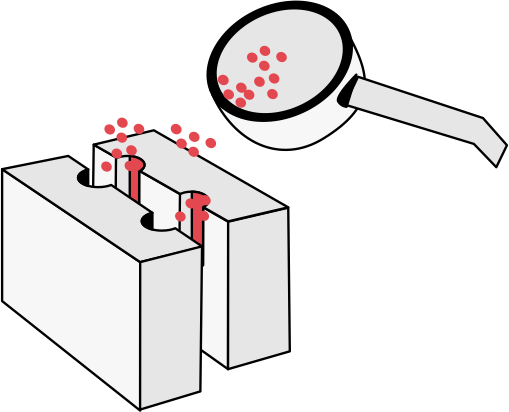
Permanent mold casting uses reusable metal dies—typically cast iron or steel. Molten non-ferrous alloy is poured or gravity-fed in. The metallic mold conducts heat faster than sand, producing a finer grain structure and better mechanical properties.

This process is ideal when you need high volume, good accuracy, and strong parts—but cannot justify the higher tooling cost of pressure die casting. Molds typically last 10,000–50,000 cycles before replacement.

Typical applications: Automotive pistons, gearboxes, pump housings, aerospace brackets, pipe fittings.

Permanent Mold Casting
Advantages Disadvantages
Good accuracy and repeatability (ISO CT 5–7) Higher mold cost than sand casting
Better mechanical properties than sand castings Limited to lower-melting non-ferrous alloys
Reusable mold reduces long-term cost Undercuts require removable cores
Smooth surface finish Slower than pressure die casting

Centrifugal Casting

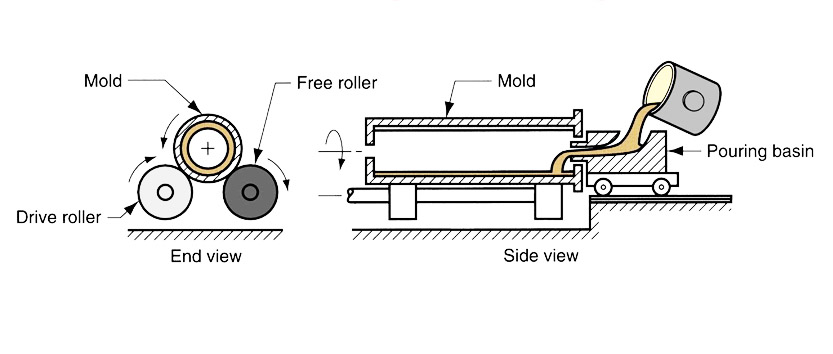
Centrifugal casting spins a permanent mold at high speed while molten metal is poured in. Centrifugal force pushes metal outward against the mold wall, solidifying from the outside inward. Denser metal occupies the outer wall; lighter impurities migrate inward and are later machined away.

Three variants exist: true centrifugal (hollow cylinders, no core needed), semi-centrifugal (solid rotational parts like gears and wheels), and centrifuge casting (multiple asymmetric parts around a central axis).

Typical applications: Pipes, cylinder liners, flywheels, clutch plates, piston rings, boiler drums.

Centrifugal Casting
Advantages Disadvantages
High density, near-zero porosity High capital investment required
No gates or risers needed (true centrifugal) Mainly limited to cylindrical shapes
Excellent material yield with low waste Requires skilled operators
Works with metals, glass, and concrete Inner bore may need secondary machining

Vacuum Casting

Vacuum casting performs the entire casting operation inside a vacuum chamber. Evacuating air before injection virtually eliminates porosity, gas entrapment, and surface blemishes. Parts emerge with outstanding surface quality and mechanical properties.

For polymer prototypes, vacuum casting uses silicone molds with polyurethane resin—ideal for 10–50 production-quality parts when injection tooling is not yet justified. For metal parts, vacuum die casting produces safety-critical components that can be welded and heat-treated post-cast.

Typical applications: Functional prototypes, automotive structural parts, aerospace components, medical device housings.

vacuum casting
Advantages Disadvantages
Extremely low porosity; excellent surface quality Higher equipment and tooling cost
Parts can be welded and heat treated Silicone molds last only 20–50 shots
Ideal for small-batch prototyping Not cost-effective for very high volumes
Wide material range: metals, polyurethanes, resins Slower cycle times

Plaster Casting

Plaster casting replaces sand with gypsum (Plaster of Paris). Plaster has very low thermal conductivity. This means molten metal cools slowly, filling thin sections and fine details before freezing—producing outstanding surface smoothness.

However, slow cooling also produces a coarser grain structure and lower mechanical properties. Plaster cannot withstand ferrous metal temperatures. The process suits aluminum, copper, zinc, and magnesium only. Molds are single-use.

Typical applications: Prototypes, decorative hardware, precision gears, valves, aluminum instrument panels.

Advantages Disadvantages
Outstanding surface finish (Ra 0.8–1.6 µm) Not suitable for ferrous or high-melting alloys
Excellent accuracy for thin-walled parts Slow cooling reduces mechanical properties
Reproduces very fine detail More expensive than sand casting
Good for small, complex prototypes Single-use molds increase cycle cost

Continuous Casting

Continuous casting produces semi-finished metal stock—slabs, billets, blooms, and bars—with a constant cross-section. Molten metal flows into a water-cooled, open-ended mold at a controlled rate. A solid skin forms immediately on the outer surface; the strand is drawn downward, spray-cooled, and cut to length.

The process never stops as long as the ladle above is fed. This eliminates batch inefficiency and dramatically improves yield vs. ingot casting. However, it requires enormous capital investment and suits only simple cross-sections.

Typical applications: Steel slabs for sheet rolling, aluminum billets for extrusion, copper rod for wire drawing.

Advantages Disadvantages
Very high throughput and low cost per tonne Enormous capital investment and footprint
Homogeneous, consistent material quality Limited to simple, constant cross-sections
Low material waste Continuous mold cooling required (risk of defects)
Lower cost per ton than ingot casting Not suitable for low volumes or complex shapes

Gravity Die Casting

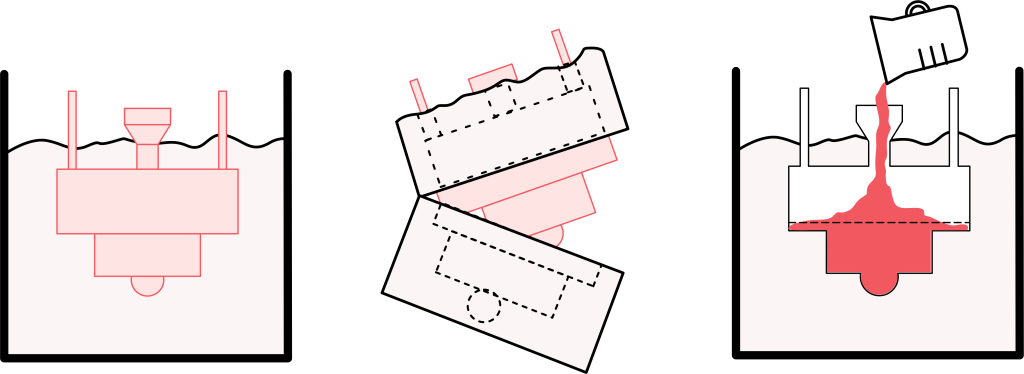
Gravity die casting uses reusable metal molds filled by gravity—no external pressure applied. The mold is preheated and coated with a release agent. Some variants tilt the mold during pouring to control turbulence and improve fill quality.

Because the metallic mold conducts heat faster than sand, solidification is quicker and grain structure is finer. Molds typically last 10,000–100,000 cycles. This process suits non-ferrous alloys—aluminum, magnesium, zinc, and some bronzes.

Typical applications: Automotive pistons, cylinder heads, kitchenware, lighting hardware, pump impellers.

Advantages Disadvantages
Better finish and accuracy than sand casting Higher mold cost than sand casting
Good mechanical properties from rapid solidification Complex undercuts require removable cores
Reusable mold reduces long-run cost Limited to non-ferrous alloys
Suitable for thin-walled parts Slower fill speed than pressure die casting

Lost-Foam Casting

Lost-foam casting replaces the wax pattern with expanded polystyrene (EPS) foam. The foam pattern is coated with a refractory ceramic wash and surrounded by loose, unbonded sand. When molten metal pours in, it vaporizes the foam instantly. Gas disperses through the porous sand, and metal fills the exact shape left behind.

Since no core, binder, or parting line is needed, lost-foam excels at complex internal passages. It suits medium-to-high volumes where foam patterns can be economically injection-molded.

Typical applications: Engine blocks and manifolds, pump bodies, fire hydrant components, valve bodies, art sculptures.

Advantages Disadvantages
Highly complex shapes; no parting lines or cores Foam patterns are fragile and can distort
Clean process—no sand binders or shakeout Pattern cost makes it uneconomical for very low volumes
Wide material compatibility (steel, iron, aluminum) Gas evolution during pouring needs careful venting
Economical for high-volume production Longer delivery times due to multi-step process

Shell Molding

Shell molding bridges sand casting and investment casting in accuracy. A heated steel pattern is coated with fine silica sand mixed with thermosetting resin. Heat cures the resin into a rigid shell. The shell is stripped, two halves are bonded, and metal is poured—just like sand casting, but with much better dimensional accuracy.

Finer sand particle size and the harder shell surface produce smoother castings. The process is semi-automated and consistent at medium-to-high volumes. Tooling is more expensive than sand casting, making it less suited to very small runs.

Typical applications: Gearbox housings, connecting rods, camshafts, cylinder heads, valve bodies.

Advantages Disadvantages
Better accuracy than sand casting (ISO CT 5–7) Not cost-effective for small batches
Excellent surface finish (Ra 3.2–6.3 µm) Part size and weight limitations
Semi-automated; consistent repeatability Metal pattern is expensive for large parts
Less machining required post-casting Resin cost adds to operating expense

The Applications of Casting

Casting is used across virtually every industry. You can implement it to make aerospace and automotive components in high-quantity production, as well as toys, furniture, jewelry, and electronics. It is also widely used for infrastructure parts like pipes, valves, and pump housings—and for large structural components in construction and energy that would be impractical to machine from solid billet.

How to Choose the Right Casting Process

Experienced casting engineers narrow the choice with four key questions:

  1. What alloy do you need?— High-melting-point ferrous metals need sand or investment casting. Non-ferrous alloys open more options.
  2. What is your required volume?— High tooling costs amortize over large runs. Low volumes favor sand, plaster, or vacuum casting.
  3. What is the part size and geometry?— Thin-walled complex shapes favor investment or lost-foam casting. Large simple shapes favor sand or gravity die casting.
  4. What tolerance and surface finish do you need?— Per ISO 8062-3, die casting and investment casting achieve CT 4–6; sand casting ranges from CT 8–12.
If your priority is… Best processes to consider
High-melting-point alloys (steel, titanium, nickel) Sand Casting, Investment Casting, Shell Molding
Very high production volume Die Casting, Pressure Die Casting, Continuous Casting
Complex geometry / thin walls Investment Casting, Lost-Foam, Vacuum Casting
Lowest tooling cost / small batch Sand Casting, Plaster Casting, Vacuum Casting
Best mechanical properties Centrifugal Casting, Permanent Mold Casting
Smoothest surface finish Investment Casting, Plaster Casting, Shell Molding
Cylindrical / rotational parts Centrifugal Casting
Raw material / semi-finished stock Continuous Casting
Rapid prototyping / small polymer batch Vacuum Casting

There is rarely a single 'best' process. Most precision parts combine casting (for near-net shape) with CNC machining (for critical tolerances). Discuss your alloy, volume, budget, and geometry with a manufacturing partner early in the design phase to save significant cost.

Frequently Asked Questions

What is the most popular type of casting process?
Sand casting is the most widely used method globally. It accounts for roughly 60% of all metal castings produced (AFS data). For high-volume precision metal parts, high-pressure die casting is the industry standard.
What dimensional tolerances does each casting process achieve?
Per ISO 8062-3, die casting achieves CT 4–6, investment casting CT 4–6, shell molding CT 5–7, permanent mold CT 5–7, and sand casting CT 8–12. Tighter CT numbers mean higher precision. See the ISO Tolerance Comparison table in this document.
What is the difference between die casting and investment casting?
Die casting uses reusable steel dies for non-ferrous alloys at high volume. Investment casting uses a ceramic shell around a wax pattern and supports a much wider alloy range—including superalloys and titanium—at higher per-part cost.
What materials can be used in casting?
Almost any metal can be cast—aluminum alloys, cast iron, steel, zinc, copper, bronze, magnesium, titanium, and nickel-based superalloys. Non-metal options include polyurethane resins (vacuum casting), plaster, concrete, and glass.
Which casting process is best for prototyping?
For metal prototypes, investment casting with 3D-printed patterns and sand casting with 3D-printed molds offer fast turnaround without expensive tooling. For polymer prototypes, vacuum casting with a silicone mold produces 10–50 production-quality parts quickly.
What is net-shape casting?
Net-shape casting produces parts very close to their final dimensions with little secondary machining. Investment casting and die casting are typically net-shape processes. Sand casting usually needs machining on critical sealing surfaces and tight-tolerance features.
Scroll to Top