

 EU
EUSprings store energy when loaded and release it when the load is removed. The right choice depends on load direction, space, and force behavior. This guide covers the main types of springs, how each works, and where engineers use them.

Principle of Spring
A spring is an elastic part. It deforms under load and returns to its original shape when the load is removed. The energy goes in as deflection and comes back as force or motion. Springs store energy as mechanical energy, ready for later use. Utilizing mechanical energy this way lets a device act without a motor or battery. That is why springs sit inside many mechanical systems, from pens to presses.
Most mechanical springs follow Hooke’s Law, F = kx. F is the force exerted by the spring. The variable x is the deflection. The letter k is the spring constant, also called the spring rate. A spring rated at 10 N/mm needs 10 N of force applied for every millimeter of travel. The spring answers with a restoring force of equal size in the opposite direction. Torsion springs follow the same rule with torque and angle, so T = kθ.
The law holds only below the elastic limit. Past that point the spring takes a permanent set and does not return to its free length.
By force behavior, springs fall into two groups. Linear springs keep a constant rate across their travel. Variable rate springs get stiffer or softer as they deflect. Most of the types of springs below are linear. Conical springs and Belleville washers are not.
Different Types of Springs and Their Applications
Springs are usually grouped by geometry. The sections below follow that order.
Helical Springs
Helical springs are wire wound into a coil. Among all types of springs, they are the most common because they are cheap to make and easy to tune. The coils store energy as the wire flexes. Wire diameter, coil diameter, coil count, and pitch set the spring constant. Helical springs split into three types by how the load is applied.
Coil Springs
Coil spring is the everyday name for a helical spring. The three helical types above are all coil springs, but the term usually points to larger load-bearing parts in vehicles and machinery. Coil springs play a big part in vehicle suspension systems, where they carry the weight of the car and give a smooth ride. A well-matched suspension also enhances vehicle safety by keeping tires on the road. Engine valve trains use them too, and heavy coil springs isolate vibration in industrial and construction equipment.
Size changes how the spring is made. Small wire is usually coiled cold. Thick wire is typically heated before coiling, since it is hard to form cold. Both are heat treated afterward to relieve stress.
Compression Springs
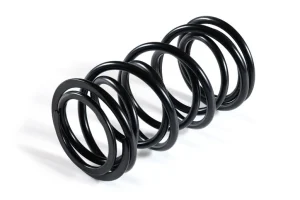
Compression springs are open wound, with gaps between the coils. Compression springs push back when squeezed. The ends are usually closed and ground flat so the spring sits square on its seat. As the spring compresses, the load rises in proportion to travel.
Long, thin springs can buckle sideways. A guide rod or a bore prevents it. Designers also keep the spring from reaching solid height in normal use, since a fully closed coil carries extra stress.
Compression springs absorb shocks in shock absorbers and mounts. Valve assemblies use them to reset, and hydraulic and pneumatic systems use them to return pistons. In a ballpoint pen, a compression spring pushes the ink mechanism forward.
Extension Springs
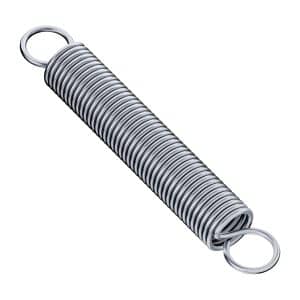
Extension springs are wound tight, and most are made with initial spring tension. The coils press together until the applied force beats that preload. Extension springs connect two parts and pull them together. Hooks or loops at the ends attach them to the assembly.
The hooks are the weak point. Sharp bends concentrate stress there, and that is where most extension springs fail. Full radius hooks and larger bend radii extend life.
Garage doors, trampolines, and tension scales all use extension springs.
Torsion Springs
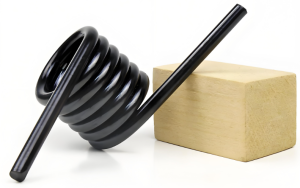
Torsion springs resist twisting. Two legs extend from the coil. Turning the legs in opposite directions loads the spring. The spring stores rotational energy, and it returns that energy as rotational force at the legs. The wire is stressed in bending, not in torsion, despite the name.
Direction matters. Load a torsion spring in the direction that winds the coil tighter. The other direction raises stress and shortens life. A rod through the center keeps the coil from bowing.
Torsion springs play the main part in clothespins and mousetraps. Torsion springs also drive door hinges, latches, and the counterbalance on many garage doors.
Leaf Springs
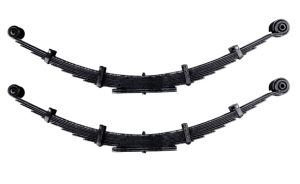
Leaf springs are stacks of flat metal strips, or single rectangular metal plates, held together as a beam. The assembly flexes like a beam on supports. Friction between the leaves adds damping, which designers of suspension systems often want. Leaf springs play two jobs at once. They carry the load and locate the axle. A stack of leaves can effectively support loads that would bend a single plate, and leaf springs let trucks carry heavy loads safely.
Among the types of springs used on road vehicles, leaf springs are one of the oldest. The shapes below differ in how the leaves are mounted.
Elliptical Leaf Spring
An elliptical leaf spring is two semi elliptical springs joined at the ends to form a full oval. Leaf springs of this shape appeared on horse-drawn carriages and early cars. They are rare today.
Semi Elliptical Leaf Spring
A semi elliptical leaf spring is a single arch, fixed at the center, with the ends attached to the frame through shackles or sliding seats. It is the standard form. Most leaf springs in service today use this shape. Trucks, trailers, and vans rely on semi elliptical springs for heavy loads.
Quarter Elliptical Leaf Spring
A quarter elliptical spring is half of a semi elliptical spring. One end bolts rigidly to the frame, and the other carries the load. It acts as a cantilever type leaf spring. Some older passenger cars and light vehicles used leaf springs in this layout.
Three-quarter Elliptical Leaf Spring
This design joins a semi elliptical spring with a quarter elliptical spring. On older vehicles it carried heavier loads with a softer ride. Today it is mostly historical.
Transverse Leaf Spring
A transverse leaf spring mounts across the width of the vehicle, not along its length. Some sports cars and light vehicles use a single composite leaf this way. Composite leaf springs offer a lightweight and durable design and save packaging space.
Disk Springs
Disk springs are shaped like washers but behave very differently from other types of springs. They carry high loads in a very small space, and they are loaded along the axis of a bolt or shaft. Disk springs apply consistent pressure across a joint even as parts settle or expand with heat. Many are sold as spring washers.
Belleville Disk Spring
A Belleville spring is a cone-shaped washer. It is stiff, and its load curve is nonlinear. Depending on the proportions, the curve can flatten over part of the travel. Stacking changes the behavior. Disks stacked in parallel raise the load. Disks stacked in series add deflection. Mixed stacks do both.
Bolted joints, clutches, and valves use them. A quick release mechanism enables fast tool changes on machine tools, and a Belleville stack provides the clamping force.
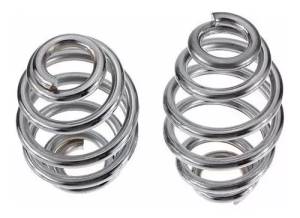
conical springs
The name conical springs covers two different parts. One is the conical disk, which is the Belleville washer above. The other is a helical spring wound into a cone, which belongs to the helical family. The helical version is what most engineers mean.
Its coils have different diameters, so they nest inside each other as the spring compresses. Solid height can drop to about one wire diameter. The rate rises as the spring closes, which makes it a variable rate spring. It also resists buckling better than a straight compression spring. Battery contacts, remote controls, and other small electronics use conical springs in tight spaces.
Curved Disk Spring
A curved disk spring is a thin washer with a gentle curve, not a steep cone. The force is low and the travel is short. It takes up axial play and keeps a light preload. Curved washers maintain steady pressure on bearings in motors and gearboxes.
Slotted Disk Spring
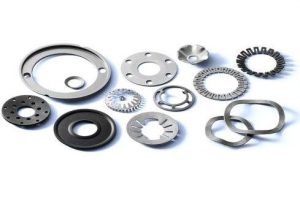
A slotted disk spring has radial slots cut from the inner or outer edge. The slots lower stiffness and spread stress more evenly. They also let a designer tune the force curve without changing the material. Clutch diaphragms and heavy release mechanisms often use this form.
Wave Disk Springs
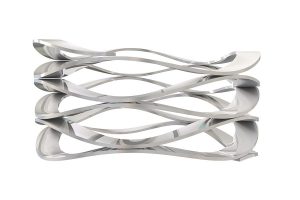
A wave disk spring is a flat washer pressed into a wave pattern. Each peak acts as a small spring. Force is light and deflection is short. Wave disk springs are often called wave washers. They preload bearings, absorb vibration, and fit where a coil would be too tall. Stacked disk springs of this type raise travel without adding much height.
Constant Force Springs
A constant force spring is a coiled strip of spring steel wound on a drum. Pulling the free end off the drum gives a nearly constant force. Unlike a standard coil spring, the load does not rise with extension. The match is not perfect, since force varies slightly at the start and end of the stroke. Still, for long travel under steady load, constant force springs are hard to beat.
Retractable cable reels, counterbalances, and cable retraction systems use them. Window blind systems use them too.
Spiral Springs
A spiral spring is a flat strip wound into a spiral, like the spring in a mechanical watch. Turning the arbor winds the spiral tighter, and the spring stores rotational energy that returns as torque. Rotation can span many turns. Spiral springs power wind up toys, retractable seat belts, and small clocks.
These parts are often called clock springs or power springs. People confuse spiral springs with constant force springs, but they work differently. A spiral spring delivers torque that rises as it winds. A constant force spring delivers a steady pull.
Flat Springs
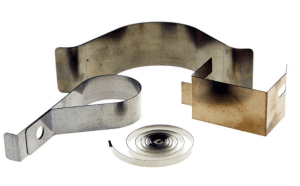
Flat springs are stamped or formed from sheet or strip. The shape is customized to the part. A flat spring can be a simple cantilever, a clip, or a complex contact. The strength of this type is freedom of form. One flat spring can carry current, hold a part, and set alignment at once.
Flat springs keep a reliable electrical connection in battery holders and connectors. Switch blades and retaining clips make sure equipment operates correctly across thousands of cycles. Flat springs also appear in medical devices and other critical systems.
Gas Springs
A gas spring is a sealed cylinder filled with pressurized gas, usually nitrogen. A piston moves through the gas, and the compressed gas pushes the rod out. Gas springs play a different part in a design than the other types of springs. Force changes only slightly over the stroke. Many designs add oil for damping. Temperature affects the force, so extreme environments need checking.
Hatchbacks, hoods, office chairs, and equipment covers use gas springs.
Machined Springs
The entries above describe spring geometry. Machined and molded springs describe how the spring is made. A machined spring is cut from solid bar or tube on a lathe or mill instead of being coiled from wire.
Designers gain control. They can add integral ends, threaded sections, or varying stiffness along the length. Machined springs serve high load mechanical systems in tight, precise assemblies. Die springs are a related heavy duty form, usually coiled from rectangular wire, and are built for high load and short stroke. The tradeoff for machining is cost, since it is slower than coiling. Industrial machinery, precision instruments, and tooling use machined springs.
Molded Springs
Molded springs are made from plastic or composite materials. They resist corrosion and do not conduct electricity, which helps in medical, food processing, and marine equipment. Plastics creep under sustained load. A molded spring that sits compressed for months slowly loses force. They suit intermittent duty. Metal springs remain the better choice for continuous high load.
Materials used for manufacturing springs
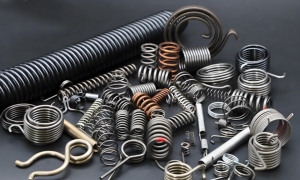
Material choice sets strength, corrosion resistance, temperature range, and cost. The choice matters for all types of springs.
Music wire is a high carbon steel with high tensile strength. It suits small springs in dry indoor conditions and rusts easily without a coating. Oil tempered and hard drawn steel wires cover most general purpose springs. They cost less than alloys and suit larger sizes. Chrome silicon and chrome vanadium alloys handle higher stress and some heat, which is why valve springs and shock loaded parts use them. Shop talk often lumps these steels together as spring steel.
Stainless steel resists corrosion. Types 302 and 304 are common for general use. Type 316 serves harsher environments. Precipitation hardening grades such as 17-7 PH reach higher strength after heat treatment. Beryllium copper and phosphor bronze carry current and resist corrosion, so electrical contacts and connectors use them. Nickel alloys such as Inconel hold strength at high temperature, which suits engines and furnaces.
