Types of Injection Molding Mold

Share:

Table of Content

Table of Content

Injection molds are the tooling that makes plastic part production repeatable and cost-effective at scale. This guide covers what an injection mold is, how its key components work, and the different mold types available — so you can make informed decisions when planning your production.

What Is an Injection Mold?

An injection mold is a precision-machined tool that gives molten plastic its final shape. Molten plastic is injected into the mold cavity under high pressure, cools, and is ejected as a finished part. Every surface feature, wall thickness, and tolerance on the part is determined by the mold design. Because the mold is reusable across millions of cycles, it is the standard tooling choice for high-volume plastic part production.

Key Components of an Injection Mold

An injection molding machine has three main units: the injection unit, the clamping unit, and the mold tool itself. Each plays a distinct role in shaping the final part.

Injection Unit

The injection unit melts and delivers the plastic. Raw pellets are fed from a hopper into a heated barrel. Inside the barrel, a reciprocating screw rotates to melt the pellets through heat and friction, then pushes the molten plastic through a nozzle into the mold. The screw design ensures a consistent melt temperature and uniform material volume before each shot.

Clamping Unit

The clamping unit holds the two mold halves closed during injection and cooling. It applies force measured in tonnes to prevent material from leaking at the parting line. There are two main clamping mechanisms: toggle clamps, which use a mechanical linkage for fast movement, and straight-hydraulic clamps, which apply direct cylinder force for large or high-pressure applications.

Mold Tool

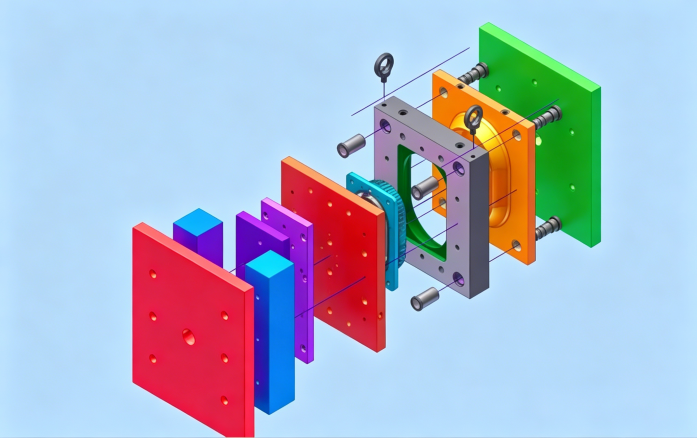
The mold tool is the precision component that gives the part its final shape. It consists of two halves — the cavity (female side) and the core (male side). Supporting systems include:

  • Runner system: channels that carry molten plastic from the nozzle into the cavity
  • Gate: the entry point where plastic enters the cavity
  • Cooling channels: passages for water or oil that regulate mold temperature
  • Ejection system: pins, blades, or sleeves that push the solidified part out once the mold opens
  • Venting system: small channels that allow trapped air to escape during injection

Types of Injection Molds

Injection molds are classified by their physical structure. The structural design determines how the mold opens, how the runner system is managed, and how many parts are produced per cycle.

Two-Plate Mold

The two-plate mold is the most basic mold structure. It has a single parting surface — the mold opens into two halves, and the runner and part are ejected together. The runner must then be trimmed manually or by robot. It works as a single-cavity or multi-cavity tool and is the most cost-effective option for straightforward part geometries.

Three-Plate Mold

The three-plate mold adds a movable middle plate between the cavity and the fixed mold half, creating two parting surfaces. When the mold opens, the runner system separates automatically from the part at a second parting line. This enables pin-point gates at the center of a part where a tab or edge gate would leave a visible mark. Three-plate molds are more complex and expensive than two-plate molds but eliminate manual gate trimming for many geometries.

Hot Runner Mold

A hot runner mold replaces the conventional cold runner with a heated manifold and nozzle assembly that keeps plastic molten inside the runner channels throughout the cycle. Because the runner never solidifies, there is no runner waste and no trimming step. Hot runner molds have higher upfront tooling costs and require careful thermal management, but they reduce material waste and shorten cycle times — making them the standard choice for high-volume production.

Cold Runner Mold

In a cold runner mold, the runner solidifies with each cycle and must be separated from the part. The runner is then either discarded or reground for reuse. Cold runner tooling is simpler and less expensive than hot runner systems. It is the standard choice for lower production volumes and for materials sensitive to prolonged heat exposure in a manifold.

Family Mold

A family mold contains cavities for multiple different part designs within a single tool. All parts are molded simultaneously in the same cycle. This reduces tooling cost when a product assembly requires several distinct components. The main challenge is balancing material flow across cavities of different sizes and geometries to prevent short shots or flash.

Multi-Cavity Mold

A multi-cavity mold produces multiple identical parts per cycle. Adding cavities increases output and lowers cost per part, but also raises tooling cost, requires tighter runner balancing, and demands more clamping force from the machine. Multi-cavity molds are standard for high-volume commodity parts such as bottle caps, medical test components, and packaging containers.

Why Do You Need an Injection Mold?

A mold is a fixed tooling cost spread across every part it produces. The higher the volume, the lower the cost per part. Once the mold is built, each cycle runs with consistent output and tight tolerances — making it the most cost-effective option for plastic parts at scale.

At Aria, we offer injection molding services from tooling fabrication through to part production. If you have a part ready for molding, we can help you get it into production.

Get an instant quote for your injection molding project at madearia.com

Written By
CNC milled aluminum precision part with complex geometry and multiple machining features

Custom Quality Parts By Aria

Send your specs. We’ll get back with a quote in 12 hours.

Scroll to Top