CNC drilling is one of the first processes engineers learn, and one of the most misunderstood once a project gets complicated. A hole that looks easy to spec on paper can turn into a broken drill, a missed tolerance, or a part that fails assembly if the wrong details get overlooked.
This guide breaks down what actually happens between a CAD file and a finished hole, and what decisions matter most along the way.
What Is CNC Drilling?
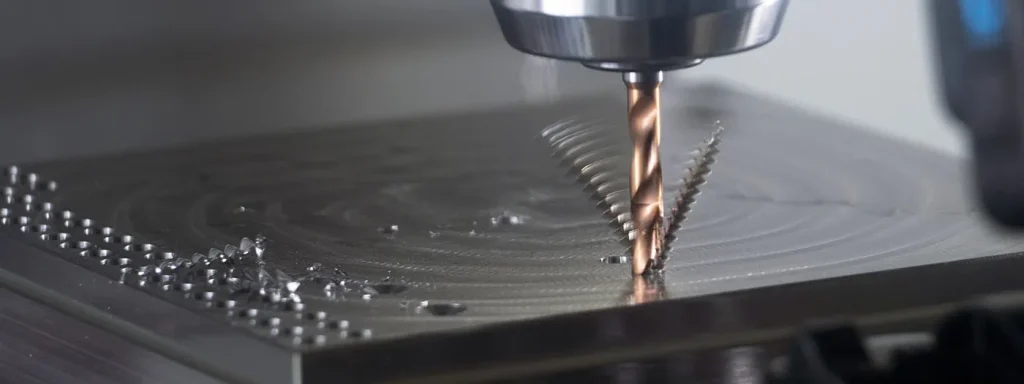
CNC drilling is a machining process that uses a rotating drill bit to cut holes into a workpiece. The machine controls where the hole goes, how deep it cuts, and how fast the bit moves. All of this comes from a pre-written program. The operator does not touch the tool during cutting.
The program uses G-code. This tells the spindle speed, feed rate, and hole position before the machine starts. Once the cycle runs, every hole comes out the same. That consistency is the main reason manufacturers choose CNC drilling over manual methods.
Holes made by CNC drilling serve many purposes. Fasteners go through them. Pins sit in them. Fluid and air pass through them. In most machined parts, holes are not optional. They are designed in from the start, and they need to be in the right place every time.
How Does CNC Drilling Work?
CNC drilling follows a fixed sequence. The machine cannot make decisions mid-cut. Everything has to be defined before the spindle starts.
Step1: Design the Part in CAD
The engineer starts in CAD software. Every hole gets a defined diameter, depth, and position. Tolerances go in at this stage too. If a hole needs to be H7 fit for a press-fit pin, that gets noted in the drawing. Vague drawings lead to wrong holes.
Step2: Convert the Design into G-Code via CAM
CAM software reads the CAD file and builds the drilling plan. Each hole gets assigned a drilling cycle based on its depth and the chip evacuation it needs:
G81 (Standard Drilling Cycle):Used for shallow holes not exceeding three times the drill diameter. The drill feeds straight to depth in one motion, with no retract in between.
G73 (Chip Breaking Cycle):Used for holes deeper than three times the drill diameter but within the drill’s flute length. The drill retracts a small distance to break chips, without fully exiting the hole.
G83 (Deep Hole Peck Drilling Cycle):Used for the deepest holes. The drill fully retracts out of the hole between each peck to clear chips completely, then re-enters to continue cutting.
Picking the wrong cycle for the hole depth is one of the most common causes of broken drills and rough hole walls.
Step3: Load the Program into the Machine Controller
The G-code file loads into the machine’s controller. The controller reads it one line at a time. Each line is a specific instruction: move here, spin at this RPM, go this deep. There is no guesswork. Every action is a number.
Step4: Mount the Drill Bit and Clamp the Workpiece
The operator installs the correct drill bit and secures the workpiece in a vise or fixture. Fixturing is critical. If the part moves even slightly during the cut, the hole position shifts. A good fixture keeps the part exactly where the program expects it to be.
Step5: Run a Dry Cycle
Before cutting, the operator runs the program without making contact with the material. This checks that tool paths are correct and the machine will not travel into a clamp or exceed its range. It takes a few minutes. It prevents scrapped parts.
Step6: Start Drilling
The spindle reaches the programmed RPM and the machine moves to the first hole position. The drill feeds into the material following the selected cycle, whether that is a straight G81 plunge or a G83 peck sequence. Coolant flows to control heat and push chips out of the hole. The machine repeats this for every hole in the program, one after another, without stopping.
Step7: Inspect the Finished Holes
Once drilling is done, the operator checks diameter, depth, and position. A bore gauge handles diameter checks. A CMM (coordinate measuring machine) is used for critical positional tolerances. Parts that pass move forward. Parts that fail trigger a review of the program before the next run starts.
Types of CNC Drilling Operations
CNC drilling is not just one action. A single part can go through several different hole-making operations in one setup. Each operation corresponds to a specific hole type in engineering, from through holes and blind holes to countersinks and counterbores. Here are the most common ones and when each gets used.
Spot Drilling
The spot drill goes in first. It makes a small indent at the target location before the main drill touches the material. This prevents the drill from sliding off position when it first contacts the surface. On smooth or hard materials, skipping spot drilling often means the hole ends up in the wrong place.
Through-Hole Drilling
The drill cuts all the way through the workpiece. The hole exits the other side. This is the most common type of CNC drilled hole. Bolts, pins, and wiring all pass through these holes. Most through holes have a depth-to-diameter ratio below 10:1. Beyond that, the drill starts to deflect and hole accuracy drops.
Blind Hole Drilling
A blind hole stops at a fixed depth. It does not break through the other side. The machine controls the depth from the program, not by feel. Blind holes are used when a threaded insert or dowel pin needs to be seated inside the part with a closed bottom.
Reaming
Reaming refines a hole that already exists. It does not create one. The reamer shaves off a small amount of material, typically 0.1 to 0.3 mm, to bring the hole to a tighter diameter and smoother finish. A drilled hole usually sits at IT11 or IT12 tolerance. After reaming, that same hole can reach IT7. Use reaming for press-fit pins, bearing bores, or any hole where a standard drill is not accurate enough.
Boring
Boring enlarges an existing hole with a single-point cutting tool. It gives better roundness and concentricity than re-drilling or reaming. It is the right choice when the hole diameter is too large for available drill sizes, or when the hole must align precisely with another feature on the part.
Tapping
Tapping cuts internal threads inside a drilled hole. The tap follows a feed rate that matches the thread pitch exactly. On CNC machining centers, rigid tapping locks the spindle rotation and feed together through the full cut. Tapping always comes after drilling. The hole has to exist first.
Counterboring
Counterboring creates a stepped hole. The top section is wider than the bottom. A socket head cap screw sits in that wider section, with the head level with or below the part surface. This is used when a bolt head cannot protrude because it would block another part or create a surface problem.
Countersinking
Countersinking cuts a cone-shaped recess at the top of a hole. Flat-head screws have an angled underside, usually 82 or 90 degrees, and the countersink matches that angle. When the screw is tightened, the head sits flush with the surface. This is standard in sheet metal assemblies and aerospace panels where surface flatness matters.
Peck Drilling
Peck drilling is used for deep holes. The drill feeds in a short distance, then retracts fully to clear chips, then feeds in again. This cycle repeats until the full depth is reached. Without it, chips pack inside the hole and the drill breaks. The standard G-code for peck drilling is G83. For less demanding materials, G73 does a partial retract instead of a full one, which is faster.
Micro-Drilling
Micro-drilling produces holes under 1 mm in diameter. Standard twist drills cannot do this cleanly. The process needs specialized bits, higher spindle speeds, and much lower feed rates. PCB manufacturing uses micro-drilling for via holes. Medical device components often need it too for fluid channels and sensor ports.
Types of CNC Drilling Machines
CNC drilling machines come in several types. Common ones include the Upright CNC Drill Press, Radial Arm CNC Drill Press, Turret-Type, Gang Drilling Machine, Multi-Spindle Machine, Deep-Hole Drilling Machine, and CNC Vertical Machining Center. Choosing the right one depends on part size, hole count, required operations, and production volume.
CNC drilling machine types comparison
CNC Drill Bit Types and How to Choose
The drill bit is the only part that contacts the material. Choosing the wrong type leads to poor hole quality, short tool life, or broken bits.
Twist Drill is the most common type. It works on metals, plastics, and composites, and comes in HSS, cobalt, and solid carbide versions.
Spot Drill is short and rigid. It makes a small indent before the main drill enters to stop it from sliding off position on first contact.
Step Drill combines two or more cutting diameters in one tool. It drills and countersinks in a single pass, mostly used in sheet metal work.
Indexable Insert Drill uses replaceable carbide inserts instead of a solid body. Cost-effective for large diameter holes above 12 mm in medium to high production volumes.
Gun Drill has a single flute with internal coolant delivery. It handles deep holes with depth-to-diameter ratios above 20:1 where standard twist drills cannot maintain straightness.
Advantages of CNC Drilling
Repeatability:Once the program is set, every hole lands in the same position at the same depth. The result does not change between the first part and the thousandth.
Speed:Drilling is the fastest way to make round holes in production volume. The machine can also tap or countersink in the same setup without stopping.
Accuracy:A well-maintained CNC machining center holds hole position within ±0.01 mm consistently. That level of repeatability is not possible with manual drilling.
Efficiency:Complex hole patterns that would take hours to lay out manually run as a single automated cycle.
Disadvantages of CNC Drilling
Round holes only:CNC drilling only creates cylindrical holes. Slots, pockets, and non-circular features need milling.
Depth limit:Standard twist drills work reliably up to about 10 times the drill diameter. Beyond that, chip evacuation becomes a problem and drill breakage risk increases.
Tolerance ceiling:A drilled hole typically holds IT9 to IT11 tolerance. IT7 or tighter requires reaming or boring after drilling.
Hard materials:Hardened steel above 55 HRC pushes carbide drills to their limit. EDM or grinding is usually a better choice at that hardness.
Applications Of CNC Drilling
CNC drilling is used across almost every manufacturing industry. Any product that uses fasteners, pins, fluid passages, or electrical connections needs drilled holes.
Aerospace
Engine housings, turbine components, and structural frames all require tight-tolerance holes in titanium and aluminum alloys. Bolt hole patterns on aircraft panels are drilled to exact positions so fasteners align across multiple assembled sections.
Automotive
Engine blocks, cylinder heads, brake calipers, and transmission housings all rely on CNC drilling. A single engine block can have hundreds of oil passages, coolant channels, and bolt holes that must align precisely for the engine to seal and function correctly.
Electronics and PCB manufacturing
Printed circuit boards use micro-drilled via holes, often under 0.3 mm in diameter, to connect copper layers. A single PCB can require thousands of these holes drilled at high speed with consistent position accuracy.
Medical devices
Surgical instruments, orthopedic implants, and bone screws require small, clean holes in stainless steel and titanium. Surface finish and dimensional accuracy in these holes directly affect how the device performs in the body.
Industrial machinery
Flanges, couplings, bearing housings, and structural frames all need bolt holes and alignment pin holes. These parts are often drilled in high volumes where repeatability matters more than complexity.
Consumer electronics
Smartphone housings, laptop frames, and wearable device enclosures need precisely placed holes for ports, buttons, and fasteners. CNC drilling handles these in aluminum and magnesium alloys at high production rates.
CNC Drilling vs CNC Milling vs CNC Boring
Drilling creates round holes fast and is optimized for high-volume, repeatable hole-making. Milling handles complex shapes, slots, and contours, and can also make holes when diameter tolerance is very tight. Boring refines an existing hole to a more precise diameter and better roundness than drilling alone can achieve.
Manual drilling depends on the operator to control position, depth, and feed rate. CNC drilling runs from a program. Every hole comes out at the same position and depth, regardless of who is running the machine or how many parts are in the batch.
Not directly. Drilling makes the hole first. Tapping then cuts the threads inside it. On a CNC machining center, both happen in the same setup with an automatic tool change in between.
Most metals work well, including aluminum, mild steel, stainless steel, titanium, and brass. Plastics and composites can also be drilled. The drill bit type and cutting speed change depending on the material.
Standard twist drills work reliably up to about 10 times the drill diameter. For deeper holes, peck drilling cycles extend that range. Dedicated gun drills can reach depth-to-diameter ratios above 100:1 with high-pressure coolant fed through the tool.
Gavin Leo is a content editor at Aria Manufacturing with hands-on experience in CNC machining, Injection molding, materials selection, and part design. Outside of work, he enjoys hiking and collecting mechanical watches.
Custom Quality Parts By Aria
Send your specs. We’ll get back with a quote in 12 hours.


 EU
EU