What Is Thread Milling?Tools, Advantages, and Process

Share:

Table of Content

Table of Content

When a job involves hard materials, large thread diameters, or thin-walled parts, thread milling is consistently the right call. In this article, I’ll cover how it works, which tools are used, and the tips that matter most on the shop floor.

What Is Thread Milling?

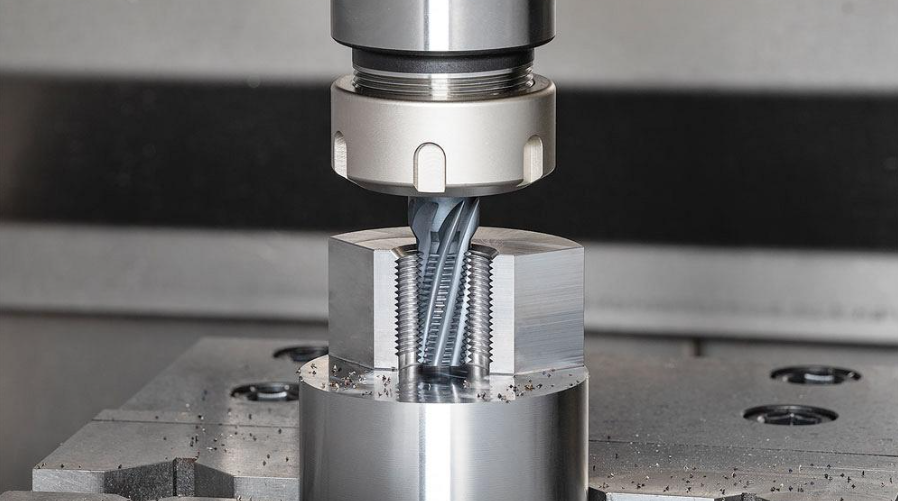
Thread milling is a CNC process that uses a rotating cutter to produce internal or external threads. The tool follows a helical path — moving in a circular arc in the X-Y plane while advancing along the Z-axis by one pitch per revolution.

Unlike tapping, which drives a tap axially into a hole, thread milling moves the cutter radially. This separation of tool diameter from thread diameter is what gives the process its flexibility.

what is thread milling

How Does Thread Milling Work?

Pre-drill the core hole

For internal threads, drill or bore the hole to the correct minor diameter first. This reduces cutting forces and improves thread accuracy.

Select the cutter and program the toolpath

The thread mill’s profile matches the target thread form. The CNC program defines the radial offset, arc diameter, Z-axis pitch advance, and feed rate — typically generated by CAM software.

Lead-in arc

The cutter descends to thread start depth, then arcs radially into the workpiece to avoid shock loading at entry.

Helical interpolation cut

The cutter completes one 360° pass around the hole wall while advancing in Z by exactly one pitch. For deeper threads or harder materials, multiple passes at increasing depth are used.

Lead-out arc

The cutter retracts from the wall through an exit arc, then withdraws from center. This prevents the tool from dragging across the finished thread surface.

Trial cut and verification

Before running production, I cut a trial thread and check it with a thread gauge. Any dimensional error gets corrected in the program before the batch runs.

Types of Thread Milling Cutters

Single-Form Cutters

One cutting tooth; multiple helical passes to reach full thread depth. Best for non-standard pitches and custom thread forms.

Multi-Form (Full-Profile) Cutters

Multiple teeth stacked axially — the complete thread is cut in a single helical pass. The standard choice for common metric and unified thread sizes in production.

Straight-Flute Cutters

Flutes run parallel to the tool axis. Suited to free-machining materials like aluminum and brass where chip control is straightforward.

Advantages of Thread Milling

Dimensional control

Thread diameter is set by the radial offset in the program. If a cutter runs slightly off-diameter, I correct the D-value without pulling the tool.

One tool, multiple sizes

A single-form thread mill covers any diameter within its pitch range. One tool replaces several taps in a mixed-thread job.

Low breakage risk

The cutter engages only a portion of the thread at any moment. Cutting forces stay manageable, and the tool does not bind the way a tap does in hard material.

Hard and exotic materials

Thread milling handles hardened steel above 45 HRC, titanium alloys, Inconel, and PEEK — materials where tapping is unreliable or impossible.

Large-diameter threads

A thread mill produces any large-diameter thread on a standard machining center. No oversized rigid tap or high-torque tapping head required.

Left-hand and right-hand threads

Switching thread hand requires only a G02/G03 direction change in the program.

Blind hole threading

The cutter does not need relief depth below the last thread, allowing threading closer to the bottom of the hole than tapping permits.

Thin-walled parts

Radial cutting forces are lower than the axial torque of a tap, reducing deformation risk on thin-walled features.

Disadvantages of Thread Milling

Slower per hole than tapping

A standard M8 thread in aluminum takes 4–5 seconds by tapping and roughly twice that by thread milling. For high-volume runs of a single thread size, tapping is faster.

Requires a capable CNC machine

Simultaneous three-axis interpolation and adequate spindle speed are required. Manual machines and basic two-axis CNC equipment cannot run a helical toolpath.

Programming complexity

 A G84 tapping cycle is one line of G-code. A thread milling program includes coordinate setup, lead-in arc, helical interpolation, lead-out, and tool compensation — typically 8–15 lines per thread.

Core hole required

Most thread milling operations need a pre-drilled hole, adding an operation where tapping could work directly in a drilled hole.

Not suitable for very small threads

Below M3, thread milling tools are fragile and difficult to source in standard configurations. Tapping or thread forming is more practical at these sizes.

CNC Thread Milling Tips

Use helical interpolation

G02/G03 with simultaneous Z movement is the correct approach. Linear segment approximations of the helix leave witness marks on the thread flank.

Set lead-in and lead-out arcs to 180°

Shorter arcs increase chatter risk at the engagement point. I use 180° by default.

Use climb milling

The cutter should move in the same direction as the feed. Conventional milling accelerates tool wear and degrades surface finish.

Separate roughing and finishing passes

For steel and harder materials, leave 0.05–0.1 mm on the thread flanks for a finish pass. One-pass cutting at full depth risks deflection and out-of-tolerance threads.

Use cutter compensation (D-value)

Program with active cutter radius compensation. Correcting wear or material variation by adjusting the D-value takes seconds versus rewriting the program.

Match parameters to material and coating

AlTiN-based coatings handle hardened steels and high-temperature alloys. Always start from the toolmaker’s recommended SFM and feed per tooth values.

Run a trial cut

Cut the first thread on a scrap piece and check with a calibrated thread plug gauge before running the batch.

Ensure coolant reaches the cutting zone

On deep internal threads in steel, chips that pack into the cutting zone cause sudden tool breakage. Through-spindle coolant or an internal-coolant cutter is the reliable fix.

At Aria, we run thread milling across a wide range of materials and thread specifications. If your part requires threaded features in difficult conditions, contact our team to discuss the right approach.

Written By
CNC milled aluminum precision part with complex geometry and multiple machining features

Custom Quality Parts By Aria

Send your specs. We’ll get back with a quote in 12 hours.

Scroll to Top