What is Blind Holes in CNC Machining?

What is Blind Hole

Share:

Table of Content

Table of Content

Blind holes appear in almost every CNC-machined part, yet they are routinely underestimated at the design stage. I work with them daily. This guide covers what they are, how they are machined, and what to consider when you design one.

What Is a Blind Hole?

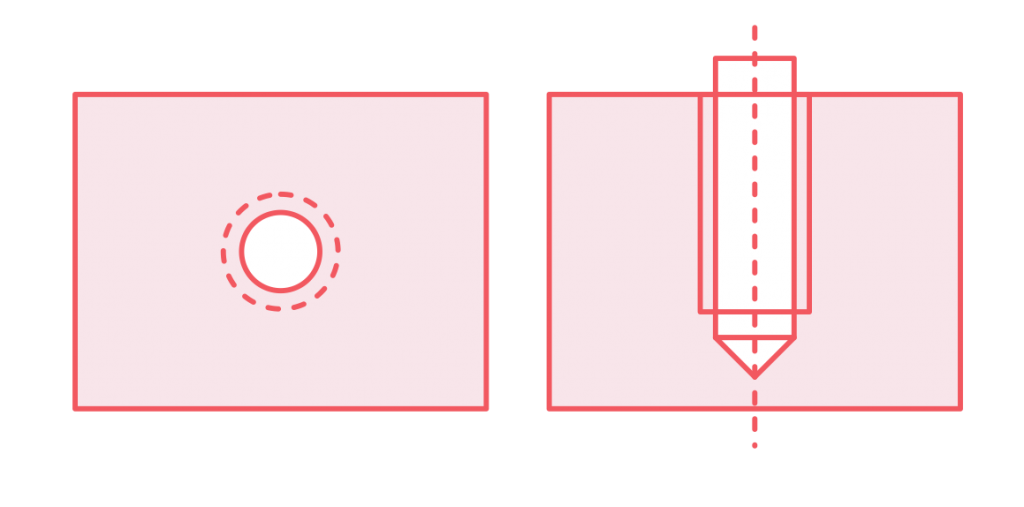
A blind hole is a hole drilled or machined to a specified depth that does not pass through to the opposite face of the workpiece. The bottom of the hole remains enclosed within the material.

The default bottom profile of a drilled blind hole is conical — a standard twist drill leaves a pointed recess at 118° to 135° included angle depending on drill geometry. This is not a defect; it is the natural result of drilling. A flat bottom requires a separate operation using a flat-bottom drill or end mill.

What is Blind Hole

How Blind Holes Fit Among Other Hole Types

Before focusing on blind holes, it helps to place them among the common hole types used in machining. Holes are classified by how far they penetrate the workpiece and by their internal features:

  • Through hole — passes completely through the workpiece, open on both faces. The simplest and cheapest to machine because chips exit from the bottom.
  • Blind hole — drilled to a set depth without breaking through to the opposite face. The bottom stays enclosed in the material.
  • Counterbore — a flat-bottomed recess that enlarges the top of a hole, allowing a socket-head fastener to sit below the surface.
  • Countersink — a conical recess at the top of a hole that seats a flat-head screw flush with the surface.
  • Threaded (tapped) hole — internal threads cut into the wall, either through or blind, to accept a screw or bolt directly.

Both blind and through holes can be counterbored, countersunk, or threaded. The rest of this guide focuses on the blind hole, which is the most demanding of these to machine.

Advantages of Blind Holes

  • Preserves material integrity on the opposite face — the opposite surface remains unbroken, which is critical in thin-walled parts and components where both faces carry structural or sealing loads.
  • Enables clean fastener installation — the fastener is fully contained within the material with no visible exit hole on the outside.
  • Required for sealing and pressure containment — the closed bottom terminates fluid or gas passages naturally, as used in hydraulic manifolds and pneumatic blocks.
  • Produces a clean external appearance — no exit holes, burrs, or witness marks from through-drilling on the outer surface.
  • Allows independent features on opposite faces — when two features would conflict or wall thickness is insufficient for a through hole, blind holes on each side solve both independently.

Disadvantages of Blind Holes

  • More complex and slower to machine than through holes — requires depth control, peck cycles, and chip management.
  • Chip evacuation must be actively managed; chips accumulate at the bottom with no exit path.
  • Higher risk of tap breakage in threaded blind holes, especially at large depth-to-diameter ratios.
  • Inspection is more difficult — depth, thread quality, and surface finish inside a closed hole require specialized gauging.
  • Higher cost per feature compared to through holes of equivalent size.

How to Machine a Blind Hole

A blind hole is produced by drilling, with secondary operations added when the design calls for a flat bottom, threads, or a recess. Two constraints shape the whole process: chips cannot exit from the bottom, and a depth error cannot be drilled out. The main steps are:

  • DrillingDrill to the programmed depth, measured to the full-diameter section of the hole, not the conical tip. For larger diameters, run a smaller pilot drill first.
  • Peck Drilling for DepthOnce the depth-to-diameter ratio passes 3:1, run the drill in a peck cycle — advancing in steps and retracting to clear chips.
  • Chip EvacuationFlush chips out with coolant or compressed air during the cycle. Packed chips raise heat and break tools.
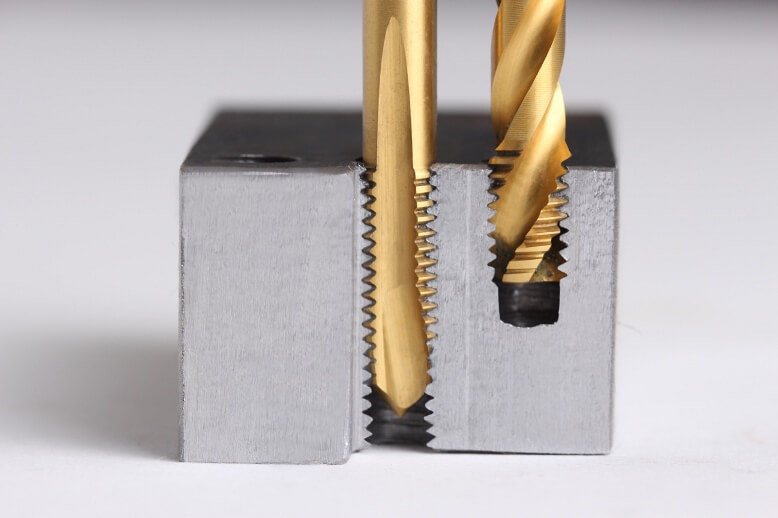
  • Secondary OperationsAdd operations when needed — an end mill for a flat bottom, a spiral-flute tap for threads, a counterbore or countersink at the entry.
  • Depth VerificationCheck the final depth with a depth gauge or probe before the next operation.
Blind hole 01

Design Considerations for Blind Holes

A few rules at the design stage prevent most blind hole problems:

    • Depth-to-diameter ratio: Keep the depth-to-diameter ratio at or below 5:1 for metals, 3:1 for plastics. Deeper holes raise tool breakage and cost.
    • Bottom profile: Leave a conical bottom unless a flat one is needed. A flat bottom adds a secondary operation.
    • Thread depth: Drill deeper than the thread. Add about 3 thread pitches below the last thread for tap lead and chip clearance.
    • Tolerance: Specify only the tolerance the function needs. Tight tolerances are harder to hold and verify in a closed hole.
    • Tap type: Use a spiral-flute tap for threaded blind holes. It carries chips upward, the only way they can leave.

Conclusion

Blind holes are standard features in CNC machining, but they demand more attention than through holes at both the design and machining stages. The decisions that matter most are the depth-to-diameter ratio, the bottom profile specification, and the thread relief depth for tapped holes. Getting these right at the design stage prevents the most common machining failures — broken taps, incomplete threads, and dimensional errors — and keeps production costs in line.

If you are designing a part with blind holes and want to review it for manufacturability before release, contact our engineering team at Aria for a DFM check.

Written By
CNC milled aluminum precision part with complex geometry and multiple machining features

Custom Quality Parts By Aria

Send your specs. We’ll get back with a quote in 12 hours.

Scroll to Top